Digital garment printing is shifting as Direct-to-Film (DtF) challenges Direct-to-Garment (DtG) through lower costs and increased automation. While DtF faces productivity hurdles, innovations like powderless systems and wider formats (up to 1.3m) are emerging. These developments aim to bridge the gap between niche personalisation and high-volume industrial production.
Digital textile printing continues to be popular and therefore still represents a good business opportunity. The most easily accessible part of this market has been printing direct to t-shirts and similar garments such as hoodies. However, there is now considerable price competition as this market matures, which is hardly surprising given the growth that we have seen in it over the last few years.
This largely explains the explosion in Direct-to-Film solutions that we have seen in the last five years, which shows little sign of slowing down. The advantage of DtF is that it offers a relatively low investment in equipment but with potentially much higher productivity than the more established Direct-to-Garment printers. This in turn has allowed print service providers to charge lower prices but still remain profitable.
However, the fundamental problem with DtF remains its relatively low productivity. It’s good enough to ensure that DtF is a profitable business for most print service providers but we aren’t seeing huge improvements in the speed of these solutions and the volume isn’t high enough to tempt many into building a business entirely around it. Naturally, several vendors have looked at ways to improve the throughput.
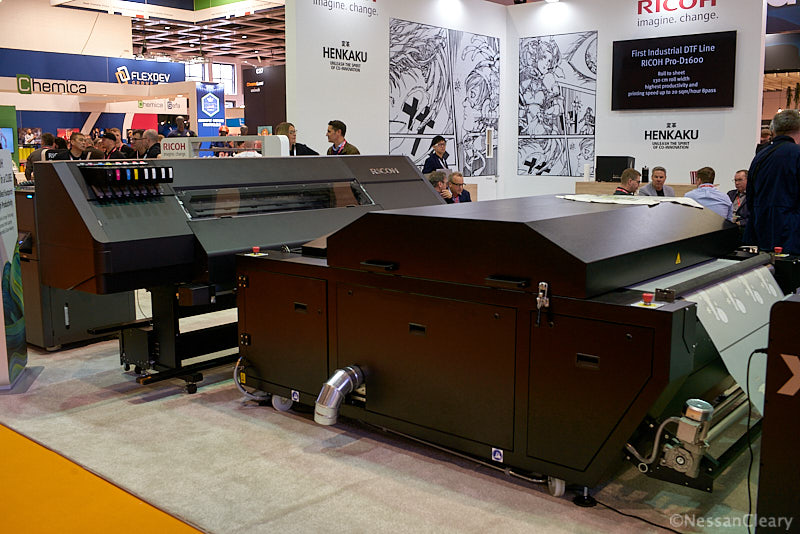
Ricoh’s D1600 is a large DtF solution taking films up to 1.3m wide.
Most of the more recent DtF machines also opt for a slightly wider width – usually 800mm instead of the more common 600mm, which allows more graphics to be nested onto the film roll. Ricoh has taken the blunt force approach of simply using a much wider printer and having a wider powder/ shaker unit built to match it to create the 1.3m wide Pro D1600 DtF solution.
Almost everybody else has aimed for better integration between the printer and powder/ shaker unit to allow for more automation. The idea is that this should lead to better print results without much oversight, allowing a single operator to run multiple machines. The Greek company Polyprint has already paved the way with its FilmJet, which can run at up to 24sqm/hr with two passes though this drops to 16 sqm/hr with four passes. It features a large powder dispenser on the top combined with automated powder regulation which means that it just needs to be filled in the morning and can then be left to run automatically through the day. It will work with any standard powder.
Brother has also picked up the baton with its recently launched DTRX printer, which automates a number of features around the printhead maintenance to reduce its operator dependence. It has been developed as an integrated solution with both the printer and the powder shaker run from a 10ins touch screen on the side of the printer. It runs at up to 19.52 sqm/hr with resolution up to 600 x 1200 dpi but has a print width of 800mm.
One of the issues holding back further development of Direct-to-Film textile printing is that current solutions rely on applying a powder on top of the still wet ink. This powder contains the binder that will ultimately stick the graphic to the textile. But there are safety issues around handling the powder, plus the process of applying the powder, heating it up and drying it slows down the whole system. Several vendors are working on powderless DtF, which essentially means jetting the binder in the printer immediately after laying down the colours.
The Japanese company Matsui has previously demonstrated a working system but has struggled to get the wash fastness to an acceptable level. However, the company is now developing a new drying unit to overcome this. The jettable glue approach won’t yet match the wash fastness of a powder system but Matsui believes that 15 to 20 washes is good enough for many customers. Better still, the samples so far show that replacing the powder with a jettable glue leads to a much thinner film, meaning a much improved hand feel, which is always important in this market.
It should also be noted that other companies, including Dupont, are not far behind with a similar system. Brother has also talked about developing a powderless DtF system, showing a prototype at the 2024 Fespa show. But Brother has taken a different approach that uses dry toner instead of inkjet and relies on printing to a transfer paper.
There is also room for print service providers to further exploit the advantages of DtF printing. There’s no reason to limit this solely to garments as fabrics are used in plenty of other products. One obvious example is applying corporate logos or even personalised messages to umbrellas,
RS Pro Transfer showed this Ultimate UV DTF printer.
The DtF inks are all water-based inks for textiles but there is a variation that uses UV-curable inks and is meant for other, more rigid substrates such as mugs, tiles or coasters. It’s a very cost effective way of applying graphics to objects but without having to invest in a dedicated direct-to-shape printer. Most of these solutions use CMYK plus white but some also have additional rollers for gold or silver foils, which can add quite striking effects.
One of the issues that has held back the DtG market is pricing, with smaller producers moving to DtF to offer lower prices to customers whilst simultaneously improving their own profit margins. Equally, DtG has struggled to break into the higher volume market which is still dominated by automated screen printing machines. Kornit has tried to address this through its Apollo DtG system, which offers a significantly higher throughput though at a high initial investment cost.
At the same time, the screen print machine vendors are defending their market space by developing more hybrid solutions that combine inkjet print engines for the basic image printing with screen printing stations to add special effects. This is allowing screen printing to stay competitive in the short run market and even to play in the personalisation space.
The only way for inkjet solutions to stay ahead of this is to increase the speed and cut the cost of investment into new printers. And there is some hope in this regard with many printhead vendors now talking about developing a new generation of heads that are able to handle higher viscosity inks. That in turn would allow inks with higher pigment loadings and more functionality that should eliminate the need for pretreatment and greatly speed up DtG printing. However, this really is looking into the future and could be several years away.
Nonetheless we should see some further developments in the garment printing market at the upcoming Fespa Global show in Barcelona this summer, particularly around DtF with both powderless and more highly automated systems likely to be shown off.
Register for Textile 2026, visitors can purchase super early bird tickets for €30 until 23 March by using the code FESG601.
Discover Textile 2026
Textile From FESPA FESPA events have always brought the key players of the textile printing industry. Now, this vibrant community gets the dedicated platform it deserves. Textile 2026, launching alongside FESPA Global Print Expo in Barcelona (19–22 May 2026), is where function, print, and production converge to shape the future of textiles. From garment manufacturing and decoration to soft furnishings and printed apparel, Textile 2026 delivers the insight, technology, and innovation that drive real business growth. Visitors can purchase super early bird tickets for €30 until 23 March by using the code FESG601.