The market for paper-based folding carton and corrugated packaging is growing due to sustainability efforts. High-volume wide format printers are bridging the gap between display graphics and packaging, offering short-run, full-colour printing. Innovations like automation, faster multi-pass printing , and single-pass systems boost productivity. Aqueous ink options are also emerging to address food-safe packaging concerns, creating a new synergy for service providers.
As part of the general adoption of more environmentally-friendly practices, there’s a greater focus on paper-based materials, such as corrugated cardboard and folding carton. These classes of substrates are already widely used in both packaging and the display graphics market, particularly around point of sale graphics, so wide format service providers are in a good position to benefit from increased demand in both these areas, especially packaging where there is the potential for very high volumes.
It’s common to conflate folding carton and corrugated boards together since they are both paper-based. But they have different handling requirements, which will affect the volumes involved, and are targeted at different applications. Folding carton is more accurately called paperboard, and is thicker than paper starting from 0.3mm and thicker, but still made from compressed wood pulp. The ISO defines it as being above 250 gsm, which gives it enough rigidity to be folded into cartons, and also makes it suitable for some display graphics. It can be printed through any wide format printer that can handle rigid materials, as well as some roll-fed machines including production printers.
Corrugated boards consist of a fluted – or wavy – sheet of paper encased in two flat liner boards, and held together with adhesive. The fluting traps air and gives the boards some cushioning as well as rigidity. There are different grades of fluting, such as B or C flutes with bigger waves for more cushioning, or E and F flutes where the waves are finer and closer together for more rigidity. Most corrugated boards used in packaging and display graphics have a single layer or wall of fluting, but some use two or even three layers with liner sheets in-between for extra protection. The result is a sustainable, paper-based board that’s reasonably strong, lightweight and easily recycled.
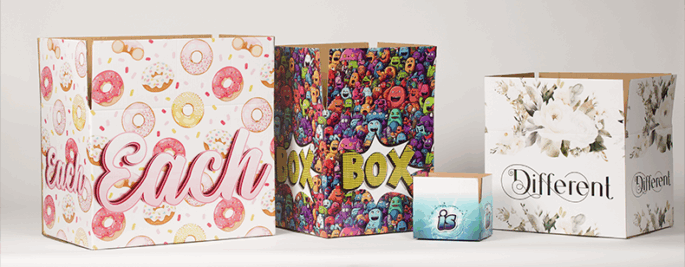
Traditionally, corrugated packaging was either pre-printed, meaning the graphics were printed to paper via a litho or gravure press and then laminated to the boards, or printed directly to the corrugated materials on a flexo press. Digital print allows for shorter run lengths, which in theory could mean runs of one for individual customers. In practice, this mostly allows for more targeted marketing campaigns, complete with full colour graphics. This is an area where wide format graphics have been used for many years, particularly for indoor display messaging as well as point of sale displays and dump boxes.
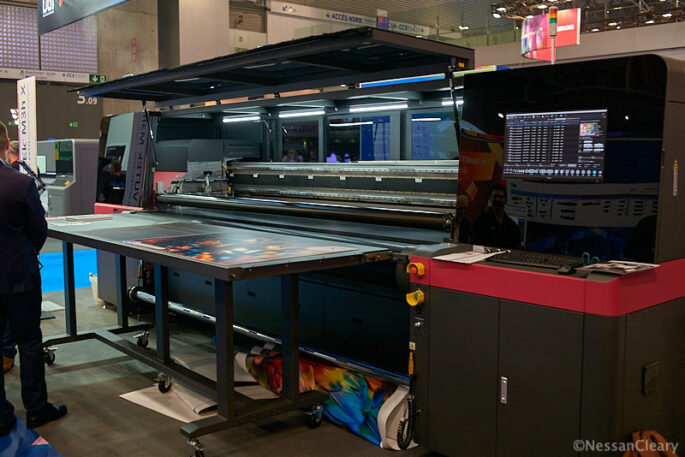
However, there are two crucial differences. The first is productivity, with packaging being a much higher volume business than display graphics. But in recent years we have seen a number of high volume wide format printers that aim to bridge this gap. In most cases, this means automating the way that the boards are loaded and unloaded from the presses. Most vendors offer a choice of partial or full automation with autoloaders either side of the print bed. Some vendors, such as Agfa and Durst, offer a range of robotic arms that can move the boards from a pallet of fresh boards to the printer and then onto to a pallet for printed boards.
Another way to increase productivity is to reduce the number of passes that the printheads make. Most wide format printers use a scanning or multi-pass approach, with the printheads mounted to a carriage that scans back and forth across the width of the media. Multiple passes are used to fill in gaps, increase the ink laydown and improve the print resolution. But in recent years some vendors have reduced the number of passes needed to dramatically improve the overall productivity. Typically this means using higher resolution printheads, adding extra printheads, and using inks with a higher pigment loading to get more ink down in fewer passes.
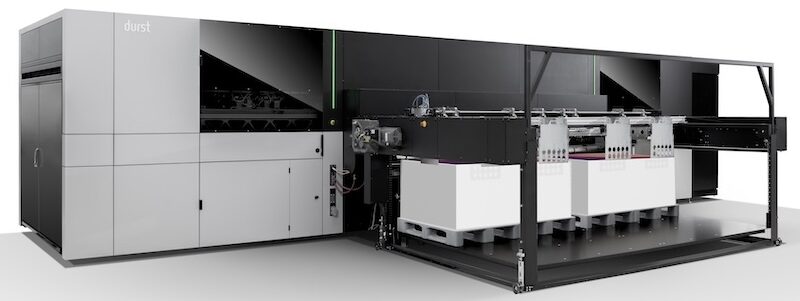
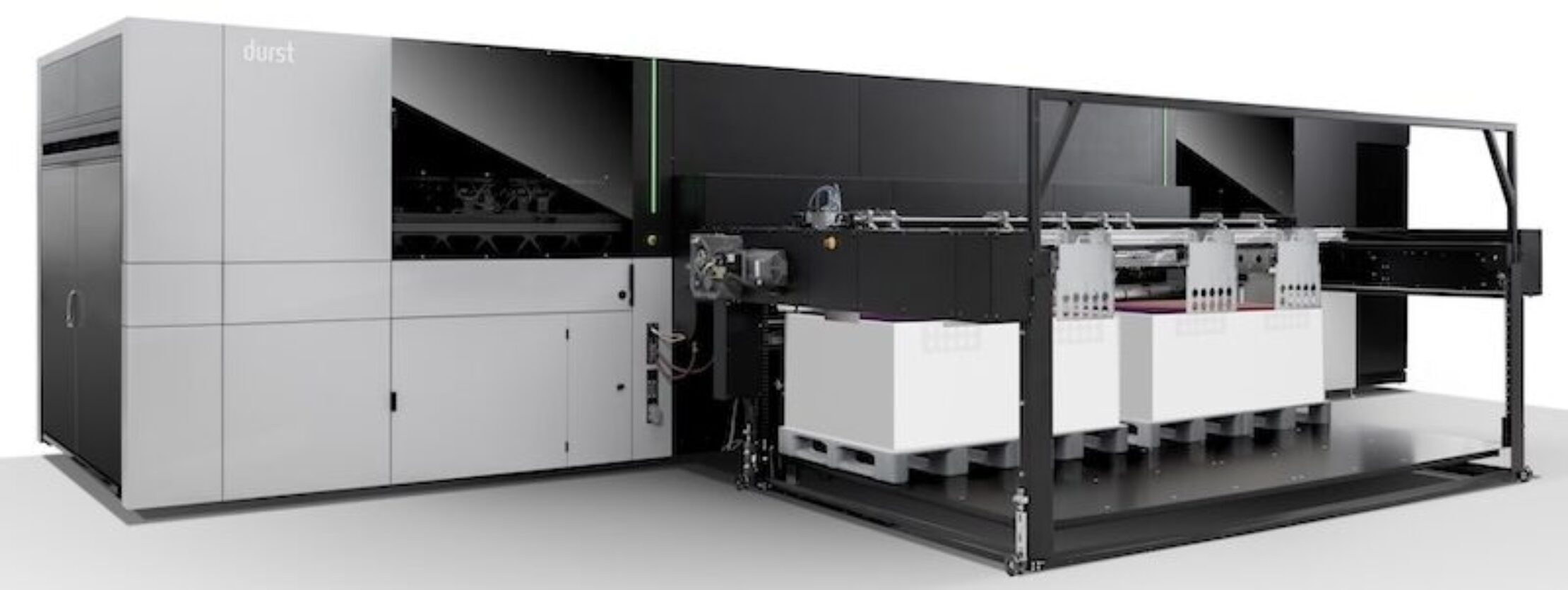
Durst, for example, has just introduced its P5 SMP, or Super Multi-Pass, press, which is targeted at both display and packaging markets. This is a 3.5m wide format hybrid design that’s able to produce up to 1,940 sqm/hr or 340 boards per hour (3.2×1.6m), which should translate to around five million square meters per year. This speed is due to a combination of reducing the number of passes and increasing the overall automation around the press, particularly the media loading and unloading.
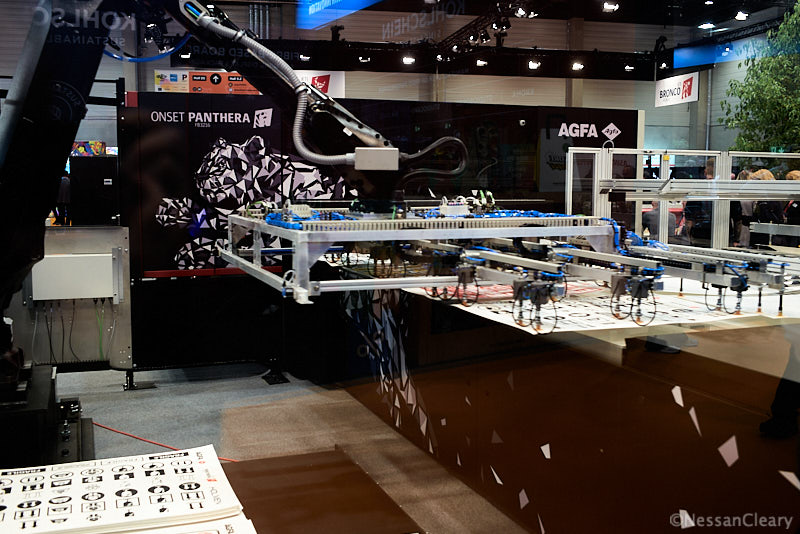
Agfa sells the Onset press, which was developed by Inca Digital, which does features a printhead array that covers the entire bed to eliminate the need to move the head carriage. Instead the Onset moves the bed, and although it can produce prints in a single pass, most users opt for at least two passes to improve the image quality. The Onset’s two-pass Express mode takes under nine seconds and produces up to 1449 sqm/hr.
Some press vendors have developed single pass systems, though these mostly operate at the cross over point between packaging and display graphics. Fujifilm, for example, has just launched its Acuity HS series, which has been developed with the Spanish vendor Barberan, with the HS6000 based on the Barberan JetMaster. This can produce up to 2000 boards per hour though it does depend on the board feeder system in use.
EFI has developed the Nozomi series of single pass printers, including both the 1.8m wide 18000 and 1.4m wide 14000 machines. There are variations on both of these to target either the packaging or the sign and display market, with all versions offering LED curing for UV inks.
This brings us to the other big difference between packaging and display graphics, after productivity. The packaging world favours water-based inks, mainly for food safety issues but also for greater sustainability. However, most wide format printers use UV-curable inks, although most have now moved to LED curing, which is more sustainable than conventional curing lamps. But with UV ink there is still the risk of some chemicals, mainly from the photo-initiators, migrating through the packaging making it hard to satisfy food safety regulations. EFI has proven that there is a market for packaging using UV ink printing, but is nonetheless developing an aqueous ink version of its Nozomi press.
Some wide format printers do use latex or resin ink, which is water-based. HP, for example, does offer automated landing systems for its 3.2m wide latex printers. But HP also offers its Indigo presses for formats up to B2, which can handle folding carton. HP also sells a number of single pass inkjet presses for larger formats, including some for pre-printing to corrugated liners.
In conclusion, there is a growing synergy between wide format display graphics and packaging, with some of the fastest high volume wide format printers now able to challenge for the short run packaging market. We can expect to see more wide format press vendors tapping into the packaging market, so there is a definite logic in wide format service providers also following this trend.
Discover more on packaging