Web-to-Print (W2P) systems automate print ordering by integrating e-commerce with production workflows, allowing customer personalisation, file preflighting, and guaranteed upfront payment. W2P reduces errors and labour, boosting low-volume profitability. Success hinges on customisation and accurate pricing, but service providers must balance automation against maintaining personal customer connections for complex bespoke jobs.
It’s strange to think that there was a time not so long ago when most people would order print jobs by telephone or even – heaven forbid – by sending off a letter. But nowadays most of us order and pay for our goods and services online. The commercial print sector embraced such online ordering over a decade ago through Web-to-Print or W2P systems, which marry ecommerce payment systems directly to print production workflows. And such W2P sytems are becoming increasingly common in the wide format market for everything from posters to signs and display graphics as well as t-shirts, gifts and promotional items.
Essentially, a W2P system automates the ordering process, including the job submission. They allow customers to personalise the standard items that you offer, adding their own text and image. The degree of personalisation varies from one system to another, and depends on how much you enable – such as selecting fonts, type size and colours, and resizing graphic elements. These systems will help customers upload their files, preflight them, and fix or flag up errors, before pushing them into the production queue.
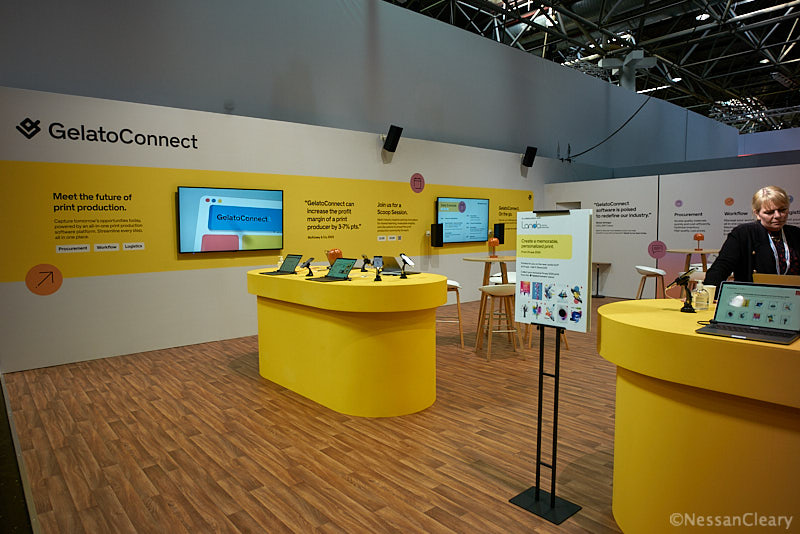
There are a number of advantages behind this, including reducing the risk of errors as customers can upload their own graphics, check they are happy with the order from a preview image and confirm their orders online. The orders can then be passed directly into the production system so that there’s no need for any further intervention that might itself also introduce errors. This degree of automation, minimising human interaction and all the time that takes, also helps to make low number orders more competitive. Ideally the queueing system should batch together multiple similar jobs from different customers to improve production efficiencies and cut waste.
Most importantly, the system will also take payment and generate an invoice before the production starts so that you are guaranteed to get paid for the job and there’s no need to waste resources chasing payment later on.
The W2P solution should include the digital storefront, that is the front page interface on the Web facing the customers. In some cases it’s possible to re-skin this storefront to trade under different brand names. You might, for example, want to keep your B2C and B2B customers separate even though all the orders are going through the same W2P and production workflow.
Depending on the type of printed products you are offering, you may also want to integrate with ecommerce platforms such as Shopify or Magento. This should help pick up a lot more consumer business, assuming you have the capacity to cope with that.
The software will need to be able to cope with multi-part orders, which might involve different print workflows, such as wide format posters, DtG/F t-shirts and labels. You may also offer other items that aren’t printed but still have to be picked and packed with the order. And you’ll need rules to determine what to do if some items are out of stock or delayed because splitting an order into multiple shipments may affect the profit on that job.
The principle disadvantage of W2P is that you lose the personal connection with customers. That may not matter if you’re using the W2P to automate some customer orders, so as to free up time to personally handle other, more valuable customers. There are still many complex bespoke projects that will need a back and forth with customers by phone or even face-to-face.
But for those customers ordering through the W2P system, it’s going to be hard to differentiate yourself from other competitors. You can do this through the range of products you offer, the ease of navigation of your web portal and the extent of the customisation that you enable, but price is inevitably going to play a major role with the bigger players being able to use economies of scale to reduce costs. Other factors, such as the quality of your products or your customer service will only be noticed by repeat customers unless you also take the time to manage your reviews. However, reviews can be a bit hit and miss and customers will blame you if they suffer a poor delivery experience, which will be out of your hands if you are relying on a courier company.
The growth of such systems mirror the changing nature of the wide format print sector. After all, the first step in implementing a W2P system is to define what sort of products you are offering. We used to think of wide format as being primarily about sign-making, where there could be tremendous variety between jobs. But nowadays the typical wide format print service provider offers a wide range of different products, from banners and posters through to mugs and t-shirts – as well as signs – all of which can be standardised so that they fit into a template. The temptation is to expand by concentrating on those products that can be easily standardised and are best suited to ecommerce. But this does not reflect the full breadth of the wide format print sector.
W2P or MIS?
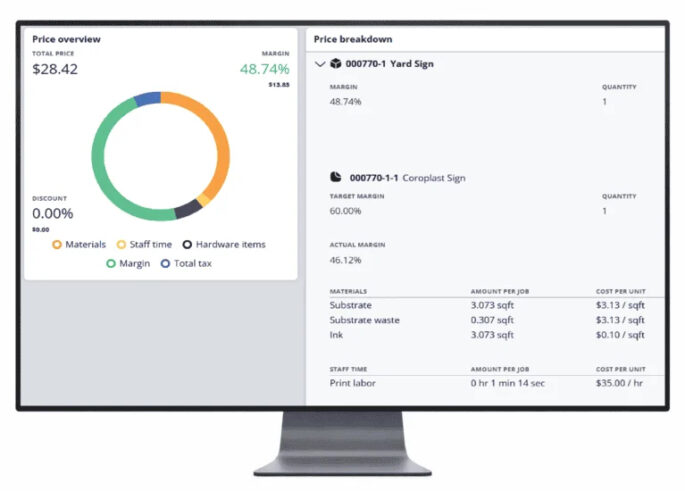
Many print service providers may feel that they need either an MIS Management Information System or a W2P Web-to-Print but not both. After all, these are expensive systems and there is a lot of overlap between the two, with some W2P vendors also selling an MIS while most MIS offer a W2P or ecommerce module. Both solutions are based on relational databases and a core competence for both is the ability to accurately estimate prices tailored to the exact order in question, and to dynamically update that price if the customer makes changes to the order.
That in turn depends on getting feedback from the production system to understand the most cost-effective way to produce the items ordered, including any additional work for customisation. The estimating module should also integrate with the inventory management system so that it knows the cost of the raw materials, and if all the required items are in stock. Whether you choose to use an MIS, a W2P or a combination of the two, will depend on your own business set-up. But either way, the W2P element will need to be deeply integrated into the production workflow.
In conclusion, the two most important aspects of a W2P system are the degree of customisation, which directly affects the customer experience, and the accuracy of the estimating, which will determine your pricing and profitability. So it’s worth taking the time to choose the system that best fits your business and the type of customers you are targeting. But a good Web-to-Print offering should significantly drive up the number of orders, and help reduce the time taken per order, which in turn should lead to higher profits.
Discover more on software