The food retail industry continues to struggle with customers’ desire to keep a tight grip on their money. Effective displays and promotional stands can help boost sales—an ideal market for printing companies. But what do they need to keep in mind when working with the food retail sector?
Consumer sentiment in Germany remains low, according to findings from the Society for Consumer Research (GfK). Pedestrian zones and shopping centers are seeing fewer visitors. This is also affecting the printing of point-of-sale (POS) materials, as retail chains are cutting their budgets for in-store advertising.
In supermarkets and grocery stores, on the other hand, the number of visitors has hardly declined. But here, retailers are grappling with a different phenomenon: shoppers are increasingly turning to store brands, budget brands, and special offers.
Second-place finishes are becoming more important
Many people therefore want to—or need to—save money when grocery shopping. As a result, secondary placements are becoming increasingly important for boosting sales. As a reminder, a primary placement is a product’s permanent, regular shelf space in a grocery store. Customers can always find it there as part of the store’s regular assortment.
A secondary placement, on the other hand, is an additional, usually temporary display of the same product in a different location within the store. It serves to attract attention, encourage impulse purchases, and highlight promotional or seasonal merchandise.
Typical examples of secondary placements include candy at the checkout, crates of beverages on pallets in the entrance area, barbecue sauces and spices next to the meat counter in the summer, or baking ingredients displayed as a special island in the run-up to Christmas.
Displays for secondary placements in food retail are increasingly being produced in small runs tailored specifically to the target audience and for only short promotional periods. As a result, lightweight, flexible, and easily recyclable materials such as corrugated cardboard have become the material of choice for printing. This presents an ideal sales market for digital printing companies.
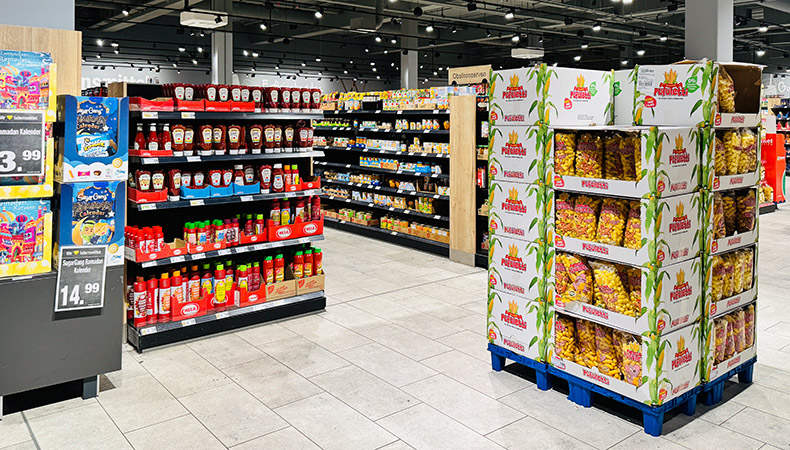
Multifunctional: The shipping boxes in the foreground also serve as a simple corrugated cardboard display. Photo: Sonja Angerer
Types of Packaging, and Why They Are Important
Printed product displays come into contact with food packaging—and occasionally even with the food itself—for example, during a tasting. This sets them apart from most other POS materials in retail. For this reason, strict guidelines apply to printed materials that come into contact with—or may come into contact with—food. Among other things, these guidelines are intended to ensure that food and beverages are not contaminated by harmful substances in the packaging.
There is a wide variety of packaging used in the food industry. Among the most important are primary packaging materials such as bags, trays, cartons, and films, which come into direct contact with food.
Secondary packaging includes trays, multipacks, and outer cartons, which are used for transportation and shelf display. In addition, there is tertiary packaging, such as shipping crates or pallet wraps, which primarily serve logistical purposes. In most cases, the end customer never even sees this packaging. For this reason, it is generally designed to be very simple and purely functional.
POS displays, stands, and similar products for merchandise presentation, on the other hand, are designed to be eye-catching and high-quality because they play a crucial role in brand communication. As a result, they often require a great many production steps. Such printed product displays can feature spot colors, spot varnish in some cases, hot foil stamping, and other specialty finishes—in short, everything that captures customers’ attention, piques their curiosity, and ultimately makes them ready to buy.
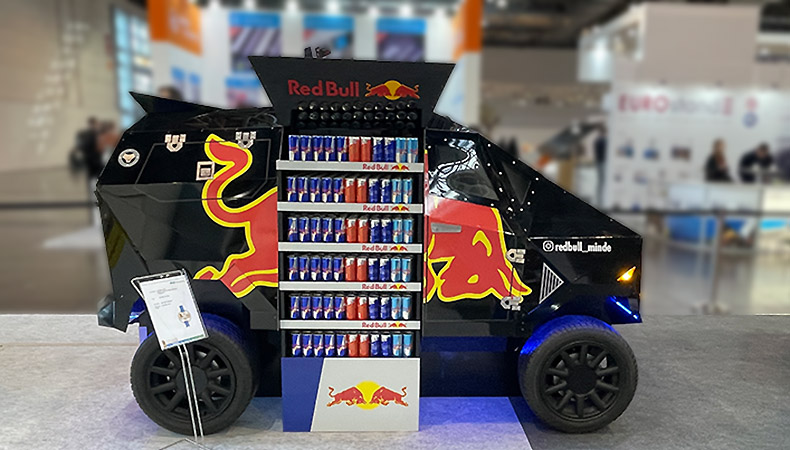
The more elaborate the packaging, the more chemicals are used. However, the food in these aluminum cans is well protected. Photo: Sonja Angerer
POS Displays, Design, and Printing
Due to their elaborate design, POS displays used for secondary product placement in the grocery industry involve the use of a large number of chemicals—such as paints, inks, adhesives, and varnishes.
The more chemicals are used in the vicinity of food, the greater the risk that the food will be contaminated by what is known as “migration.” In this context, “migration” refers to the transfer of substances from the printed packaging into the packaged food. This can occur through
Transfer printing: When sheets that are printed on one side but have not yet completely dried or cured are stacked on top of one another, part of the image transfers to the unprinted side of the sheet.
Gas-phase migration: Volatile substances diffuse into food, for example when exposed to heat.
Migration of substances from the substrate: Components of printing inks—especially soluble pigments, but also solvents, oils, and photoinitiators—migrate directly through the substrate. This often occurs particularly easily with foods that are high in fat.
Undesirable substances can also be released from the substrate itself, for example, if the raw materials are contaminated. Reactions may also occur between chemicals applied during the printing or finishing process.
The EU General Regulation (EC) No. 1935/2004 on materials and articles intended to come into contact with food establishes the legal limits for contaminants that may migrate into food. In addition, major food suppliers such as Nestlé (“Nestlé Guidelines”) have established their own guidelines that partners supplying packaging prints must follow.
Overall, the issue of migration in food packaging is very complex. For this reason, the Fraunhofer Institute for Process Engineering and Packaging, for example, offers migration testing of food packaging as a service.
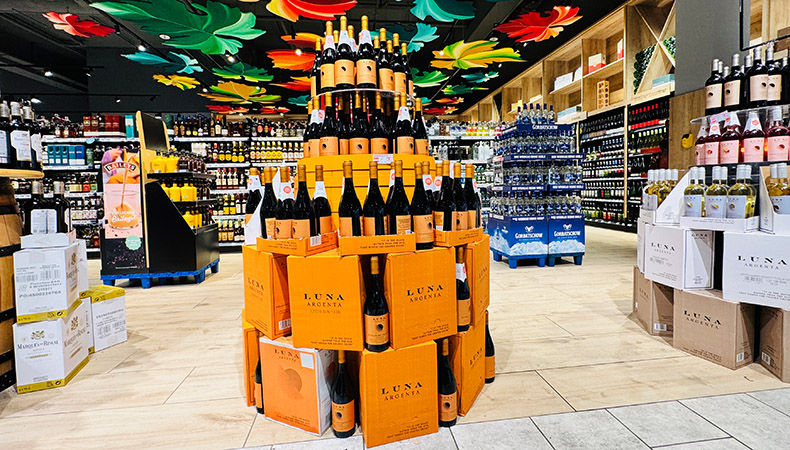
In the highly competitive market for premium alcoholic beverages, product displays are key tools for boosting sales. Photo: Sonja Angerer
In addition, digital printing presses that use water-based ink for printing on corrugated cardboard are becoming increasingly important. Examples include the EFI Nozomi 14000 AQ, Canon corrPRESS iB17, and Koenig & Bauer Durst CorruJET 170 models. These are designed for large print runs of digitally printed packaging. The inks therefore generally comply with the EU’s General Regulation (EC) No. 1935/2004. When used with suitable substrates, they can be employed for both POS displays and product carriers, as well as for printing primary and secondary packaging for food products.
With traditional secondary-placement displays, however, food items often do not come into direct contact with the display stand at all. This is because they are well protected by their retail packaging. For this reason, POS displays that also serve as product holders for the food retail sector can often be printed with water-based or latex inks that are not specifically certified for food contact.
UV and eco-solvent inks are also used occasionally. However, solvent-based and UV inks often have a noticeable “chemical” odor in the signage industry, which is particularly off-putting to customers in the food retail sector.
POS displays for the grocery industry are more complex than you might think
While digitally printed product displays—especially those made of corrugated cardboard—are expected to remain a growing market in digital printing, their production is considerably more labor-intensive than that of POS posters or displays for the non-food sector.
This is because the requirements for printing substrates and inks can be significantly higher. It is important to prevent food from being contaminated by contact with paints, varnishes, or adhesives, or from developing odors that might deter customers and staff.
Print service providers that regularly produce product-bearing POS displays for the food industry should therefore invest in appropriately certified printing and finishing equipment and prioritize ongoing training and professional development on the topic of “low-migration inks.”
Discover Corrugated 2026
The new trade show “Corrugated,” featuring accompanying conference sessions for corrugated cardboard processors, will take place at Fira Barcelona from May 19 to 22, 2026. Until March 23, visitors can purchase early-bird tickets for €30 using the code FESG601.