PVC films are widely used for full-vehicle wraps. But PVC has come under criticism. Will it be possible to do without polyvinyl chloride in car wrapping in the future?
Polyvinyl chloride (PVC) is now considered the standard in the field of car wrapping. In recent years, however, there have been efforts to phase out vinyl as a substrate in digital printing. This is because it is considered environmentally unfriendly and difficult to recycle. This article explores the current situation regarding the use of PVC for vehicle wrapping and explains its advantages, disadvantages, and alternatives.
PVC: Still the Standard for Vehicle Graphics
“The vast majority of car-wrapping films sold in Germany and Europe (by Spandex) are still made of PVC materials. PVC-free alternatives currently account for only a small but growing share of the market—depending on the country and product segment, their share is estimated to be in the single-digit percentage range,” says Stephanie Edling, Marketing & Product Management Coordinator at Spandex Deutschland GmbH.
The situation is likely not fundamentally different for other film manufacturers and suppliers at this time. This is because, for the most part, they offer only a small selection of PVC-free films. These are typically based on thermoplastic polyurethane (TPU) or PU, polypropylene (PP), or PET.
Vinyl’s current dominance is primarily due to its advantages. PVC films are known for their durability and resistance to weather, UV radiation, and mechanical stress. They can also be easily adapted to the contours of a vehicle. When it comes to printable films for vehicle graphics, another factor is that solvent-based digital printing inks were developed specifically for vinyl. However, latex and UV-curable inks often still produce the best results on PVC films.
However, Marco Kimmich, President of the GEWA General-Wrapping-Association e. V., has observed that something is currently changing in this area: “In recent years, customers—specifically OEMs and fleet operators—have been asking for PVC-free films. However, film manufacturers have been slow to respond, so as a vehicle wrapper, we’ve only been able to meet this demand to a very limited extent. Now, however, the market is gaining momentum, and TPU films are being offered for vehicle wrapping. These TPU films have the potential to be a game-changer, as they perfectly combine color changes with paint protection.”
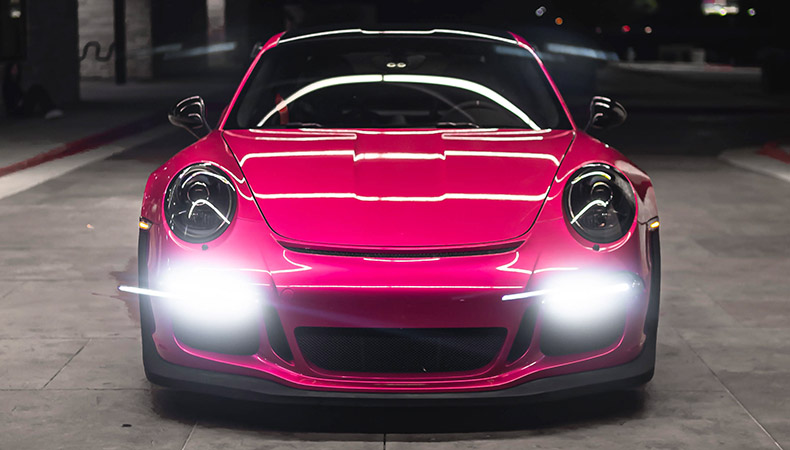
PVC films are still the standard in car wrapping. Pictured: KPMF VWS 4 Series, available from Spandex starting in mid-March 2025, among other places. Photo: Spandex.
Will we stick with PVC?
PVC films and laminates are available in a wide variety of colors and surface textures. They range from affordable, calendered products for short-term use on flat surfaces to premium cast films for 3D applications with an outdoor durability of five years or more. No wonder PVC films remain ubiquitous in banners, stickers, and signage. So there’s no sign of them being a “no-go” at the moment.
Stephanie Edling confirms this as well: “PVC films offer a high degree of flexibility, durability, and conformability, which are essential for vehicle graphics. Alternatives that are completely PVC-free still have limitations in terms of elasticity and adaptability, so a complete replacement is not realistic at this time.”
Marco Kimme sees it a little differently: “TPU is clearly superior to PVC in almost every respect,” he says, and can cite a number of reasons for this. For example, TPU offers significantly higher resistance to UV rays, chemicals, and weathering, and ages more slowly. This holds true regardless of whether the film is applied to horizontal or vertical surfaces. The films are also “self-healing,” meaning that minor scratches disappear on their own when exposed to heat. Car wrapping customers benefit from the TPU film’s excellent paint protection properties even in very cold or hot weather, as well as from its exceptionally vibrant colors. Furthermore, according to Kimme, TPU film is easier to clean because dirt hardly sticks to it.
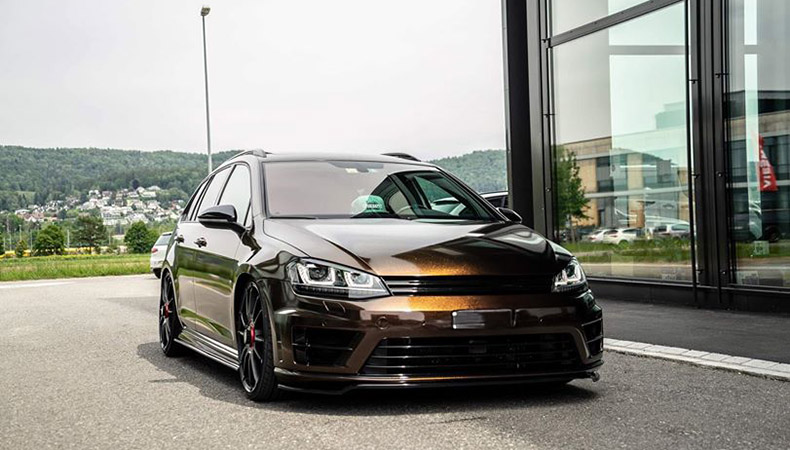
PVC is a proven material for automotive bonding. Pictured: KPMF film (over Spandex). Photo: Spandex
The Controversy Over PVC
PVC therefore has many desirable properties for vehicle graphics. Nevertheless, from an environmental and health perspective, the use of this material is far from ideal, as PVC has several drawbacks.
Working with PVC can therefore pose a health risk. Vinyl contains plasticizers, which are necessary to make it flexible. Some of these plasticizers, such as phthalates, are suspected of being harmful to health. For this reason, phthalates are banned in many consumer products in Germany, according to the Federal Environment Agency.
Volatile organic compounds (VOCs) are often released during vinyl printing. This is particularly true when using solvent-based inks and when the vinyl films are heated.
Finally, the disposal of PVC remains problematic in many cases. The material is not biodegradable. Although there is a growing number of PVC recycling facilities, deinking and sorting by material type are particularly labor-intensive processes, especially for printed and laminated films.
As a result, graphic films containing PVC often end up in waste-to-energy plants. However, these plants must be equipped with very effective filters to process vinyl, because toxic dioxins can be produced during incineration.
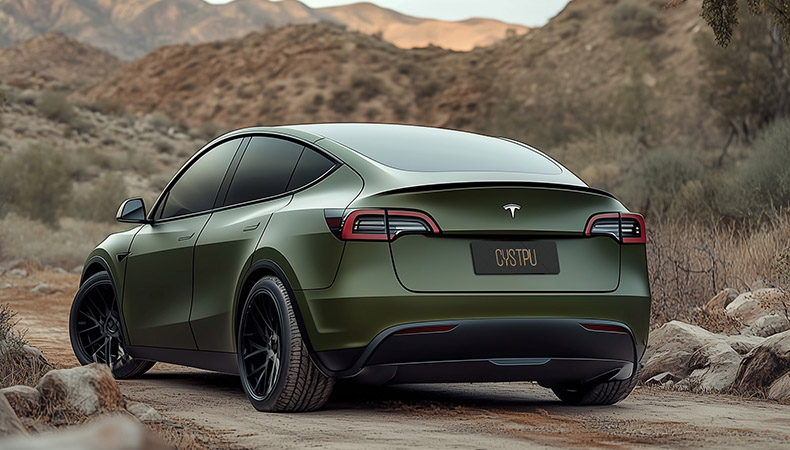
TPU films (shown here from CYS Europe) are available in high-gloss and matte finishes. Photo: CYS Europe
Alternatives to PVC
So it’s fair to say that PVC can be viewed as a material that is, at the very least, controversial. That’s why manufacturers and distributors—as well as fabricators—are increasingly looking for alternatives.
Currently, these are primarily PU and TPU films. They contain fewer harmful chemicals, and their combustion does not produce chlorine or dioxins. One example of PU-based vehicle wraps is the Avery Dennison MPI 1405 series.
However, working with TPU films can present some challenges for users who are not accustomed to the material. Edling comments: “Installers are often still hesitant, since PVC-free materials frequently have different processing characteristics.” Kimme agrees, and points out that TPU films are currently still more expensive than PVC materials. For him, however, TPU is overall the better choice for high-quality, durable vehicle wrapping. Colored TPU films are available, for example, from CYS Europe.
Other PVC alternatives, such as the EcoPlot Aslan PP 112 PP films, are generally intended only for short-term use on flat surfaces. They can be used in car wrapping, for example, for small-format signs or decals on side panels without beads or rivets. The same applies to PET films such as Neschen Easy Dot PET.
PVC Remains a Controversial Choice for Car Wrapping
PVC is still used for most automotive decals. However, this controversial material no longer seems indispensable. With TPU, as well as PU, PET, and PP, there are now alternative films that are, in some cases, significantly superior to PVC for automotive decals.
Currently, their market share is still small. But that could change rapidly in the coming years. This will then lead to price differences among the various types of film largely evening out.
Particularly in public tenders and among corporations subject to environmental reporting requirements, PVC-free alternatives are already being requested more frequently. In addition, more and more digital print shops, advertising technicians, and film applicators are recognizing that PVC-free films are better for their own health, among other reasons. However, it is now also up to the end customers who commission vehicle wraps. They must be willing to accept slightly higher prices so that the environment and their health are less adversely affected.