

Is the computer now taking the reins at the print shop? New tools with built-in AI could transform the industry from the ground up. It’s time to develop strategies to address this.
Artificial intelligence (AI) has long been more than just a buzzword. In print production, it opens up new possibilities that go far beyond automation. Given the increasing demands for speed, quality, and cost efficiency, AI is thus becoming a decisive factor for competitiveness. But what does this mean specifically for digital printing and the advertising industry?
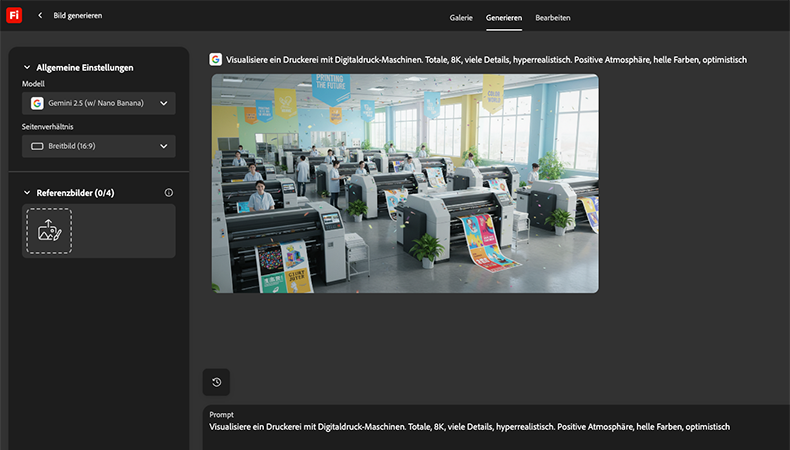
AI in Design: Creativity Meets Algorithms
AI is already being used extensively in the field of design, particularly in illustration, image editing, and layout. Adobe’s professional software across its entire product line uses “Adobe Sensei,” the company’s in-house machine learning platform. As a generative AI model for creative content, “Firefly” even offers basic features free of charge to the general public.
Other professional design software, such as Corel Draw and Affinity, as well as countless apps for end users, also use AI to create creative content. This allows even people without formal design training to create simple illustrations, logos, product photos, and layouts of appealing quality.
This means that full-service print shops and signage companies could lose significant sources of revenue from consulting and creative services. At the same time, it is likely that data generated by end customers using AI will not be readily printable. This means that additional effort will be required during the prepress phase.
AI in Prepress: Automated Prepress Processes
Automation is already well advanced in prepress. This is particularly true for checking submitted data and for creating and monitoring complex workflows. Vendors such as Callas, OneVision, and Agfa offer comprehensive suites for this purpose, typically based on the Adobe PDF Print Engine. This reduces waste and speeds up production. However, the use of AI is generally not yet promoted in this context.
However, when it comes to RIP functions such as imposition and nesting—as well as color matching and screening—most providers have been using highly complex algorithms for years. In some cases , these are effectively “expert systems”— a type of AI that has been trained for a specific task. It remains to be seen to what extent the rapid advances in research and development can bring further improvements in this area.
The online printing company Mixam is already promoting its AI-powered service to quickly and reliably optimize (semi)professional customer data. Typical errors, such as missing bleed margins or insufficient resolution, are corrected there using AI without the need for human intervention.
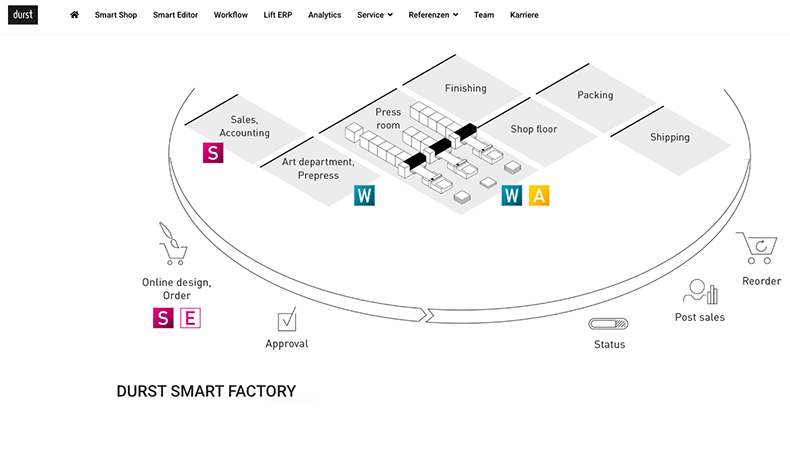
AI in Workflow Optimization
Many printer manufacturers allow users to register their current devices with cloud services. Examples include
This allows customers to use services such as remote monitoring and view data on utilization and ink consumption. In some cases, continuous monitoring also makes it possible to predict errors and problems. This allows for preventive maintenance and repairs to be scheduled, thereby preventing system failures from occurring in the first place. This is a major advantage for print shops.
Printer and RIP manufacturers, as well as providers of cutting solutions such as Zünd, offer complex workflow solutions with cloud connectivity. These solutions help print shops better plan their capacity and shorten turnaround times. It can be assumed that AI is already being used at various levels within cloud systems to structure and interpret the collected data.
AI in Administration and Customer Management
AI is also changing the rules of the game in the back office. Enterprise Resource Planning (ERP) systems such as Lift and Advanter, and Customer Relationship Management (CRM) applications such as Salesforce, have long been standard at larger digital printing companies.
Some of these applications already use AI to sort customer data, predict ordering behavior, and automate personalized offers. For companies, this means more efficient communication, higher customer satisfaction, and better capacity utilization.
For smaller businesses in the digital printing and signage industries, however, such comprehensive software solutions are usually too expensive and, ultimately, too resource-intensive relative to the size of their orders.
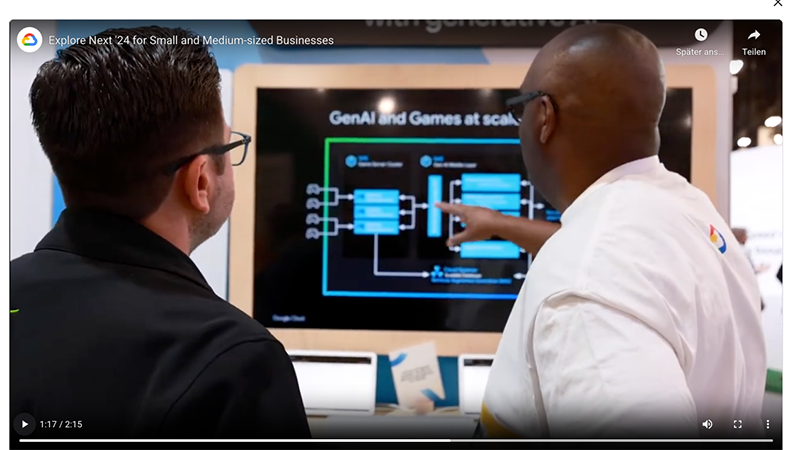
But even they can already benefit from AI in their administrative processes. For example, the Microsoft 365 cloud service offers the ability to create simple AI agents. With an additional subscription costing about 20 euros per user per month, organizations can build in-depth analyses and AI-powered workflows tailored to their business using Microsoft products. Google Cloud also offers similar capabilities for small and medium-sized businesses.
AI and the Printing Industry: Seizing Opportunities, Understanding Risks
In the coming years, AI will transform the printing industry just as fundamentally as it will other industries and business sectors. In the short and medium term, the graphic arts industry may even be better equipped to handle this than other sectors. This is because the level of automation and digitization is already high, and many companies are highly innovative.
However, AI is not a substitute for expertise or skilled workers. Rather, it is a tool that streamlines processes and ensures quality. Companies that invest early on benefit from lower costs and greater flexibility.
At the same time, the use of AI requires new skills and a critical examination of issues such as data protection, as well as the nature of employment opportunities. It seems likely that entry-level and low-skilled jobs will be eliminated.
The remaining jobs are likely to be more technical and analytical in nature than manual. This could help make the printing industry more attractive again to highly qualified candidates and motivated young professionals. However, companies should take care to ensure that the structural change accelerated by AI does not also wash away valuable production knowledge and sought-after manual skills from their organizations. The future of print production is smart—but it remains a joint effort between people and machines.
Learn more about AI