Visit Corrugated 2026
Coming to Fira Barcelona, 19-22 May 2026, Corrugated is a new dedicated exhibition with curated conference content aimed at corrugated converters.
Corrugated board is being reimagined as a premium, sustainable medium for luxury packaging and retail displays. Driven by the “unboxing” trend and advances in inkjet technology, printers can now deliver high-quality, short-run graphics. While the material presents handling challenges, new automated lines and embellishment tools are turning corrugated into a high-margin opportunity.
Paper-based corrugated board is not a new material in any way at all but brands are finding new ways to use this substrate and that is opening up new business opportunities for print service providers. This applies to both display graphics and to packaging meaning that there is also some cross over between the two that can create further opportunities, particularly around retail environments.
Paper-based materials are both easily renewable and recyclable, which fits in with the increasing emphasis on sustainability. In some cases this has meant corrugated media being used where previously plastic might have been the first choice, which might require more intricate designs to form shapes around objects for better protection in transport. In addition, brands will also look to cut their overall use of packaging, perhaps with smaller boxes or by substituting a thinner corrugated board, both to cut weight and transport costs, and for the reputational advantage of making it easier for consumers to recycle their packaging.
More to the point, consumers are now much more willing to accept corrugated as a primary packaging media even for luxury items where in the past they might have viewed it as being too rough or seen it as a cheaper material that was only suitable for lower-value products within the packaging. The relatively recent phenomena of consumers and reviewers producing unboxing videos has forced retailers to pay more attention to the aesthetic quality of the boxes. That means more full colour graphics printed to the outside of the boxes, and in some cases additional information on the inside.
It helps also that a newer generation of inkjet print technology is capable of achieving better image results with short run lengths, and enabling increased volumes at lower costs. And, of course, the greater focus on corrugated means that there are more equipment vendors offering a greater range of kit for print service providers to choose from.
However, corrugated is not an easy material to print to. It can be quite thick and there is a significant chance that some boards will be warped, which might result in damage to inkjet printheads. At the same time the flat boards can also be quite delicate and there is risk of crushing them if there is too much pressure, which has to be taken into account in the design of the feeder and transport systems through the different production machinery.
There are two main markets using corrugated media. This includes sign and display, which is relatively short run and handled through existing flatbed printers and cutting tables. Then there is the packaging market, which splits into medium run lengths and is catered for by a growing number of inkjet solutions, and the longer runs that are mostly printed via flexo presses. Over the last few months we’ve covered the various print solutions plus the die cutters and folder gluer lines that are necessary to turn blank sheets into printed boxes.
All of this equipment can be assembled together to form complete production lines but there are also several vendors that offer corrugated printers as part of an automated solution for shorter runs even down to one-offs that are suitable for e-commerce operations. One example of this is the Polish company Zemat Technology, which makes the Boxmat range of corrugated box making machines that are mainly designed for short runs. Amongst this, the company has also branched out into corrugated print solutions, though these are mainly designed to be used with the Boxmat feeders to create a complete box making and printing solution. The idea is to print to the underside of the sheet and then die cut and form the box.
The choice includes two flexo print units as well as the JetBox inkjet printer. This has mainly been conceived as a single colour printer but there is an option for two colours. It’s a modular machine, with a print width of 210mm but it is possible to combine four modular printing units within the one device for a total print width of 840mm. It will take sheets up to 2400 mm. It uses a fast drying oil-based ink, and has print resolution of 360 dpi.
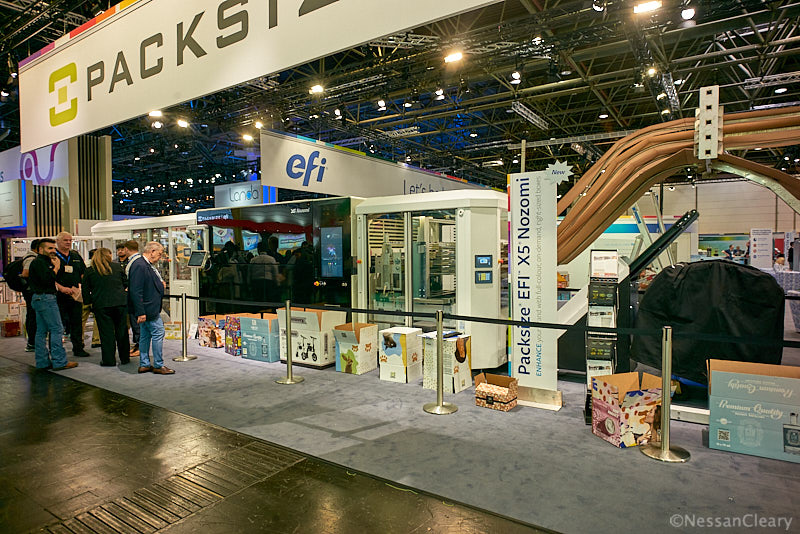
EFI has developed a complete printing and converting line for producing corrugated boxes called the Packsize X5 Nozomi. This is a collaboration with Packsize, which makes automated packaging packaging solutions and has developed the X-series of automated box converting machines. EFI has added a Nozomi print engine complete with a Fiery front end. It has a corrugated feeder that has four Z-fold supply feeders, each holding different sized corrugated rolls so that there’s a choice of widths. The first step is to cut a board from the chosen roll. The print unit has been fully integrated into the Packsize. It applies a primer and then prints in CMYK plus orange, using EFI’s UV LED inks. From there, the board is die cut, then formed into the box and glued. The boxes are output to a conveyor belt that’s fitted with a label print and apply unit, so that shipping details and hazard labels can be automatically applied to the box. The entire system is fully automated and will run with very little operator intervention, apart from picking the boxes up from the end. The system can produce one box every six second, which translates into a maximum of 600 boxes per hour though the actual number will vary depending on the size of the boxes.
Finally, as corrugated is becoming a more mainstream material, so brands are looking at applying the techniques they currently use to enhance other types of print in order to further the appeal of their corrugated applications. Thus Scodix, which makes embellishment presses, has adapted its media handling in order to expand into the sign and display market. The Scodix presses are designed to take substrates that have already been printed, either using offset or digital presses with water-based or UV inks, and then to add further effects or embellishments to increase the value of those prints. Thus the new B1-sized Scodix Ultra 7000 SHD can handle corrugated sheets up to 4.5mm in height and up to 3.4kg in weight as well as rigid substrates such as acrylic, Forex and foam board plus paper and even leather. This device can create up to 17 effects, including foil, embossing, glitter, metallics and several security features. This is primarily aimed at point of sale displays which will also allow retailers to match the effects on packaging to a corresponding POS display.
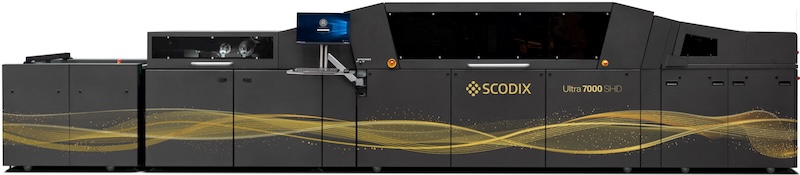
You can see the new Ultra 7000 in action along with many other corrugated solutions at the Corrugated section alongside Fespa’s Global Print Exhibition in Barcelona in May.
Coming to Fira Barcelona, 19-22 May 2026, Corrugated is a new dedicated exhibition with curated conference content aimed at corrugated converters.