Starting in September 2026, the EmpCo rules are intended to ensure that sustainability claims can no longer be made without substantiation in the EU. What does this mean for print substrates? How can digital print shops prepare for this?
“We are a green printing company and use only sustainable materials”—statements like these could have consequences after September 27, 2026, particularly if they cannot be sufficiently substantiated. The “Empowerment of Consumers” Directive of February 28, 2024—EU/2024/825 (EmpCo)— tightens the requirements regarding inaccurate or vague claims about environmental and climate protection as well as sustainability. In Germany, the Unfair Competition Act (UWB) has largely adopted these requirements in an amendment from February 2026.
For printing companies, this means they will need to be even more careful when selecting printing substrates in the future. After all, the printing substrate is the variable that is easiest to adjust in digital printing. When switching, for example, from PVC to PET film, some machine settings do need to be adjusted. However, compared to installing new hardware or changing the workflow, the effort involved is considerably less.
What does sustainability mean when it comes to printing substrates?
Sustainable substrates are printing materials that can be produced, processed, and disposed of in a way that conserves resources as much as possible throughout their entire life cycle. This includes reduced CO₂ emissions, recyclability, and the avoidance of problematic components such as chlorine or phthalates.
The use of renewable raw materials, such as natural fibers or pulp, instead of fossil resources can also help reduce the environmental impact of manufacturing printing substrates. However, monocultures, unsustainable land management, and—in particular—illegal deforestation can lead to other problems.
In many cases, however, digital printing applications must meet high standards. They must be tear-resistant and weatherproof, and must be able to be securely fastened. For this reason, service providers and signage technicians must apply adhesive, laminate, or eyelet the prints. However, as composite materials, such products can only be recycled by material type if they can be easily separated. For this reason, digital prints consisting of multiple components usually end up in waste-to-energy facilities or landfills.
The difference between true sustainability and greenwashing therefore lies primarily in the details. Truly sustainable solutions must therefore take into account the entire life cycle as well as the supply chain. This holistic approach (“Cradle to Cradle”) is becoming increasingly prevalent. However, marketing claims often highlight only individual benefits. With the new EmpCo rules taking effect, some common slogans related to print substrates will no longer be permitted.
Sustainable Printing Substrates in Transition
The selection of sustainable substrates has increased significantly in recent years, as buyers of printed products are demanding alternatives that are less harmful to the environment. In analog printing, as well as in digital printing for large print runs and in the production of packaging and POS displays, recycled and FSC-certified papers and cardstock remain an important standard. Ilford/Tecco, Igepa with its Masterjet Pro line, and many others have been offering these types of materials for years.
In large-format printing, however, vinyl and banners are the most widely used materials for outdoor applications. PVC remains the preferred material for this purpose.
Sustainable Alternatives to Plastic Film
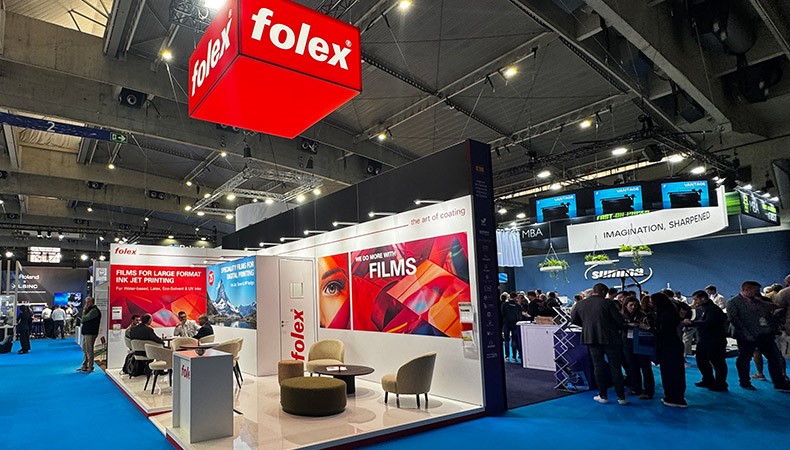
In recent years, however, an increasing number of sustainable films made from PVC alternatives such as polypropylene (PP) and polyethylene (PE)—designed specifically for digital printing—have entered the market. Examples include Orajet 3720 and 3740, the SP 3500 Opaque Matte Series from Avery Dennison, the Grafity GEF portfolio, Folex SI 164, and Hexis HXLT200. They are designed for a wide range of indoor and outdoor applications, such as signage and trade show displays.
Banners, mesh, and textiles without PVC
PVC truck tarps, backlit or blockout materials, and PVC mesh netting on construction scaffolding are now increasingly being replaced by PET-based alternatives, such as Seemee Loop Mesh products from Serge Ferrari.
Soft signage applications have become the standard for interior decoration and signage. In most cases, these are printed on polyester using the sublimation process. Because the fabrics are significantly lighter, easier to transport, and easily reusable compared to solid tarps, they are considered a more sustainable signage solution. Soft signage fabrics are available, for example, from Berger Textilien.
Synthetic papers: durable and reusable
Synthetic paper, such as DuPont’s Tyvek, is a nonwoven material, typically made of polyethylene. It is manufactured from petroleum products and is highly resistant to weathering. As a result, it can contribute to environmental pollution. However, its high durability also means that products made from Tyvek can often be reused, which offsets its environmental impact over its entire lifespan. A typical example is race bibs at sporting events.
Green Plate Printing: Reducing the Environmental Impact
In digital printing, lightweight PVC foam panels—such as Forex —have long been the primary choice for direct printing on rigid materials. There are now several alternatives:
- Aluminum composite panels with a PE core, such as Dibond from 3A Composites, contain no PVC. However, the production and processing of aluminum consume a great deal of energy.
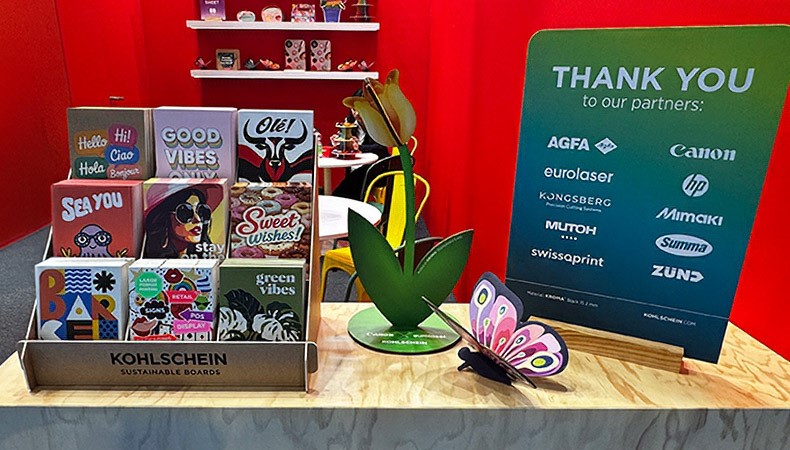
- Hollow-core polypropylene sheets, such as Kohlschein Akyplac, are PVC-free, ultralight, weatherproof, and moisture-resistant. They are best known as campaign posters on lampposts. They are easy to install and can be recycled by material type after use.
- Honeycomb and textured paper panels, such as DISPA, Swedboard, or Katz Display Board, are made of 100% cellulose, a renewable raw material. Their multi-layered structure makes them rigid, making them suitable for many indoor applications and some short-term outdoor projects. After the event, simply dispose of the display in the recycling bin.

Substrates for Sustainability in Vehicle Decal Application
PVC film printed with eco-solvent ink is still considered the gold standard in vehicle wrapping. This is because it is easy to work with and, depending on its quality and intended use, can last ten years or more. Compared to repainting a vehicle or repeatedly replacing the wrap, applying a PVC vehicle wrap can therefore offer environmental benefits. Over its lifetime, the amount of waste generated and the use of chemicals are relatively low.
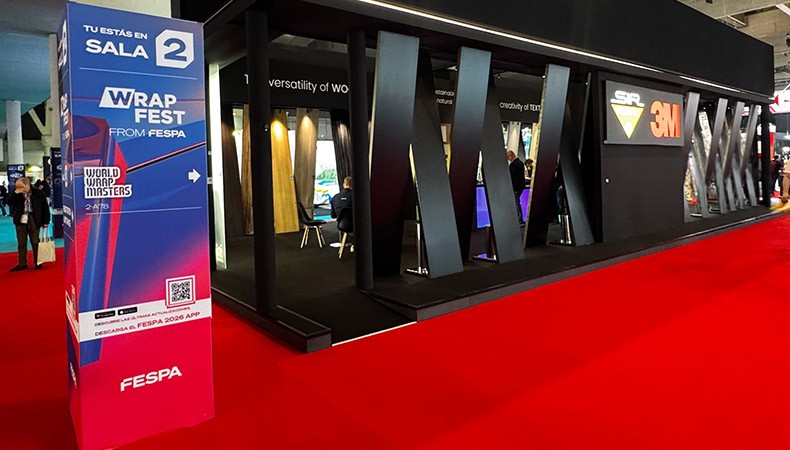
The growing number of PVC-free films is generally based on thermoplastic polyurethane (TPU) or PU, polypropylene (PP), or PET. They are printed with UV-curable or latex inks. Suppliers include Cys Europe, 3M with its Envision product line, and Arlon with its Vital product line.
Challenges and Opportunities in Environmentally Friendly Materials
Over the years, there have been significant developments in the selection of materials for digital printing in terms of sustainability. The use of PVC is declining, and more substrates made from renewable raw materials or containing recycled content are entering the market. Greater attention is also being paid to ensuring that displays can be reused multiple times or are easily recyclable.
At the same time, it is evident that technical requirements and economic conditions are slowing down the transition. Sustainability often leads to higher costs and requires adjustments to the production process. Against the backdrop of the weak economic situation in many parts of the world, this poses a challenge for printing service providers. However, in light of new regulatory standards such as the EmpCo Directive, these changes are unavoidable if the industry wants to remain attractive to its customers.
Discover more content on the topic of sustainability