Today, printing service providers, advertising technicians, and trade show booth builders must not only supply high-quality textiles but also be able to demonstrate just how sustainable they actually are. But which criteria matter—and which solutions are sustainable?
Textile printing is considered one of the growth segments within the digital printing industry. However, this is also because digital textile printing covers a very broad range of applications. In this article, we will focus on just two areas, both of which are particularly important to the advertising industry:
- Apparel Printing (Promotional Textiles, Workwear, Personalized Products, Sportswear, and Small Batches)
- Soft signage and textile exhibition stands.
What these two sectors have in common is that sustainability requirements have recently been significantly tightened throughout the entire value chain. The revised version of the Unfair Competition Act, which took effect in February 2026, has tightened the guidelines for transparent product communication. Sustainability claims must now be objectively verifiable.
Buyers of digitally printed textiles are passing these challenges on to the printing companies. As a result, the question has also come into focus for printing service providers: What defines a sustainable textile?
Sustainable Apparel for Digital Printing: A Brief Explanation
For garment printing, sign-making and digital printing companies purchase blank items. These are unprinted textiles such as T-shirts, hoodies, caps, or bags.
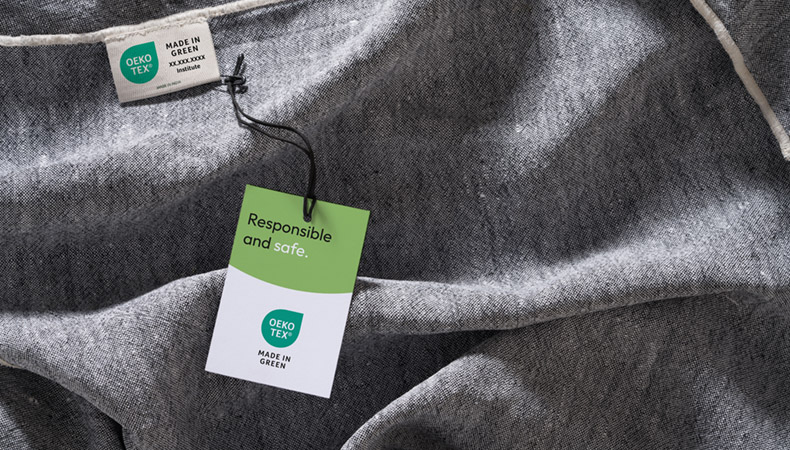
Print buyers and consumers focus on relevant standards such as GOTS and OEKO-TEX. These standards take into account environmental and health aspects as well as social criteria. The Amfori-BSCI system helps companies systematically verify social standards throughout the entire supply chain.
The Green Button is a government textile certification introduced in 2019 by the Federal Ministry for Economic Cooperation and Development. It assesses whether companies systematically take responsibility for human rights and environmental standards in their supply chains.
It all comes down to the process chain
The growing importance of such standards is also evident in the fact that many manufacturers of raw textiles are aligning their production chains with stricter guidelines. Companies such as FOL International GmbH, owner of well-known raw goods brands like Fruit of the Loom, Russell Athletic, and Jerzees, transparently document their sustainability strategies.
For printing service providers that specialize in the production of sustainable, printed apparel, however, simply purchasing the appropriate raw textiles is not enough. This is because most certifications today require that on-site processing be taken into account as well.
The OEKO-TEX Passport, with its modular approach, is particularly relevant for digital printing companies. This is because the label makes it possible to include not only the raw fabric but also inks, primers, and other auxiliary materials in the certification process.
Digital Product Passport (DPP)
The Digital Product Passport (DPP) will become mandatory for the textile industry in 2027. Textile products will thus be among the first to be subject to this new documentation requirement regarding supply chains, composition, and recycling options. The DPP stems from an initiative under the European Union’s “Green Deal.”
At this time, many details have not yet been finalized. However, experts expect that the DPP will be required of all companies that manufacture and decorate clothing. This is expected to apply regardless of company size.

The “Green Button” is a textile label issued by the German Federal Ministry for Economic Cooperation and Development. Photo: BMZ
Sustainable Textiles for Soft Signage and Trade Show Design
When producing textile signage (soft signage) and textile prints for trade show construction, printing service providers are also increasingly confronted with the issue of “sustainable textiles.” This is simply because major brands must now include event and marketing projects in their sustainability reports. However, the challenges here are significantly different from those involved in the production of printed apparel.
The demand for POS and trade show booth products is primarily driven by the client’s creative and marketing teams. They often prefer products that are certified with textile labels.
In reality, however, many labels commonly used in garment printing are hardly suitable for soft signage. That said, the OEKO-TEX 100 Product Class 4 certification is specifically designed for materials used in decorative applications.
Sustainability from the very beginning
Often, however, even small changes to the project could lead to significant savings in logistics, the raw materials required, or even the recyclability of promotional textile prints.
In this area, printing service providers need to take on a more advisory role and highlight ways in which POS materials or trade show booths can be designed and manufactured so that they can be reused multiple times.
However, this also requires adjusting many processes at trade shows and retail spaces. Banners or backdrops that are to be reused must be taken down with as little damage as possible. The parts must then be packed in such a way that they can be stored and reassembled later. But that requires care and time. Budgets and time frames for setup and takedown at trade shows and retail spaces will therefore need to increase in the future.
Recyclability and Sustainability
Sometimes, sustainability in digital textile printing can simply mean that a banner can be recycled as a single material. Until now, this was often not the case, especially with black-back fabrics. This is because the opaque layer on the back was usually achieved by applying a black PU coating.
That’s why Procedes, a textile printing specialist based in Lemwerder, is breaking new ground with its 100% polyester Beitex Greyback. This material is opaque without a coating because a gray textile thread is woven into the reverse side.
“When combined with polyester cords, these materials are ready for the recycling process. We collect them by type, which allows us to ensure that our sustainable, PVC-free textile prints are recycled and can serve as raw materials again,” explains Michael Bete, Head of Business Development at the Procedes Group. “We developed the material in collaboration with textile manufacturers. Such joint efforts across the entire value chain are necessary to make trade show construction more sustainable and to offer new recycling opportunities.” As a result, a recent Procedes trade show booth in Düsseldorf was the first to be completely recycled and reused.
Sustainable textiles: without them, there is no future for printing service providers
With the revision of the Unfair Competition Act and the introduction of the Digital Product Passport, a lot is changing for digital printing service providers as well. A vague product promise to strive for sustainability in textile printing will soon no longer suffice. Companies must provide evidence of robust certifications such as OEKO-TEX, GOTS, and other relevant seals. What’s new is that these no longer merely promise a competitive advantage but are also becoming a legal requirement.
Michael Bete confirms this as well: “The requirements for sustainability reporting, as well as the effort to position one’s own brand as climate-conscious, are driving increased customer demand for verifiably green solutions in textile printing. Trade show organizers, too, should continue to prioritize this issue.” For printing service providers, this means it’s high time to take sustainability seriously in textile and apparel printing.