Textile printing for public spaces places special demands on materials, printing processes, and compliance with legal standards. What do printing service providers need to keep in mind? ?
Whether at trade shows, in hospitals, daycare centers, hotels, government offices, or event venues—anywhere people gather, strict guidelines regarding safety, hygiene, and sustainability apply. For printing service providers and suppliers, this means they must not only work creatively and efficiently, but also stay up to date with the latest technical and legal requirements.
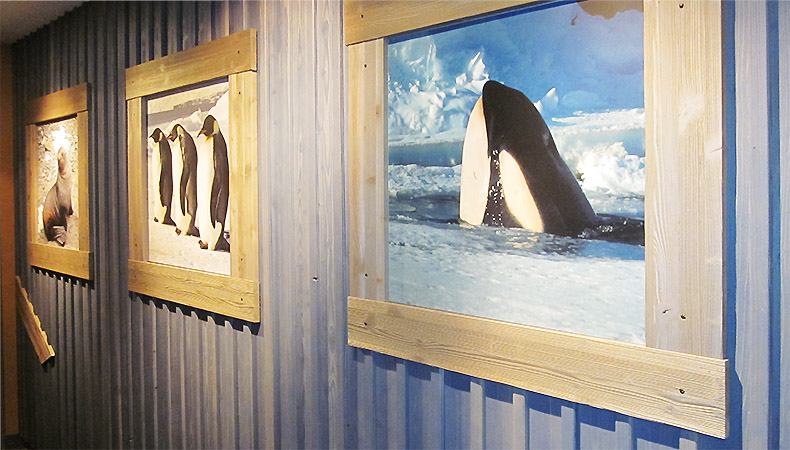 Canvas prints in a hotel’s wellness area: In addition to fire safety, resistance to moisture and high temperatures must also be ensured here. Photo: Sonja Angerer
Safety Standards for Advertising and Textiles in Public Spaces
In public facilities, special fire safety requirements apply to textiles. In Germany, these are regulated, among other things, by DIN standards and the guidelines of the Federal Environment Agency. Fabrics must often be classified as flame-retardant, for example, in accordance with the German DIN 4102-B1 or the European fire safety standard EN 13501-1. These requirements apply to curtains, wall coverings, upholstery fabrics, and also to printed advertising media such as banners, textile trade show booths, or roll-ups.
In addition to fire safety, mechanical safety and toxicological safety also play a role. Textile surfaces must not emit any substances that are hazardous to health. For preschools and schools, there are additional requirements regarding resistance to saliva and sweat, as well as the mechanical durability of the materials.
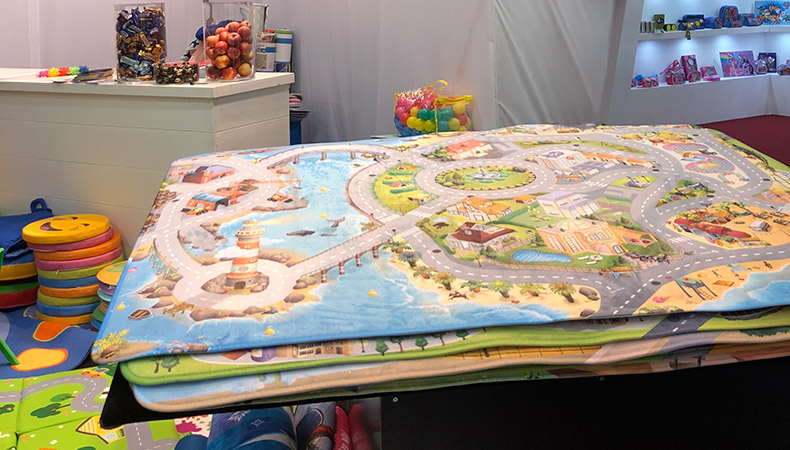 Textiles that are primarily used by children, such as these play rugs, must meet particularly high standards. Photo: Sonja Angerer
Special Requirements for Textiles in Hospitals and Daycare Centers
In hospitals, hygiene is a top priority. Textiles must be capable of being disinfected and must not promote the spread of germs. The Austrian Institute for Hospital Hygiene recommends that printed textiles in patient and common areas be regularly cleaned chemothermally or thermally at a temperature of at least 40, preferably 60, degrees Celsius. This can easily cause printed fabrics to wear out and fade, largely regardless of the printing technology used.
In preschools, the requirements are different: Here, the focus is primarily on safety and the absence of harmful substances. Textiles must be durable, saliva-resistant, and free of hazardous chemicals such as formaldehyde, phthalates, heavy metals, PFAS, or bisphenols. Particularly for fabrics used in furniture that is primarily used by children under 14, additional German and European standards may apply, such as DIN EN 17191 for seating furniture.
Some manufacturers therefore offer inks for direct-to-fabric and transfer printing that come with specific certifications attesting to product safety. Examples of DTF printing include the DuPont Artistri P1600 series, which is certified with the Oeko-Tex Eco Passport and GOTS, and Mimaki’s PHT50 ink, which is also certified with the Oeko-Tex Eco Passport.
 Textile light boxes at the Bauma trade show: With several hundred thousand visitors passing by, fire safety must be a top priority. Photo: Sonja Angerer
Textiles at the Airport and at Trade Shows
All posters, display stands, and fixtures at German airports must meet at least the B1 fire safety standard. This applies to the entire product, including the adhesive backing, frame, and any electrical components. However, local regulations often go far beyond this. This can extend to requiring compliance with fire safety classes A2 or A1. Printing service providers should therefore coordinate with local fire safety officials well in advance.
Trade show organizers have faced criticism in recent years, for example, due to unfair working conditions. The use of chemicals and raw materials for short-term applications is also often viewed critically today. In addition to proof of B1 certification, many trade show venues therefore require additional certifications such as GOTS, the EU Ecolabel, or other labels for textiles used in trade show construction. On top of that, there are increased requirements for recycling. Textiles should be separated and collected by type so that they can be easily reused.
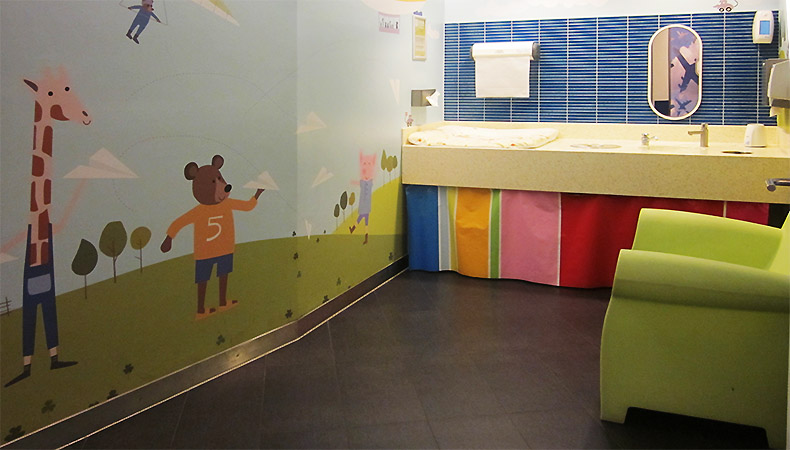 Wallpaper and fabric wall coverings in hospitals and preschools must be particularly easy to clean. Photo: Sonja Angerer
How Suppliers Ensure Compliance with Standards in Textile Printing
Print service providers must demonstrate, through certifications and test reports from recognized laboratories, that their products comply with the applicable standards.
A professional quality management system (e.g., in accordance with ISO 9001) is essential for this. This is because compliance with the standards must be systematically documented and monitored. For example, fire safety certificates are always valid only for a precisely defined production process: the printing press, inks, substrate, and post-press processing must be verifiably identical.
The same applies to health and environmental certifications such as Oeko-Tex Standard 100 or Blue Angel, and even to washing tests conducted in accordance with ISO standards.
 If the contracting party is a public entity in Germany, the warranty period for permanently installed carpets can be four years or longer. Photo: Sonja Angerer
Warranty Periods for Public Buildings
While warranty periods rarely come into play for advertising applications and trade show construction, the situation is different for furniture, wall coverings, and textile floor coverings in public buildings. In Germany, these periods are governed by the VOB/B (Contract Procedures for Construction Works). They are generally four years. Suppliers must remedy defects free of charge during this period. Suppliers should therefore clarify in advance, for example, how resistant the inks and printing substrate used are to abrasion and standard cleaning methods.
Textile Printing for Public Buildings: Don’t Take It Lightly
Textile printing for public spaces is a challenging field that requires technical expertise, legal compliance, and creative solutions. To succeed in this field, one must be familiar with the applicable standards, implement them reliably, and continuously improve. The future belongs to printing service providers who combine quality, sustainability, and innovation.