Corrugated board is a sustainable powerhouse for packaging and displays. This article explores three printing methods: pre-print liners, inline integration, and post-print board decoration. With inkjet technology from HP, Agfa, and Koenig & Bauer Durst, manufacturers can now achieve high-speed, environmentally friendly production using water-based inks for both high-volume and personalised runs.
As we increasingly look for more sustainable solutions, corrugated paper boards have become more and more common. This is hardly surprising, as such boards can be relatively strong with a healthy strength to weight ratio, offer a degree of cushioning for protection in transit and can be easily printed on. And on top of all this, they are highly recyclable.
Naturally, given the volumes involved in packaging, the majority of corrugated materials are printed through conventional print technologies. In the past this meant rotogravure but increasingly flexography and offset presses are also being used, and recently a number of digital presses are also challenging for a slice of this work.
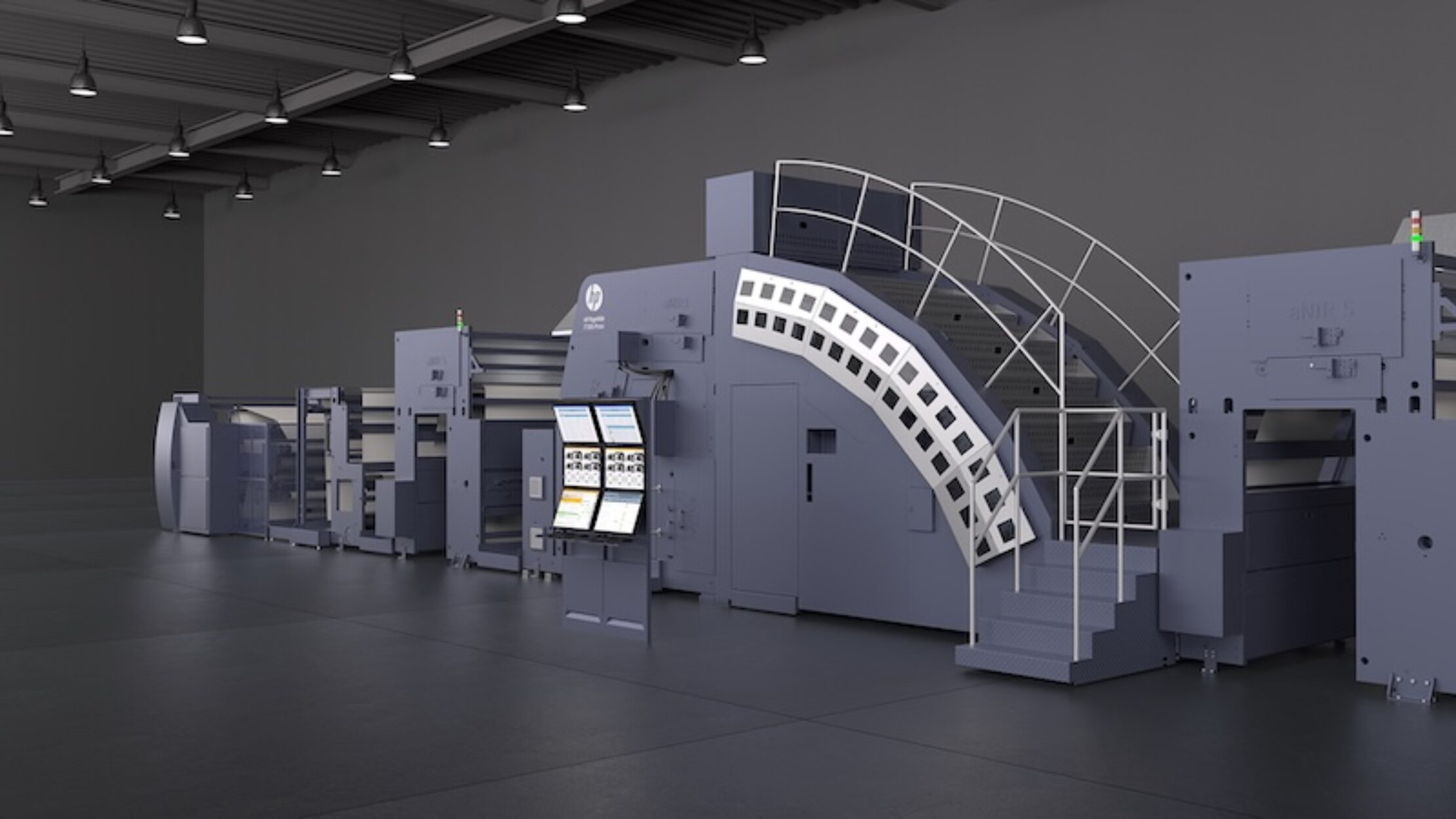
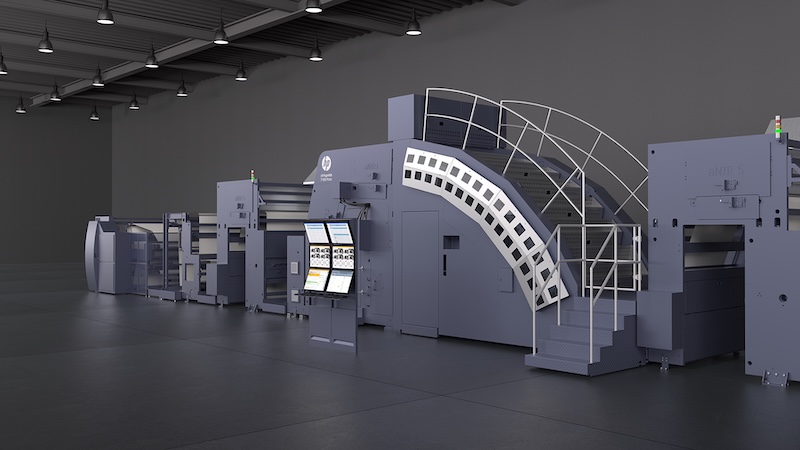
This HP T700i is a 1.7m wide inkjet press for pre-printed top liners for corrugated boards.
There are three basic approaches. The fastest is to preprint, meaning printing to the outer facing side of the corrugated boards, which is known as the top liner. This can then be fed in to the corrugating machine to glue the top liner with the graphics in place as the corrugated boards are formed. This has the advantage that it can be run on a standard press at its maximum speed, as with any other paper-based media.
HP has developed a number of single pass inkjet presses designed to fit into this workflow for pre-printing to the top liner with print speeds, up to 305mpm. This includes both the 1.7m wide PageWide T700i and the 2.8m wide T1100, both of which were built in collaboration with Koenig and Bauer but use HP’s proven thermal inkjet printheads with water-based inks. They print to standard coated, uncoated, brown kraft, paperboard, and recycled papers.
The Jetliner Monochrome is a 2.8m wide inkjet for use inline with a BHS Corrugator.
Then there is the inline method, with an inkjet unit added inline to the corrugator to print onto the top liner. BHS, for example, which manufactures corrugating machines, has developed the Jetliner series, which can be used to print directly to the top liner as it feeds into the corrugator line, or to a separate roll. The development was originally begun in 2016 with Inca Digital, which Agfa acquired in 2022, allowing Agfa to also supply BHS with ink.
The initial project was to develop a 2.8m wide printbar for use with a BHS corrugator, which has since evolved into the BHS Jetliner Xceed. This is a single pass inkjet unit, printing CMYK at speeds up to 300mpm across a 2.8m print width. As such, it can print high resolution variable data with full colour graphics to both coated and uncoated substrates.
There is a single colour model, the Jetliner Monochrome, that runs at up to 400mpm and can be used to print high resolution variable data text as well as barcodes and tracking numbers directly at the corrugator stage as the boards are formed saving the need for a separate print process.
Finally there is postprint, which involves printing to the finished boards, meaning that the printing can take place at a separate print factory from the board manufacturing. This involves overcoming a number of challenges in handling the boards, which have to be picked up and transported through the press but without crushing or otherwise damaging the boards. The boards are often not perfectly flat, which usually necessitates a vacuum handling system to hold them flat so that the printheads can be reasonably close to the media at the point of printing but without the risk of the boards striking the nozzles and damaging the expensive heads. There are a number of single pass inkjet presses dsigned specifically for postprint corrugated work just starting to appear.
So, for example, Koenig and Bauer Durst is a joint venture between Koenig and Bauer and Durst, which offers a number of presses originally developed by each of the partners. This includes the Delta SPC 130 which was originally developed by Durst. This can print direct to corrugated boards, up to 1.3 x 2.8m. It will run at speeds of up to 120mpm though this drops to 90mpm for higher quality work, with resolution up to 1000 dpi.
Then there is the CorruJet 170, which is built on a Koenig and Bauer design, and is a much more heavy duty machine. It takes sheets up to 1.3 x 1.7m and can produce up to 5,500 sheets per hour with a maximum resolution of 1200 dpi in CMYK. Koenig and Bauer Durst has also developed a water-based inkset that is certified for food packaging, and can be used with both the CorruJet 170 and the Durst Delta SPC 130.
Almost all of the inkjet presses use water-based ink, which have the potential to be environmentally-friendly. This avoids the risk associated with UV-curable ink that some chemicals, typically from the photo-initiator in the ink, could migrate through the packaging and contaminate the products within. This issue generally affects food packaging but can also apply to some pharmaceuticals. This does not affect water-based inks and all the vendors have had their inks certified to comply with the relevant packaging standards such as Swiss Ordinance Nestle.
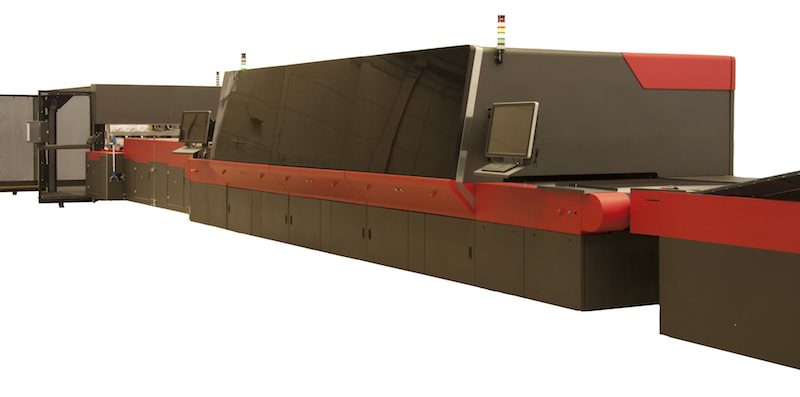
That said, EFI sells the Nozomi, which is a single pass press developed out of EFI’s wide format technology and which does use UV-curable ink. EFI took the more pragmatic approach that food packaging only accounts for a small part of the market and that using UV-curable ink would allow it to get to market much faster. That strategy proved reasonably successful with many sites worldwide operating multiple Nozomis though EFI is now working on a water-based inkset for the Nozomi AQ.
EFI’s Nozomi is an inkjet printer designed to print to corrugated boards.
Another issue is the volume of work, with packaging generally involving long print runs. All of the presses that we’ve mentioned so far are single pass inkjet presses, which allows for high throughput. However, a single pass system doesn’t leave any room for errors so these presses include vision systems throughout to inspect the print and check for errors. Prints that fail can be ejected before reaching the stacker, and those boards reprinted.
The alternative would be multi-pass printing, which can be done on virtually any hybrid or flatbed printer. The main challenge here is ensuring the printer can handle the required volume. Agfa, for example, sells the Onset Panthera series which can produce good results in just two passes, running at 1449 sqm/hr. Equally, Durst sells the Super Multi Pass, which it bills as an alternative to single pass and which can produce up to 1940 sqm/hr and around 5 million sqm per year.
So there are plenty of options when it comes to printing for corrugated boards. However, that is only half the story and over the next couple of months we’ll look at the die cutting, folding and gluing options that are needed to convert those printed boxes into packaging or POP displays.
Discover Corrugated 2026
Coming to Fira Barcelona, 19-22 May 2026, Corrugated is a new dedicated exhibition with curated conference content aimed at corrugated converters. The four-day exhibition will be a lively display aimed at manufacturers of decorative and graphical corrugated packaging - where they can explore a varied showcase of the latest product solutions from leading brands covering machinery suppliers, services, software, consumables, printing equipment, converting solutions and plant logistics.