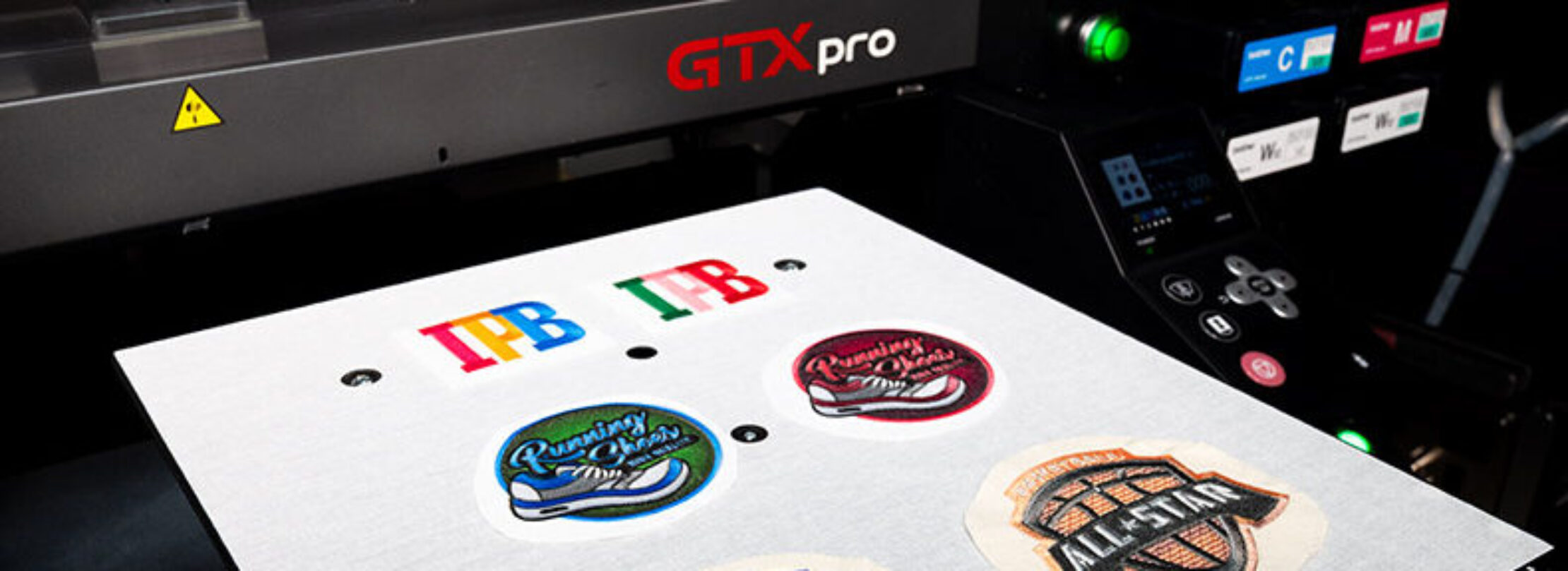
At the FESPA Global Print Expo 2025, Industrial Solutions partner Brother showcased its new DTE solution. What is “Direct to Embroidery,” and what impact could this technology have on textile finishing?
It’s no coincidence that embroidery on clothing and promotional items is considered one of the highest-quality finishing techniques. The designs must first undergo a labor-intensive preparation process for embroidery (“punching”). Depending on the number of colors in the design, countless spools of thread are then required for the embroidery machine. This is the only way to bring the designer’s vision to life.
That’s why one of the most exciting new products at this year’s trade show in Berlin could be found at the Brother booth, 2.2-C30: a DTE (Direct-to-Embroidery) system. Simply put, it combines Brother DTG printers from the GTX-Pro and GTX600 series with a camera system and Brother’s Acculine X software. This software detects where the design is located on the printing plate. This makes it possible to print onto the pre-embroidered design with absolute registration accuracy and a resolution of 1,200 dpi.
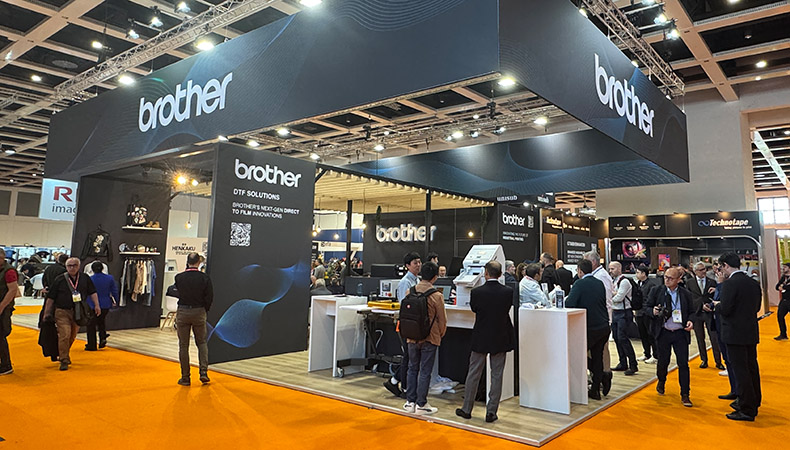 At the FESPA Global Print Expo in Berlin in May 2025, Brother DTE showcased its products to a broad audience of industry professionals. Photo: Sonja Angerer
Benefits of DTE for Textile Finishing
The advantages of DTE are obvious. This is because the embroidery design only needs to be executed in a single color. The graphic gets its color from inkjet printing. This not only saves textile finishers the cost of purchasing many spools of thread, but also allows them to reduce their inventory and, ultimately, minimize waste.
This is because conventional embroidery shops often have to dispose of a large number of spools of thread—for example, because the color is no longer needed, or because the remaining length is too short to be put to good use. This costs a lot of money and harms the environment.
With the help of DTE, it’s also possible to create photorealistic designs that were previously virtually impossible to produce via embroidery or, given the effort involved, simply not cost-effective. Folker Stachetzki, Head of Marketing at Brother Internationale Industriemaschinen GmbH, explains: “With DTE, creative professionals can get the most out of the combination of printing and embroidery. Solid fills are no longer necessary because they are printed. Embroidery is used only for elements that complement the print visually or tactilely—such as outlines or 3D details.” A positive side effect: punching also becomes easier when only one thread color needs to be considered.
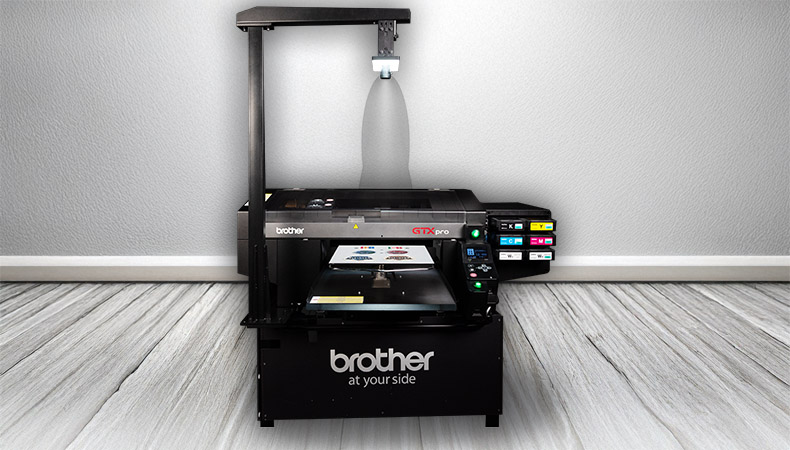 The DTE camera system can be installed on Brother GTX Pro and GTX600 printers. Photo: Brother
Inkjet and Embroidery
The thread spool problem in textile finishing with embroidery is nothing new. Customized designs and careful preparation of the embroidery file have so far ensured that detailed graphics can be produced using as few colors as possible.
A few years ago, Coloreel —a Swedish company founded in 2019—also introduced a solution for single- or multi-head embroidery machines from well-known manufacturers such as Tajima, Ricoma, and ZSK.
This machine prints a light-colored yarn made from recycled polyester in four colors using an inkjet printing module equipped with Ricoh printheads. The yarn is dried immediately and excess ink is removed, so that it enters the embroidery head fully dyed. The color combination is determined based on the design file so that the colored graphic is embroidered. The principle is therefore similar to that used for self-patterned sock yarn.
However, Coloreel’s technology had not yet gained a foothold in the market, so the company filed for bankruptcy in mid-2024 and relaunched in October 2024 as Coloreel AB under new ownership.
In comparison, Brother’s DTE technology is less complex and less prone to errors. For example, there are no issues with broken threads. In addition to printers, the Brother Group also manufactures professional embroidery machines, which are another key component in the process.
However, Stachetzki emphasizes that professional machines from any manufacturer can be used for DTE embroidery: “There are no restrictions, although we naturally prefer that Brother embroidery machines be used.”
The maximum embroidery area possible with the DTE method is determined primarily by the embroidery machine used. The Brother printers in the GTX Pro series have a maximum print size of 40.6 x 53.3 cm, or 61 x 61 cm for the GTX600.
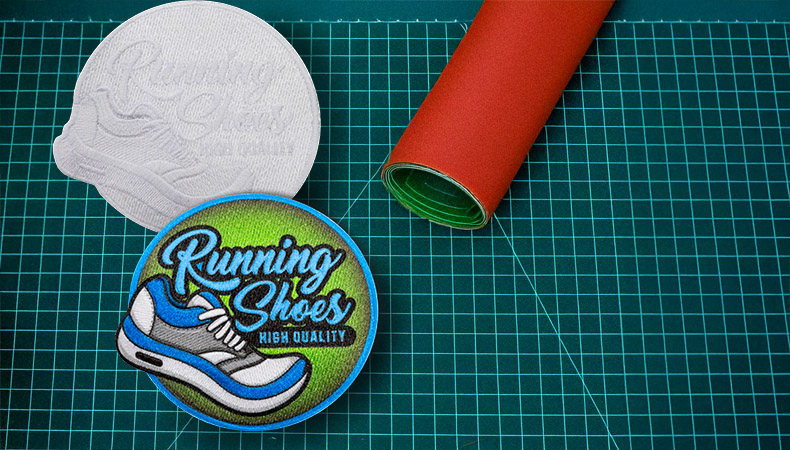 Top: Embroidered patch, not yet colored; bottom: Finished patch printed with DTE. Photo: Brother.
The Impact of DTE on Textile Finishing
The Brother DTE system is scheduled to launch in Europe in August 2025. It is planned as a complete system comprising a camera module, software, and a printer. However, Stachetzki promises that companies that already own a compatible Brother GTX printer will also be able to purchase the add-on modules individually. Depending on the configuration, the price for a DTE system is expected to start at well under €10,000. This makes the technology attractive even for smaller companies or print service providers that do not yet have a significant embroidery business.
DTE opens up new creative possibilities for companies that purchase embroidered clothing or place embroidery orders. This is because the DTE process is suitable for all materials that can be printed on using Brother printers.
However, some substrates—such as polyester and other synthetic yarns—require pretreatment. Stachetzki comments: “We are already in talks with market-leading yarn manufacturers who will soon be offering yarn that has been pretreated for DTE.”
But according to Stachetzki, DTE technology will bring about changes not only technically but also in terms of design. “DTE will look somewhat different from conventionally embroidered designs. We see this as a creative advantage. The combination of printing and embroidery offers new design possibilities that cannot be achieved with purely embroidered or printed designs. The look is more modern, richer in detail, and particularly appeals to fashion- and design-conscious target groups. It is a deliberate evolution of classic textile finishing, not a replacement.”