
In the printing industry, the long-held belief was that whoever had the best hardware would win. But the tide has turned—today, data and its processing are at least as important. This overview explains why that is the case and what it means for printing service providers.
From Printer to Data Center
In the past, new printing presses were the focus of industry events. Investments in digital front ends (DFEs) or workflow solutions, on the other hand, were rarely celebrated—even though they are often just as expensive.
It’s actually strange that software is often valued less than hardware in the printing industry. After all, the meteoric rise of digital printing and the rapid digitization of the graphic arts industry would not have been possible without computers and custom software.
Digital printing is always particularly useful in these situations
- where it handles tasks that simply aren’t possible with analog printing, such as personalization or variable data
- where it can be used more efficiently than analog methods, such as for small print runs in four-color printing.
Accurate data has always played an important role in this context. This has become even more pronounced in recent years. That’s because today’s economy, which is heavily focused on the Internet, provides brand owners and companies with vast amounts of data of all kinds.
In addition, consumers have become accustomed to a more personalized form of communication and to customized consumer goods. This is good news for digital printing. Variable data printing (VDP), in particular, is therefore becoming increasingly important.
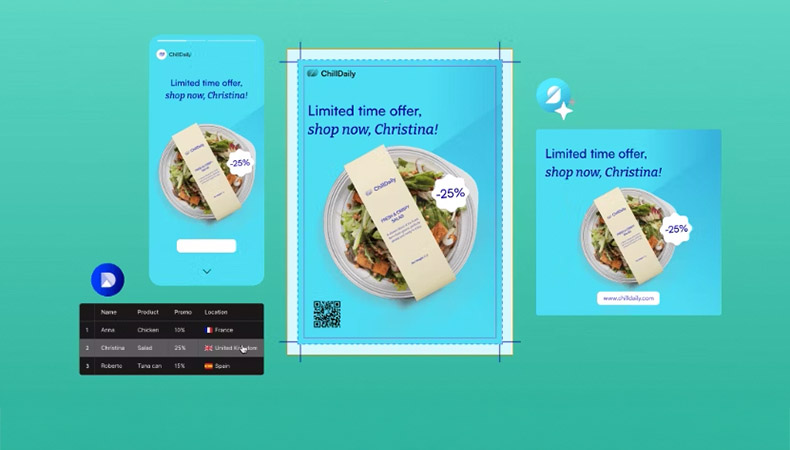
With Chili Publish Chili GraFX, brand owners can easily customize their print data for different countries and target audiences. Photo: Screenshot.
Variable Data Printing, Explained in a Nutshell
VDP was initially used primarily for mailings and transactional printing, such as credit card statements. Today, almost all digital printing applications can be combined with variable data. These can include, for example, posters and point-of-sale materials, as well as promotional gifts, packaging, marketing materials, or custom-designed textiles.
In VDP, a design is combined with a database that provides custom content such as text, images, or logos. This allows thousands of unique prints to be produced without any human intervention.
Because the prepress process for printing variable data is significantly simplified, these materials can be produced particularly quickly and cost-effectively. However, this requires high-performance printers, the appropriate software, and a fast IT infrastructure.
Because VDP allows them to be optimized specifically for the recipient, these types of prints are particularly effective. That is why printing service providers can charge higher prices for their products.
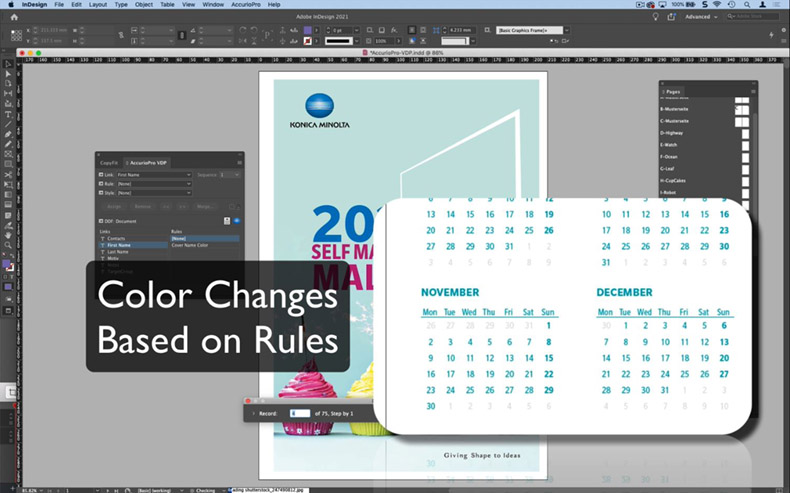
Konica Minolta’s AcccurioPro Variable Data Module is versatile and easy to use. Photo: Konica Minolta.
Special Features of VDP Files
In the early years of digital printing, print service providers often had to make do with “open” files, such as those from Adobe InDesign. Today, submitting print-ready data as a PDF is largely the standard.
There are many different versions of PDFs. The currently recommended format for data transfer in print is PDF/X-6, which is based on PDF 2.0 and offers significantly expanded functionality. PDF/VT-3 was introduced at the end of 2020 and is also based on PDF/X-6. The standard was developed specifically for variable data and has largely replaced older file formats such as AFP, IJPDS, and PPML. However, these are still in use to some extent in direct mail.
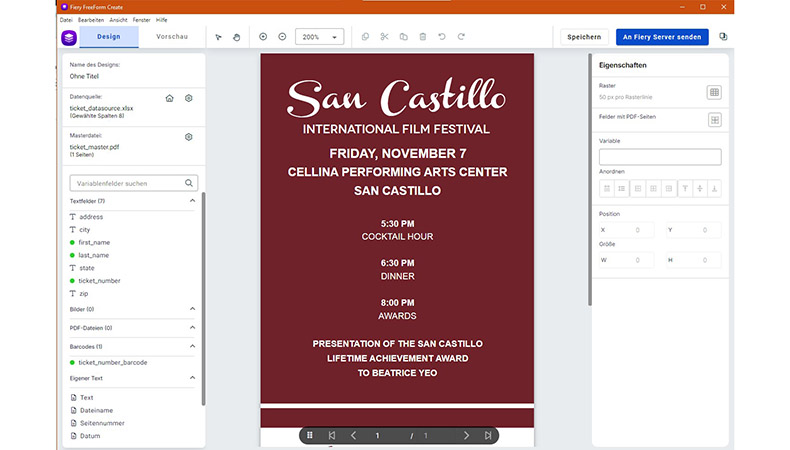
Fiery Freeform Create can be used to create files for variable data printing (VDP). Photo: Screenshot
The new PDF/X-6 and PDF/VT-3 standards offer significant advantages over their predecessors. They support modern color spaces, improved transparency handling, and enhanced metadata capabilities that are essential for complex production workflows.
A metadata framework is already implemented in the PDF/VT format. This allows you to define automation tasks typical of direct mail campaigns—such as specifications for distributing print pages across different machines or for addressing. These can already be used in the corresponding workflows.
However, PDF Processing Steps (ISO 19593-1) is much more relevant for large-format printing. This standard is intended to standardize the implementation of cut and crease lines, as well as finishing steps such as hot foil stamping. This would eliminate the often misleading naming of PDF layers used to identify specific processing operations. The standard, published in 2018, has already been adopted by Esko and Global Graphics, among others.
There are several ways to create designs using VDP functionality. Examples include Dynamic VDP, an Adobe Illustrator plug-in from Esko; AccurioPro Variable Data from Konica Minolta; the CHILI GraFx Suite (formerly Chili Publish Suite); and Fiery Freeform Create.
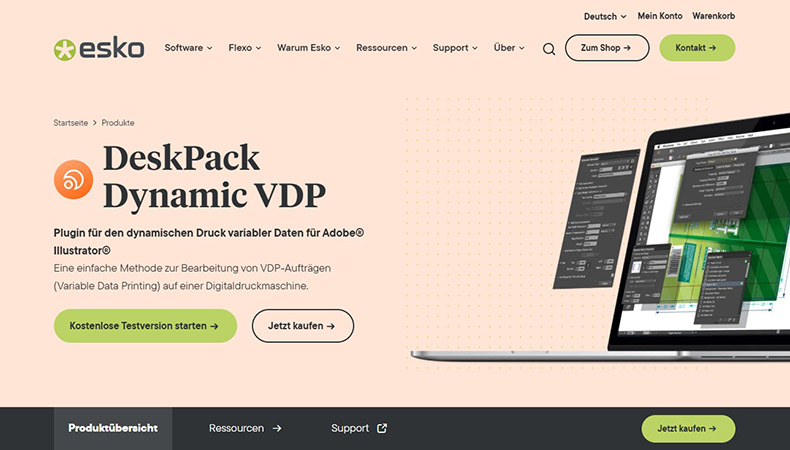
Dynamic VDP is an Adobe Illustrator plug-in from Esko. Photo: Screenshot
Challenges in Submitting Print Files
The quality of customer data has always been a challenge for print service providers. In recent years, the situation has actually gotten worse. This is because many campaigns focus on digital channels. As a result, designers have less and less experience creating print-ready files.
When it comes to variable data printing, perfect print data is perhaps even more important than for other jobs. Because large quantities are often printed in a single run, even small errors can lead to long delays or a large amount of waste. That’s why it’s all the more important for print service providers to educate their customers on what matters when submitting files.
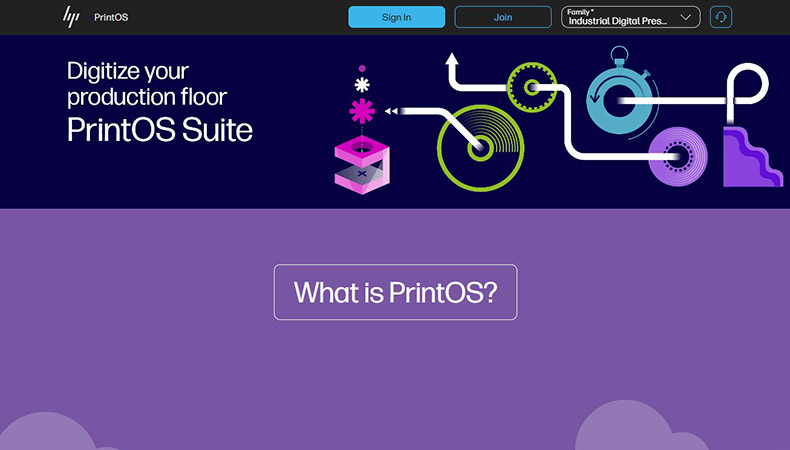
HP PrintOS is an example of cloud-based software designed specifically for print data. Photo: Screenshot
From the Printing Press to the Ecosystem
Printing press manufacturers recognized the growing importance of data in the printing industry as early as the 2010s and developed their own software products for workflow and data preparation. Prominent examples include HP with PrintOS and Agfa with Asanti and PrintTune.
In some cases, formerly independent software providers were also integrated into the process. For example, in April 2024, the Durst Group announced the acquisition of Callas, a prepress and PDF specialist. The goal is to create an open and interconnected software platform for the printing industry.
The cloud is playing an increasingly important role in this context. For example, Chili Publish—now known as CHILI GraFx —has continuously refined its platform and positioned itself as a cloud-based solution for creative automation.
How can printing service providers adapt to the new world of data?
Since data handling and automated workflows are becoming increasingly important to the profitability of printing service providers, it seems advisable to ramp up investment in these areas.
It will also be just as important in the future to train employees and customers on how to handle data. This is because, especially with variable data printing, any file that isn’t delivered in perfect condition will have an even greater impact on profits than usual.
Recent acquisitions and consolidations in the industry show that software and workflow solutions are increasingly viewed as strategic assets. Printing service providers should therefore not only invest in hardware but also continuously expand their expertise in data processing and optimization.
The implementation of new PDF standards, such as PDF/X-6 and PDF/VT-3, should be viewed as an investment in the company’s future viability. At the same time, it is important to develop training programs for employees and customers in order to take full advantage of these new technologies.