
Paper-based honeycomb panels are also becoming increasingly popular in digital printing and the advertising industry. However, there are significant differences between the products. Here’s what print service providers need to know about them.
Whether for exhibitions, trade show booths, or point-of-sale materials, many print buyers are looking for environmentally friendly alternatives to lightweight foam and aluminum composite panels. This is because manufacturing them from fossil-based raw materials requires a great deal of energy. Furthermore, these panels are often difficult to recycle in a way that allows them to be turned back into high-quality plastic products.
Paper-based honeycomb panels are made from cellulose, a renewable raw material. They can be printed on or laminated directly. After use, they can simply be disposed of with paper waste. Since effective paper recycling systems are already well established throughout Europe, disposal is easy and inexpensive. In some cases, well-sorted paper waste can even generate a small revenue.
As a result, retail chains, as well as museums and trade show organizers, are showing increased interest in honeycomb panels. Accordingly, there are many suppliers. Two main technologies are used to manufacture honeycomb panels:
- Sine wave (e.g., ReBoard, Swedboard)
- Honeycomb (e.g., Smurfit Kappa, Beelite).
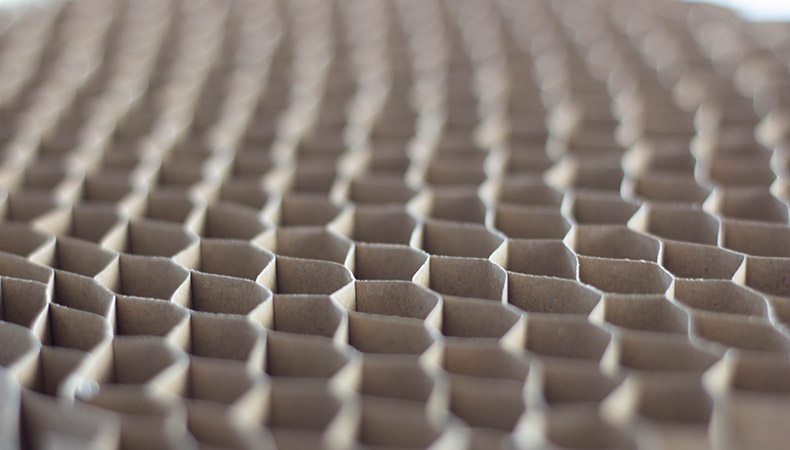 Close-up: Honeycomb structure in honeycomb panels. Photo: Swap (Saxony) GmbH
Manufacture of Honeycomb Panels
Unlike corrugated cardboard, honeycomb panels are not made from cellulose but from paper. “Of course, we make sure to use only paper from FSC-certified sources in Germany or Europe,” says Uwe Müller, authorized signatory and head of marketing and sales at SWAP (Sachsen) GmbH. Founded in 1996, the company manufactures honeycomb panels using both the sine wave and honeycomb processes.
Since around 2018, the company has also been serving the “visual communications” sector, primarily with specialty products and custom-made honeycomb panels. Other markets include furniture manufacturing, the construction industry, specialized industrial packaging, and the automotive sector.
Sine Wave for Honeycomb Panels
With Sinus technology, the paper is first processed into corrugated cardboard and then glued together layer by layer to form a block. The block is rotated 90 degrees, allowing for the cutting of sturdy “slices” of the sheet material. Thicknesses starting at approximately 5 mm are possible. Depending on the application, the honeycomb structure can then be laminated with paper of various qualities and colors. For printing applications, white, coated paper containing recycled content is typically used.
The panels can be easily processed using both screen printing and direct-to-substrate digital printing with UV-curable inks. “If a customer wants to use water-based, eco-solvent, or latex inks, the top layer may need to be optimized with a coating. However, there is hardly any demand for this, so we omit it as a standard practice. After all, that also saves on chemicals,” says Dr. Udo Gassner, managing director of Swap (Sachsen) GmbH in Frankenberg.
Honeycomb Technology for Honeycomb Panels
To make honeycomb panels, several rolls of paper are cut into strips, coated with adhesive dots, bonded together to form a composite, and then expanded before lamination. For technical reasons, honeycomb panels are generally at least one centimeter thick.
As with sinusoidal wave technology, the face paper determines the applications for which the honeycomb panel is suitable. SWAP Sachsen customers typically use them for digital printing, but the panels can also be used for screen or offset printing.
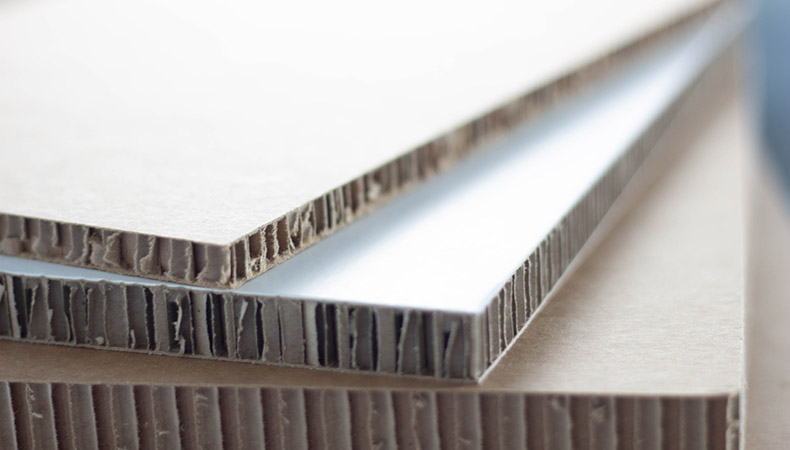 Stack of honeycomb panels made using sine-wave technology. Photo: Swap (Saxony) GmbH
The Right Honeycomb Panel for Your Application
In general, honeycomb panels are very versatile for printing applications. They can be printed on directly or laminated with self-adhesive film. Regardless of the manufacturing technology, however, they are suitable only for dry indoor environments or limited use in covered outdoor areas.
Honeycomb panels are relatively lightweight yet offer high compressive strength and flexural rigidity. Despite their high stability, they are easy to process, for example using digital cutting tables. Motorized knives or milling cutters are typically used for this purpose. The material can also be punched. Laser cutting is possible for thinner panels as well. However, the material may need to be covered in some cases to prevent soot marks.
Compared to honeycomb technology, sinusoidal-wave panels are slightly heavier because they contain more material. This also provides greater rigidity, even at thin thicknesses. The cells in the sinusoidal-wave design are slightly smaller, which makes them easier to mill and results in neater-looking open edges.
Since honeycomb material is usually more than one centimeter thick, it is better suited for display stands, back panels, and other applications that need to look substantial while remaining lightweight. Thin sine-wave material is also well-suited for ceiling hangers and signs.
As paper-based materials, both types of honeycomb panels are well-suited for the circular economy, since the fibers can be reused multiple times before the quality of the recycled material declines too significantly. When total weight and volume are taken into account, the proportion of ink is low even in panels printed over their entire surface. As a result, deinking is not a problem either.
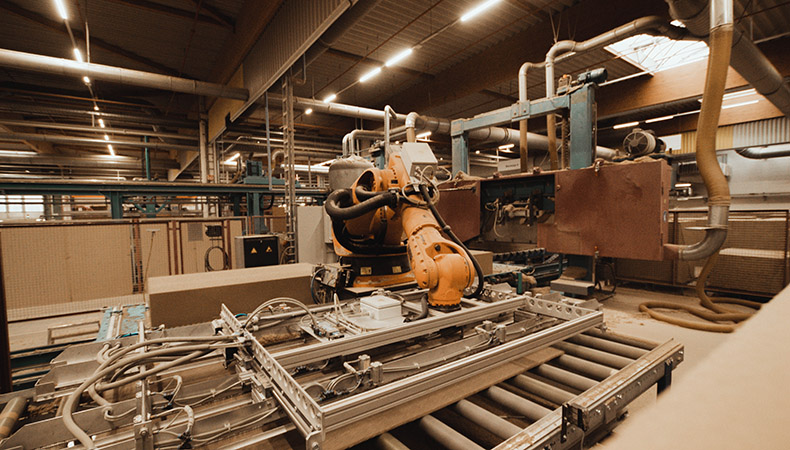 A look at honeycomb panel production at Swap (Sachsen) GmbH. Photo: Swap (Sachsen) GmbH
The Future of Honeycomb Panels
“We would like to see honeycomb panels used even more frequently in visual communications in the future. They are a good alternative to petroleum-based printing substrates and can be processed very well using machines commonly found in the advertising industry,” says Uwe Müller.
“When used indoors, honeycomb panels can effectively replace lightweight foam and composite panels without advertisers having to compromise on performance. Thanks to the low disposal costs, this can even save money,” adds Dr. Gassner.
Swap (Sachsen) GmbH primarily serves its Viscom customers in Germany through direct sales, while international sales are handled by distributors. So it’s quite possible that the trucks from Frankenberg will soon be seen more often outside print shops throughout Germany…