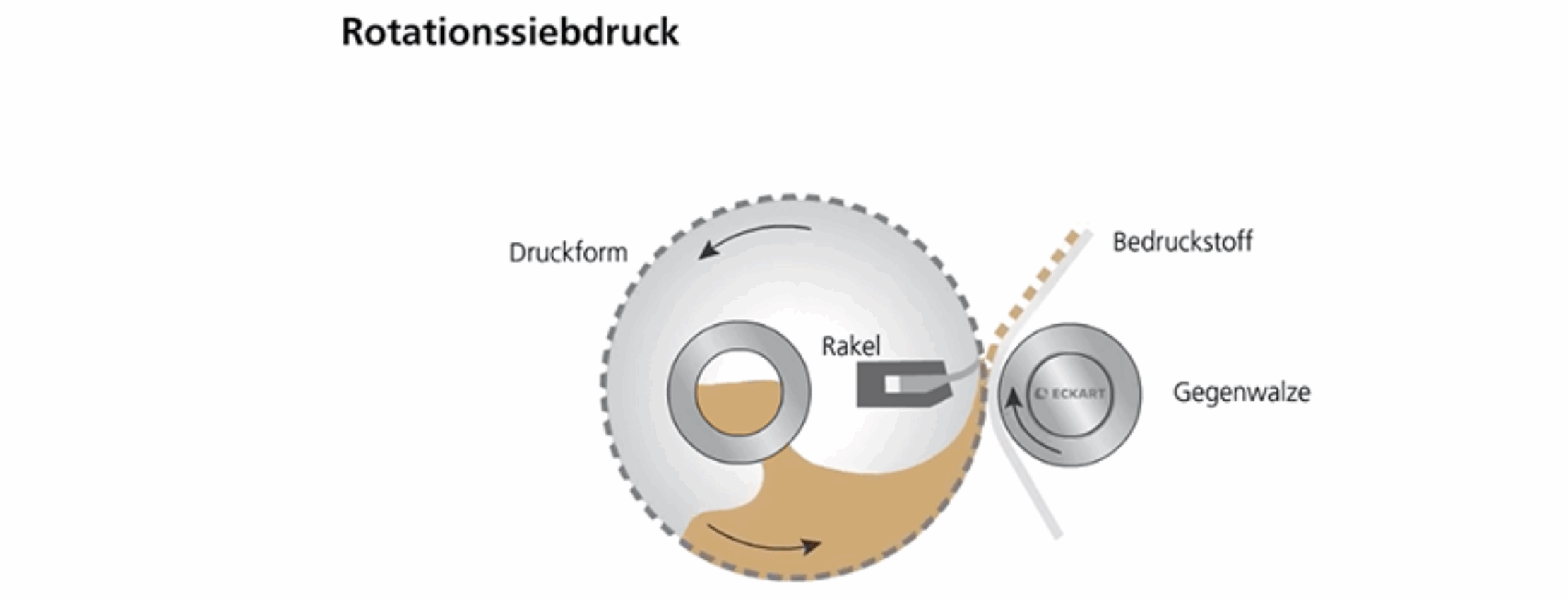
Rotary screen printing—also known as rotary screen printing—is a tried-and-true process in the textile industry that, despite increasing digitalization, is by no means obsolete. On the contrary: It remains indispensable for many applications. This article explores the technology, its significance in the industry, and its future prospects.
How Rotary Screen Printing Works
In rotary screen printing, the printing form—a cylindrical screen—is continuously moved across the material to be printed. Specialized machines for manufacturing screens for rotary screen printing, such as the Lüscher JetScreen! LT Round Series , can expose printing plates up to 3.50 m in length.
Inside the cylinder is a squeegee system that forces the ink through the screen onto the substrate. This process is particularly efficient for long print runs and high-volume production.
A key concept in rotary screen printing is the repeat: The repeating pattern must match the circumference of the printing cylinder exactly to enable seamless designs. For this reason, repeat patterns for rotary screen printing are often developed by specialized designers. This ensures that uniform print images are produced without visible transitions. They can be produced in various color combinations using the same printing template. This makes them ideal for home textiles such as bedding or curtains.
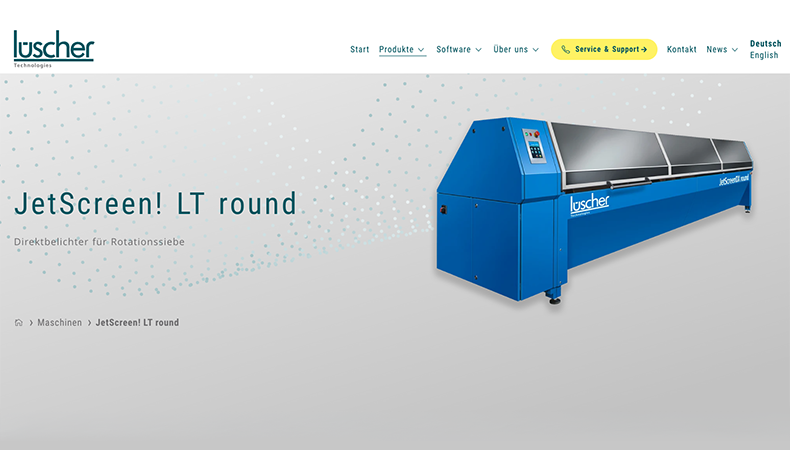 Lüscher offers a direct-to-screen exposure unit designed specifically for rotary screen printing. Photo: Screenshot
The Importance of Rotary Screen Printing in the Textile Industry
Rotary screen printing is particularly common in industrial textile production. It is used in:
- Home textiles: bedding, curtains, tablecloths
- Clothing: T-shirts, athletic wear, work clothes
- Technical textiles: Upholstery and padding in the automotive industry, medical textiles
- Decorative fabrics: upholstery, tapestries, textile wallpaper
Rotary screen printing offers very high production speeds. Since the screens can be produced at resolutions of up to 2,400 dpi, photorealistic images, complex designs, and subtle color gradients are possible. It also results in very high ink density and opacity. As a result, the print remains vibrant for a long time, even under difficult conditions.
The selection of suitable inks for rotary screen printing on textiles on the global market is diverse and tailored to specific fibers and pretreatment methods. For large print runs, the price per square meter for textiles printed using rotary screen printing is therefore significantly lower than that of digital printing.
For small print runs, however, the high costs of preparing the artwork and setting up the rotary screen printing press have a significant impact. Small runs in textile printing are therefore not cost-effective with this method. Production consumes significantly more water, energy, and chemicals than digital printing processes. It also cannot be converted to new designs as quickly. Furthermore, due to technical limitations, non-repeating patterns are not possible.
Market Trends in Rotary Screen Printing
Although digital textile printing is growing rapidly and taking market share, rotary screen printing remains stable in certain segments. This is because demand for high-volume, cost-effective printing processes persists—especially in the mass production of fast fashion and fast furnishings/fast decor.
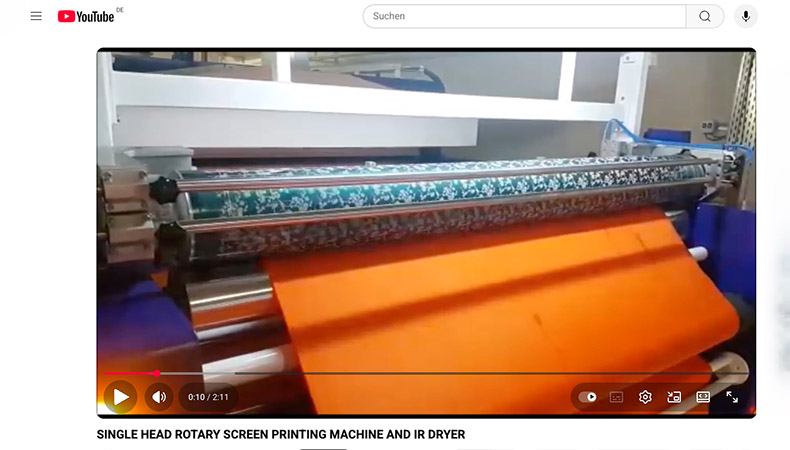
The largest market is the Asia-Pacific region, particularly China, where most rotary screen printing machines are installed. In Europe, Turkey is a major hub for the textile industry; Turkish companies such as Muratex therefore offer rotary screen printing machines (video). There are also specialized users in Central Europe, particularly in the fields of technical textiles and high-quality home textiles.
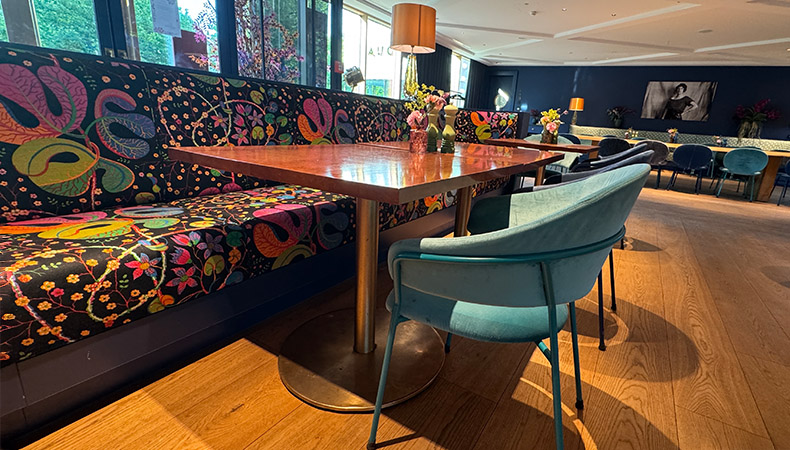 Furniture fabrics produced using rotary screen printing can be identified by their repeat pattern. Photo: S. Angerer
Conclusion: Is rotary screen printing still relevant today?
It’s fair to say that rotary screen printing, although an established process, is by no means outdated even today—it still has its place. However, there are some limitations.
Rotary screen printing remains relevant for:
- Mass production
- Technical Applications
- Designs with heavy ink coverage
In this context, rotary screen printing offers impressive print quality, efficiency, and durability, making it indispensable for many applications.
In areas characterized by a wide variety of designs, small print runs, or frequent changes, digital printing is far superior. In addition, small, digitally produced runs of textiles custom-made for customers are more environmentally friendly, as they consume fewer resources and less energy.
In addition, global supply chains have been significantly disrupted in recent years by the pandemic, armed conflicts, and customs barriers. It remains to be seen whether this will also have an impact on the location of rotary screen printing machines for textile printing. It is quite possible that, in the future, some production of low-cost textiles in large runs will return to Southern and Southeastern Europe.