Printing can do much more than you might think: modern printing technologies can also be used in completely different fields. For example, in product development, fashion, or research. FESPA showcases three exciting examples that are sure to surprise you.
Printed Speaker, Extra-Lightweight
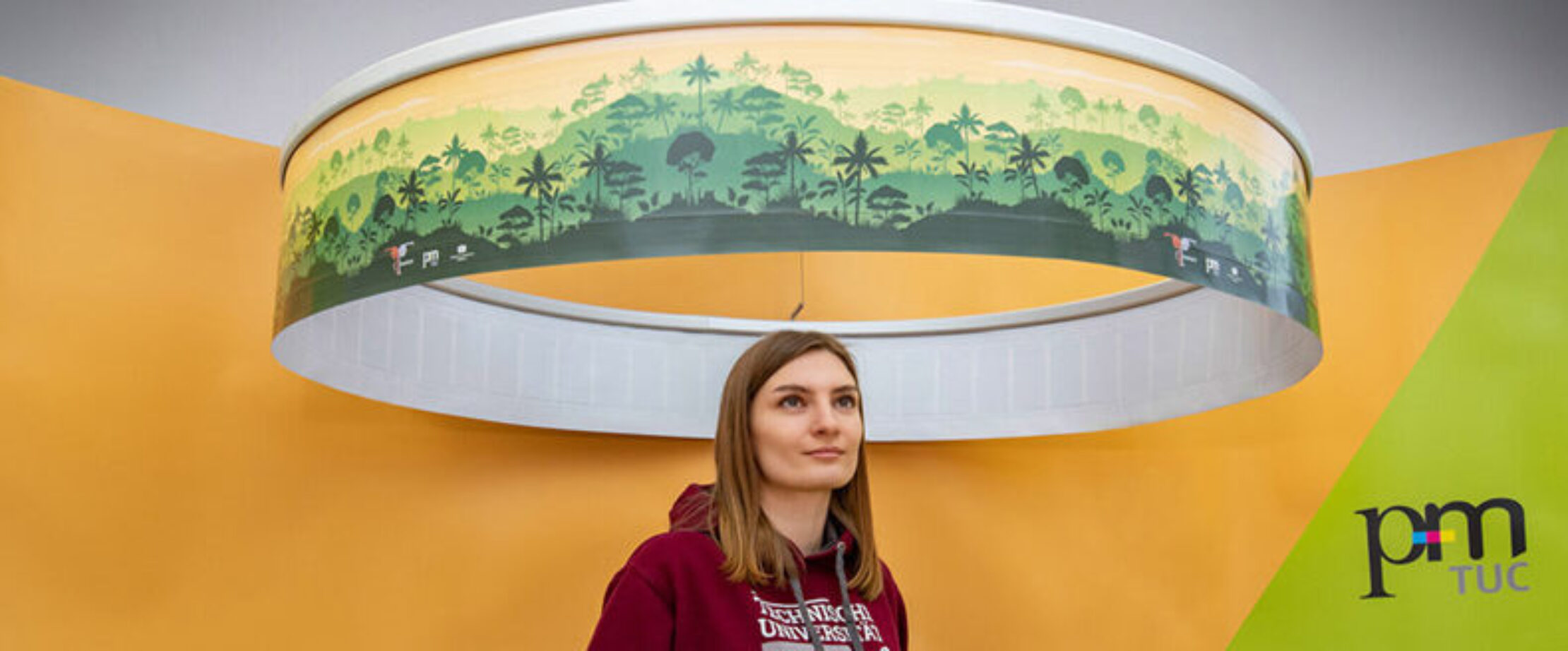
“Congratulations on graduating from high school”—with this 13 x 7.5 m greeting card, Chemnitz University of Technology (TU) recruited first-year students in June 2025. It’s no coincidence that the university relies on large-format digital printing for its communications. As early as 2021, researchers there—as part of a project group led by Georg C. Schmidt at the Institute for Print and Media Technology—developed a new type of loudspeaker. “T-Paper” consists almost entirely of two layers of offset paper printed with conductive material. Between the layers of paper is an additional piezoelectric active layer, whose movements cause the thin, laminated sheets to vibrate. This produces a loud and clear sound.
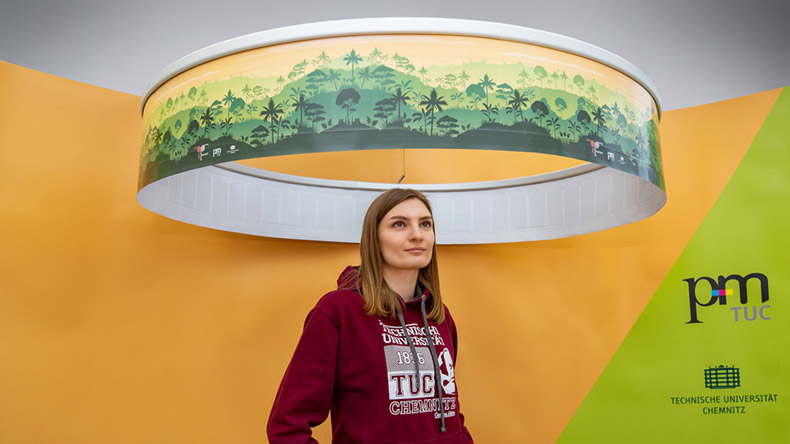
“T-Ring” printed loudspeakers developed by the project group led by Georg C. Schmidt at the Institute for Print and Media Technology at Chemnitz University of Technology. Photo: Jacob Müller
Multiple segments can be assembled into what is known as a “T-ring.” In an experiment, the scientists succeeded in creating a four-meter-long panel from 56 individual speakers. Since the structure is 90% paper, the speaker ring weighs only about 150 grams. It can also be printed in color on both sides, as the electronics are safely protected between the sheets (video).

Since 2022, Epson and Japanese designer Yuima Nakazato have been working together to make the fashion industry more environmentally friendly and personalized. Photo: Screenshot
Digital printing makes fashion sustainable and unique
Since 2022, Epson and Japanese designer Yuima Nakazato have been working together to make the fashion industry more environmentally friendly and personalized. Digital textile printing plays a key role in this effort, as it allows designs to be printed directly onto fabrics—quickly, precisely, and in a way that conserves resources.
At the 2025 Paris Haute Couture Fashion Week, Nakazato presented his “Fade” collection, which was inspired by a trip to the eastern Sahara. The landscape photos taken there were transferred directly onto delicate fabrics such as silk organza using Epson printing technology. Using AI-powered image editing and print preparation, the designs were optimally adapted to the delicate fabric and the roll width of the digital printers.
In January 2025, Nakazato also unveiled a shoe collection made from non-woven materials for the first time in Paris. The collection featured a felt-like substrate produced using Epson’s Dry Fiber technology. The sheets made of recycled cotton fibers were also digitally printed to enhance the color.
Visitors to the major exhibition at Tokyo City View (video) in February 2025 were able to purchase these limited-edition, one-of-a-kind pieces. Epson sponsored the exhibition and also showcased its printing and recycling technologies there.
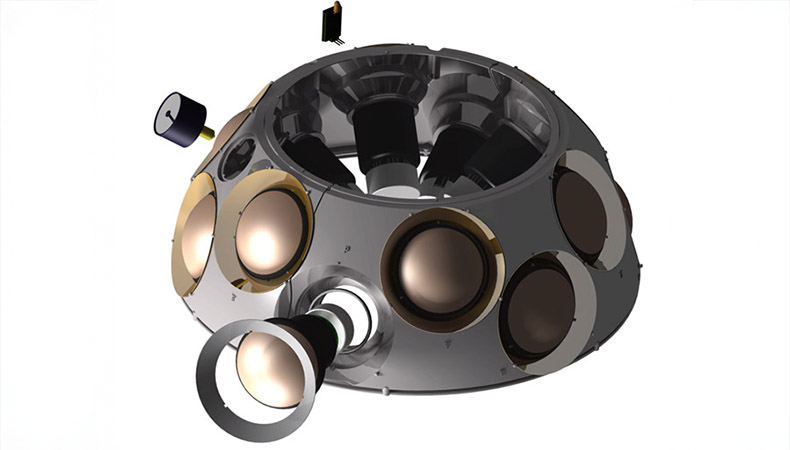
Schematic 3D rendering of a DOM unit (upper section). Graphic: Weerg.
3D Printing Helps Science
The KM3NeT research project, initiated by the Netherlands Institute for Subatomic Physics (Nikhef), aims to detect neutrinos—subatomic particles that are extremely difficult to detect—using an undersea telescope.
The so-called Cubic Kilometer Neutrino Telescope will be installed in the Mediterranean Sea and is expected to consist of approximately 6,000 digital optical modules (DOMs) by the end of the 2020s. These spherical sensor housings are about the size of a soccer ball. They were specifically designed for use in the deep sea and contain highly sensitive optical and electronic components for detecting neutrino interactions.
After extensive testing with various providers, Nikhef decided in 2021 to use the Italian online 3D printing service provider Weerg to print the outer shell. Weerg operates Europe’s largest installation of HP Multi Jet Fusion systems.For the project, spherical housings with a diameter of 380 mm are being manufactured. This is exactly the maximum part size that can be produced using the HP Multi Jet Fusion 5210.
The material used is nylon PA12, an engineering plastic with outstanding mechanical properties, particularly high stiffness and chemical resistance. At Weerg, the components are additionally given a black surface finish to meet visibility and corrosion protection requirements under extreme environmental conditions.
Now that the first 3D-printed DOMs were installed in the deep sea off Toulon back in 2021, project leaders believe the project is on the right track.
3D printing plays a crucial role in this success, as it enables cost-effective mass production of the DOMs while maintaining consistent quality. The first success was reported as early as 2023, when an exceptionally high-energy neutrino was detected using the measuring station.
Conclusion: Print remains surprisingly relevant
These three projects show that printing is not only versatile but also full of surprises. With creativity and modern technology, applications are being developed that go far beyond what anyone could have imagined in the past.
The examples mentioned are certainly spectacular. These are not business areas that a service provider could easily enter. Nevertheless, they are inspiring. Printing technology is extremely versatile, allowing it to be used in a wide variety of markets. When combined with the boundless creativity in the industry, the possibilities of printing are virtually limitless…