Car wrapping is a popular way to customize and protect vehicles. However, designers who don’t have much experience with car wrapping often struggle to come up with a suitable design. Here’s how to create the perfect car wrap.
A search for the hashtag #Carwrapping yields over 1.4 million posts on Instagram alone. So it’s safe to say that car wrapping is the most popular application in digital printing and advertising technology—not only among business customers but increasingly among private customers as well.
Graphic designers therefore often receive requests to create vehicle designs for their clients or to adapt existing designs. While there are true-to-scale templates available for most common vehicle types—such as those from CC Vision—that make the work considerably easier, and Adobe Stock and Shutterstock offer mockups for presentations, there are still a few things designers should keep in mind.
Choosing the Right Films
Choosing the right film is crucial to the success of a car wrap. That’s why designers should work with their clients to determine which substrates to use as early as the briefing stage. This is because there are different types of films, each with its own advantages, disadvantages, and price points.
Vinyl Films (PVC): These are the most commonly used films for car wrapping. They are durable, flexible, and available in a wide variety of colors and textures. Vinyl films are ideal for complex designs and offer good UV resistance. There is also white, printable PVC film specifically designed for car wrapping. It is usually printed digitally with eco-solvent inks, though UV-curable and latex inks are also used.
High-quality cast vinyl film is required for highly curved surfaces, beading, or rivets, as well as for long-lasting wraps. Companies such as 3M, Avery, and Orafol offer these products. Full-vehicle wraps are usually done using cast films.
For short-term, partial applications on slightly curved surfaces on vehicles, however, less expensive, calendered PVC film is often sufficient. Rolled films for automotive graphics are available from Grafityp, for example .
(Thermoplastic) polyurethane films (TPU / PU): These films are an alternative to PVC and are particularly resistant to scratches and chemicals. However, they are more expensive than vinyl films and require more careful application. They are available, for example, from CYS Europe.
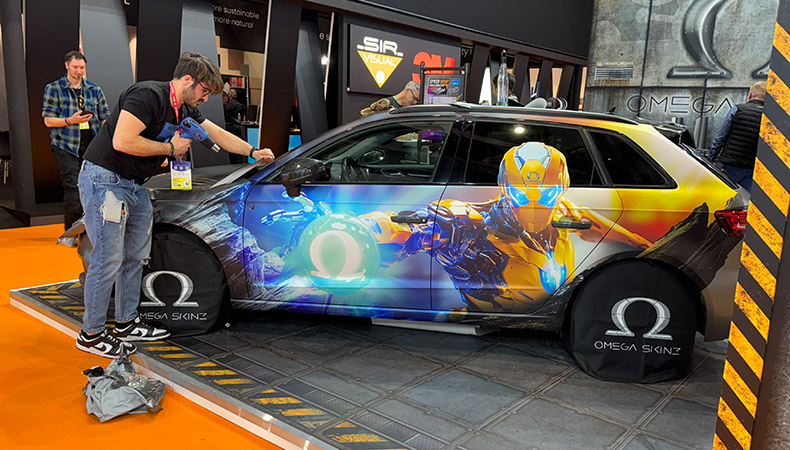 Rear side windows may be covered with stickers as long as they do not obstruct visibility. Photo: Sonja Angerer
Environmental Impact of Car Wrapping
When selecting films, designers should also consider their environmental impact. Some films, particularly those made of PVC, contain harmful chemicals that can be released during production and disposal.
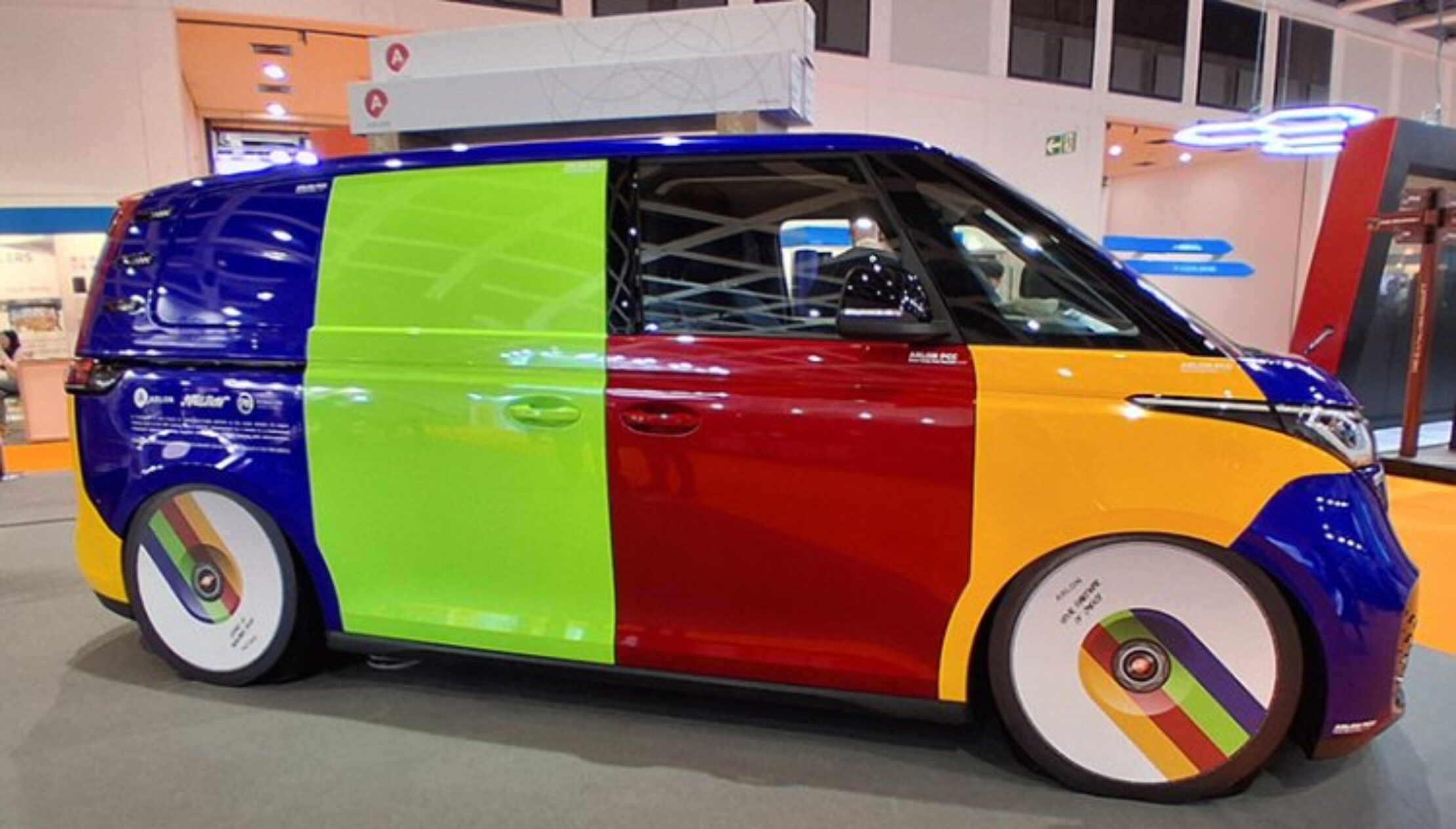
Many manufacturers now offer alternatives to PVC film, such as Hexis or Arlon. Designers should explicitly recommend these products when bringing their designs to life. This is because, in many cases, end customers are not yet even aware of these new, less environmentally harmful products for vehicle graphics.
But designers can do even more to make car wrapping more sustainable. After all, the design often determines how much actually needs to be printed and how much waste is generated during the application process. Often, through a skillful combination of colored, effect, and printed film, it’s possible to create great designs while significantly reducing material usage.
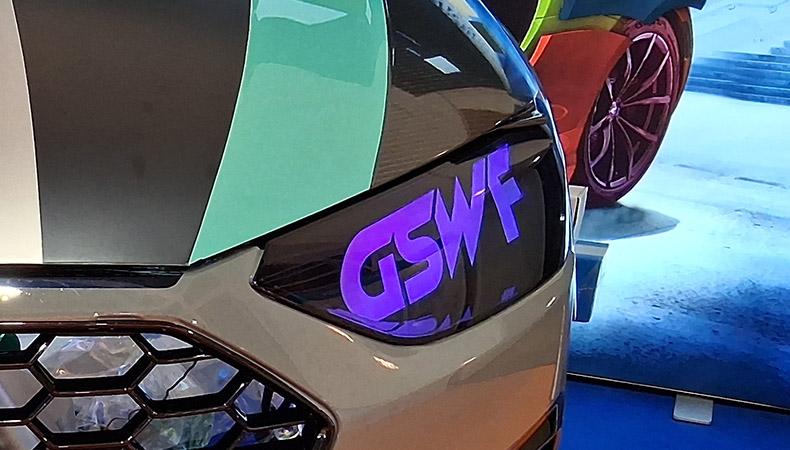 Not allowed in Germany: Decorated lights. Photo: Sonja Angerer
Communication Goal and Motivation
In most cases, business customers specify during the initial briefing what communication goal they want to achieve with the vehicle wrap. Just as with a poster, it makes sense to focus on a core message that’s easy to grasp. This is because the vehicle will often be visible to potential customers for only a few seconds.
That’s why it’s especially important to focus on at least one channel for establishing contact. This could be a vanity phone number or a catchy name for a website. For vehicle wraps commissioned by end customers, designers should also insist on a briefing.
Legal and Technical Framework for Vehicle Wrapping
Both private and commercial customers interested in car wrapping are often unaware of the technical and legal restrictions involved. However, these restrictions can significantly impact the design. To ensure a perfect car wrap, the designer should therefore inform the customer of these important points in advance.
For example, a design that is too reminiscent of the police or fire department can certainly be problematic. However, highly reflective, glow-in-the-dark, or non-reflective (Vanta Black) surfaces are also generally not accepted. In Germany, it is strictly prohibited to apply decals to lights and license plates.
In general, however, vehicle wraps are not typically subject to registration requirements in Germany. That said, the wrapped vehicle must still comply with the Road Traffic Regulations. Therefore, the front and side windows may not be wrapped at all, and the rear side windows may only be wrapped in a way that does not impair visibility. For rear windows, one-way vision film with 50% light transmission is permitted.
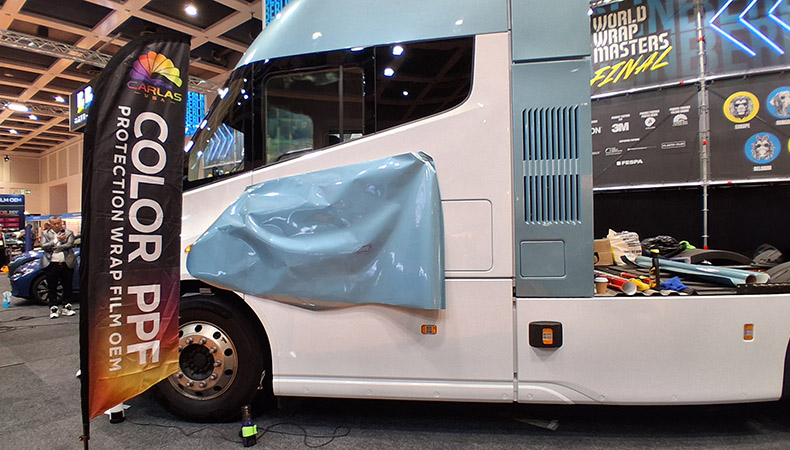 When the designer recommends the right film, it helps ensure that vehicle wraps have the least possible impact on the environment. Photo: Sonja Angerer
Choosing the Right Design for the Perfect Car Wrap
In addition to legal and technical requirements, a high-quality image is the most important factor for a successful wrap. It must be high-resolution; that is, at the size it will eventually be printed, it should have a resolution of at least 210 ppi.
At the same time, the design must complement the vehicle’s shape. This may mean, for example, that key graphic elements should not be placed on strongly curved surfaces such as fenders, as this can result in distortion or changes in size.
Decal pieces that extend over doors can also be problematic. The decals must be applied with extreme precision to ensure that no misalignment is visible. Nevertheless, an unintentionally comical effect can occur if, for example, only half a face is visible when a sliding door is open.
With a good design, such problems can be avoided from the outset. When designing car wraps, however, it often makes sense to do more than just create a digital preview on the vehicle template. The design should be tested by applying a test wrap to a critical area. This allows you to adjust and optimize it before wasting expensive wrap material and labor time on the final application.
Planning for the Perfect Car Wrap
With the right materials and techniques, even less experienced designers can create impressive car wraps. However, it’s important to work with the client to develop a detailed briefing that takes legal and technical constraints into account from the outset. This also ensures that the project is successful and uses as few resources as possible.