Illuminated pylons combine technical precision with high advertising impact and open up new revenue streams for digital print shops—provided they have the right expertise and partners. This article offers practical insights to help businesses transition from being purely print shops to becoming full-service providers of outdoor signage.
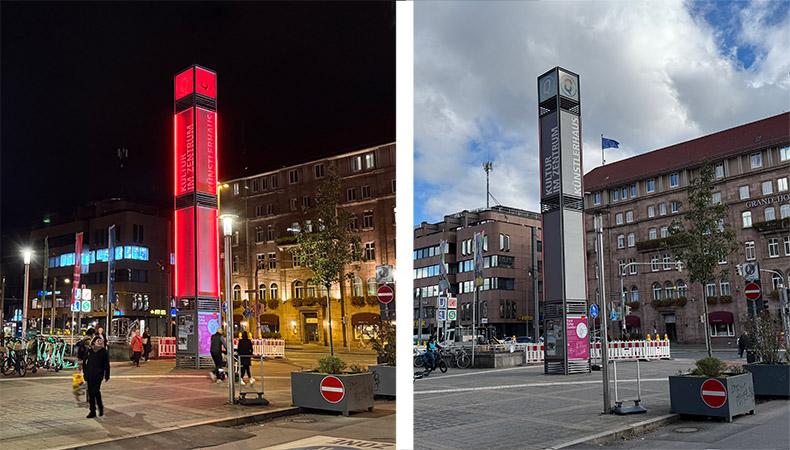
Everyone has seen them at some point: lighted pylons—freestanding, illuminated advertising structures. They are considered the pinnacle of outdoor advertising, as they often involve complex projects. That’s why they’re often found in front of renowned cultural institutions, banks, and commercial buildings. After all, they combine brand visibility with wayfinding: you can often see them from a distance.
This article explains the types, areas of application, and production requirements for digital printing companies, as well as the necessary partners and legal framework for profitably tapping into the illuminated pylon market.
Illuminated Pylons in Advertising Technology
Lighted pylons straddle the intersection of architecture, technology, and print. Their significance in advertising stems from the combination of height, lighting, and visual impact. They are visible from great distances and thus have an enormous advertising impact, especially in urban areas.
Illuminated pylons range from standardized modular pylons to oval and curved profile designs, all the way to custom-made special constructions with large acrylic fronts. Technically, the systems differ in their lighting principles, such as homogeneous backlit surfaces with translucent films or modular frames with interchangeable displays.
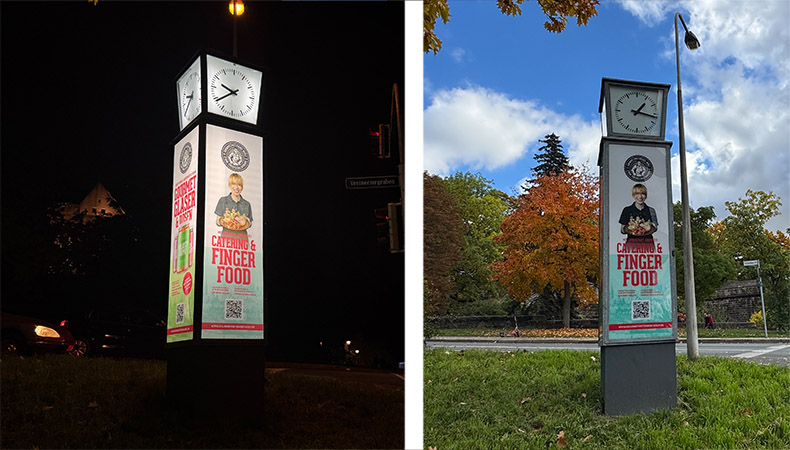
Variations include single-sided or double-sided illuminated columns, multi-part, combinable modules for rotating campaigns, and integrated pillars with additional elements such as digital screens or directional signs. In many cases, the transition to outdoor digital signage is seamless.
Applications for Lighted Pylons
Illuminated pylons are used wherever wayfinding and brand recognition are needed, such as at the entrances to commercial properties, in parking lots, at gas stations, in shopping centers, and at convention centers. Illuminated pylons are also frequently used for cultural promotions at museums and event venues.
The functional requirements range from weather resistance and vandal-proof design to uniform light distribution and good visibility at night. In addition, light towers must comply with urban planning and, in many cases, traffic regulations regarding shape, color, and luminance. As a result, installing a light tower is usually a complex project in which printing companies and signage firms must rely on partners and subcontractors.
What do service providers need to keep in mind when constructing illuminated pylons?
As a general rule, the manufacture and installation of illuminated signs in Germany has once again been a trade requiring a master craftsman’s certificate since early 2020. Anyone who wants to install an illuminated pylon as a general contractor therefore needs a full-time employee with a master craftsman’s certificate in the sign and illuminated advertising trade. In addition, it is often impossible to do without the assistance of structural engineers, construction companies, metal fabricators, electrical engineers, and installation companies.
Like all large advertising structures, illuminated pylons must be approved, typically by the building authority. Details can vary significantly from place to place. A site plan, construction plan, and structural stability analyses are always required. In principle, these can be provided by any structural engineer. However, it is advisable to find a partner who already has experience with similar advertising structures.
If the illuminated pylon is located on public land, a special-use permit must also be applied for. In the vicinity of particularly prominent areas and structures, a historic preservation assessment may also be required.
Large illuminated pylons require a solid foundation and a stable supporting structure. Construction companies and metal fabricators usually collaborate on these projects. Electricians or neon sign manufacturers create connections that comply with standards and document that they meet the requirements specified in the project plan—for example, regarding water and dust resistance. Installation teams ensure safe final assembly.
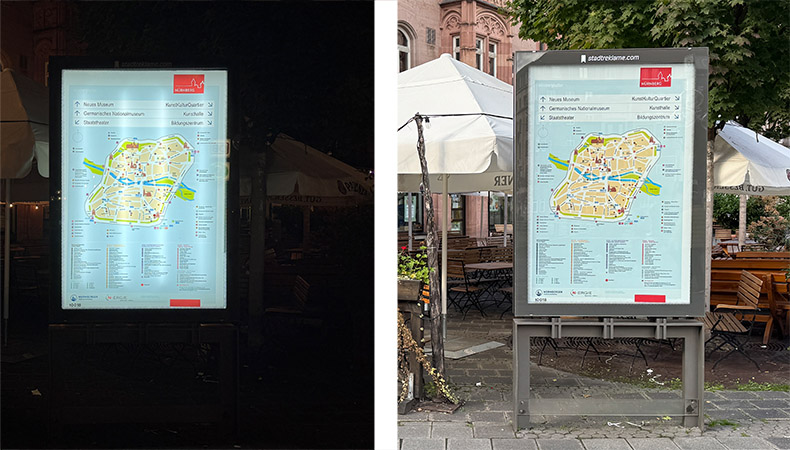
Printing Requirements for Lighted Pylons
Lighted pylons also place special demands on printing service providers, for example in terms of color matching and management, as well as printing and post-press processing.
Print production for illuminated pylons requires expertise specific to the materials and lighting conditions. For example, backlit media must be printed using calibrated settings for LED backlighting, because colors are perceived differently when backlit than when viewed in direct light. Color management and light proofing under both daylight and low-light conditions are essential to ensure color stability and optimal lighting effects.
Further processing—such as laminating onto acrylic, precision contour cutting, milling out service openings, and applying adhesive surfaces or screw hole markings—requires precise production data and suitable machinery.
Large, fragile items must be packed in a way that protects them from impact and the elements to prevent damage during transport.
If the printing company acts as the general contractor for the entire project, its employees should already have experience managing and executing complex orders—from post-project cost analysis to insurance matters. After all, the administrative burden is also considerable. Documented acceptance reports, material data sheets, and test reports are required to clearly resolve liability and warranty issues.
In Germany, the statutory warranty period for delivered goods is generally two years. For construction- or manufacturing-related work on a structure—which often includes freestanding, permanently installed light towers—a five-year liability for defects applies under construction law.
Manufacturer or supplier warranties for components such as LED modules, power supplies, or acrylic fronts are often provided separately and may be shorter or longer. Depending on the manufacturer, typical warranty periods for LED components range from two to five years.
In addition to warranty issues for an illuminated pylon project, provisions should also be made regarding the terms and conditions for ongoing maintenance, necessary repairs, and the installation of new designs.
Economic Outlook for Digital Print Shops
The addition of illuminated pylons to their portfolio gives digital printing companies the opportunity to offer comprehensive solutions. This can significantly increase revenue and margins compared to standard printing jobs. Illuminated pylons represent an attractive area of expansion within the signage industry. They combine design and technical expertise, thereby also raising the profile of the various trades involved.
Building a network of trusted partners can be time-consuming, but it is ultimately necessary to minimize risks and establish reliable supply chains.
Entry-level opportunities include the sale of standardized modules, such as those from Leuchtreklame-Shop or Werbepylon.de, as well as collaboration with specialized providers like Lauschner Lichtwerbung. This can later lead to an expansion into custom-built structures. Investments in employee training and appropriate machinery are essential for this.
Learn more about signage