Regarded as one of the stand-out growth and diversification markets in recent years, Rob Fletcher takes a closer look at printed corrugated packaging and considers the machinery required to succeed in this expansive sector.
Corrugated packaging has moved beyond its traditional role as a purely protective layer. Now, it sits at the centre of brand storytelling, supply chain efficiency and sustainability strategy — making it one of the most dynamic growth areas in print.
As retail channels fragment and e-commerce volumes continue to reshape distribution, demand is rising for corrugated packaging that is not only functional, but visually impactful and operationally smart. For print companies, this shift represents a significant opportunity, but also a technical and commercial challenge.
Success in printed corrugated packaging requires more than simply scaling up format size; it demands the right combination of hardware, substrates, ink, workflow control and finishing capability, alongside a clear understanding of what brand owners and converters now expect from print partners.
In this feature, several leading manufacturers offer their opinion on how to make the most out of opportunities in this sector.
Evolving landscape
Virginie Dubois-Guignard, marketing and communication Manager for corrugated board at Bobst, said while the manufacturer sees modest but steady growth in the printed corrugated market, the landscape is continually evolving.
“Consolidation and mergers among major groups continue to guide the sector, which means independent sheet plants need to be more agile than ever to meet customer demands,” Dubois-Guignard said. “Speed, flexibility and the ability to handle shorter runs efficiently are becoming key differentiators.
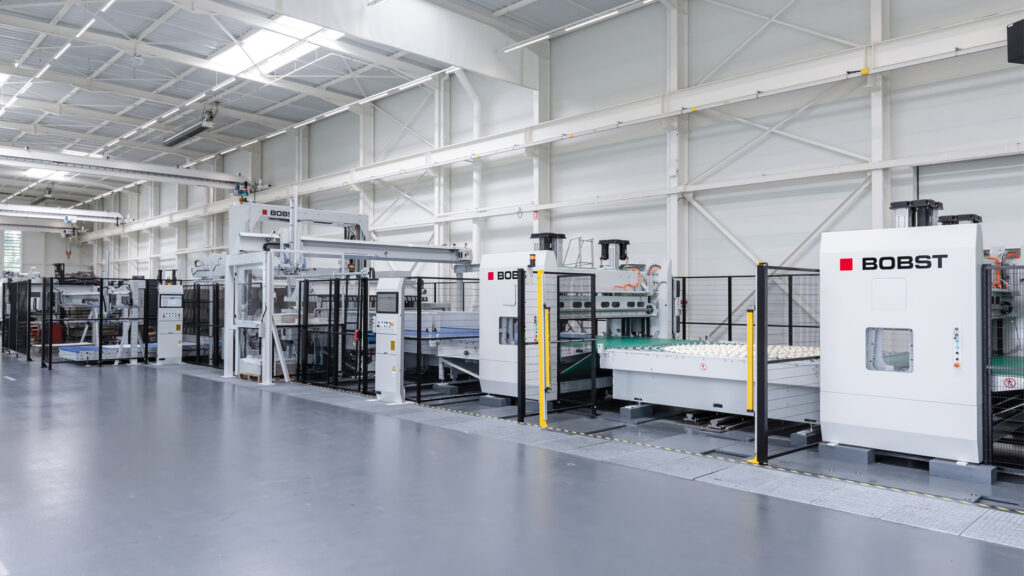
Bobst said its MASTERDRO delivers high-productivity converting with sophisticated automation
“At Bobst, our vision centres on connectivity, digitalisation, automation and sustainability, and these pillars are directly relevant to helping corrugated printers stay ahead and capture growth in this competitive market.”
So, what sort of work should printers be looking to target in this sector? Dubois-Guignard pointed to shelf-ready packaging (SRP) as a “significant opportunity”, saying it remains firmly embedded within retail strategies, and with competitive supermarket chains expanding, particularly discount retailers growing their footprint, demand for high-quality, efficiently produced shelf-ready solutions is only increasing.
“Converters that can offer fast turnaround, consistent quality and cost-effective production will be very well positioned,” Dubois-Guignard said. “Alongside this, it’s also worth watching how brand owners’ requirements are changing; they want greater consistency across the supply chain, which plays to the strengths of converters investing in connected, automated workflows.”
As to how Bobst can help, Dubois-Guignard picked out several solutions from its portfolio of hardware. For independent sheet plants looking for a strong entry point, the NOVAFFG and VISIONFFG machines are new to the market and have developed with flexibility in mind.
At the advanced end, Dubois-Guignard said the MASTERFLEX-HD+ and MASTERDRO deliver high-productivity converting with sophisticated automation, while also ensuring exceptionally high print quality.
“Importantly, we provide true end-to-end solutions, including robotics integration, supporting our customers’ move towards fully connected, automated production lines, which is at the heart of the BOBST vision to shape the future of the packaging world,” Dubois-Guignard added.
Changing purchasing behaviours
Also offering advice is Daniel Velema, managing director of Koenig & Bauer Durst, who said while the standard brown box market is mature, printed corrugated packaging remains a high-growth segment.
“We’re seeing a major shift in how brand owners view shipping containers as opportunities to communicate and connect with consumers,” he said. “Industry analysts project the global corrugated packaging market will grow at a CAGR of 3.8% to 5.5% through 2030, with digital printing within this segment outpacing that at rates exceeding 6%. The latter obviously from a low base.
“Beyond the macro numbers, growth is also being driven by trends such as plastic-to-paper substitution, retail-ready packaging, and the rise of middle-class consumers in markets like India and Indonesia who are changing purchasing behaviours.”
As for target areas, Velema said this starts with finding a “clear USP” and that printers should focus on applications where they can deliver genuine value, and where they can also remove complexity for brands and retailers.
“The winners will be those that offer solutions, not just sheets,” Velema said. “In the end, it is about making a sustainable profit. Players offering an all-encompassing solution remove a headache for the retailers, and brands will be the winners.”
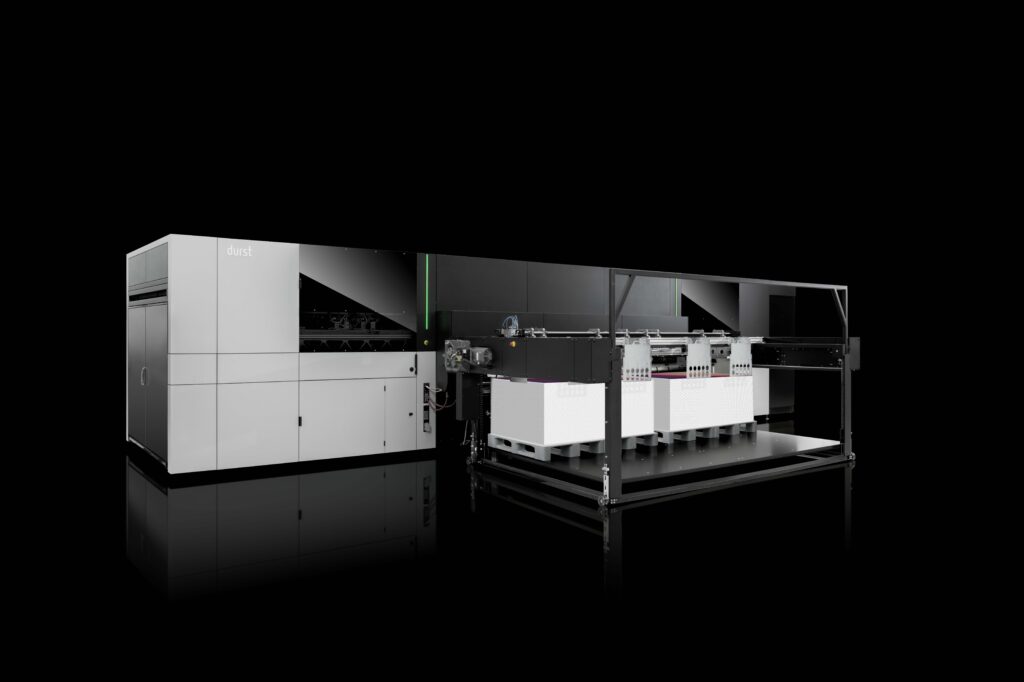
On this, Velema turned attention to hardware solutions from Koenig & Bauer Durst, focusing on the Delta SPC 130 Automatic. The manufacturer’s flagship device, the machine is typically configured with six colours, digital white, and digital primer, plus automated feeding and stacking.
However, he added that the press is “only an enabler”, saying that the company wants to understand our customers’ businesses and make them successful. He added: “As such, we work closely with operational managers, shift leaders, operators and technicians on the floor to fine-tune workflows and maximise profitability.”
Major opportunities
Also commenting is Christian Harder, chief sales officer of the larger Durst Group, who said printed corrugated packaging continues to offer significant growth potential, driven by several long-term structural trends.
“E-commerce remains a strong driver, but growth is not limited to shipping boxes,” he said. “We also see major opportunities in point-of-sale and point-of-purchase displays, where high-impact graphics and short campaign cycles are essential. Corrugated is increasingly used for retail displays, promotional stands, and branded in-store solutions – all of which demand excellent print quality and flexibility.
Durst said its P5 SMP is designed for industrial corrugated production.
“In addition, there’s an ongoing shift not only from flexo but also from offset printing toward digital solutions. Brands are looking for shorter runs, faster time-to-market, versioning, and customisation. The ability to personalise packaging – for regional campaigns, seasonal promotions, or targeted marketing – is becoming a key differentiator. Corrugated packaging today is no longer just protective; it is both protective and promotional. That creates clear growth opportunities for printers who can combine quality, flexibility, and efficiency.”
Going into further detail, Harder said that printers should focus on value-added applications, rather than purely price-driven high-volume commodity work. This includes short and medium production runs, seasonal and promotional campaigns, customised and versioned packaging, e-commerce-ready packaging, high-quality retail-ready packaging, POS/POP displays, and sustainable plastic-replacement solutions.
“The real opportunity lies where flexibility, speed, and premium print quality matter. Printers that can offer fast turnaround, customisation, colour consistency, and production reliability will gain a competitive edge,” he added.
In terms of hardware from Durst, Harder said at entry level, solutions like the P5 X provide an “ideal gateway” into high-quality corrugated production. He said that the system offers versatility, reliability, and strong ROI, making it perfect for companies entering digital corrugated printing or expanding their capabilities with a flexible, multi-application platform.
At the advanced end, the P5 350 HSi and P5 SMP are designed for industrial corrugated production, with advanced automation features in place to support productivity. These include automated corrugated handling, digital substrate alignment, different levels of automation options, feeder and stacker configurations, and robotics integration for maximum efficiency.
“As supply chains accelerate and marketing cycles shorten, converters need solutions that deliver speed, consistency, and flexibility,” Harder said. “The future lies in combining digital technology, automation, sustainability, and customisation.”
Harder’s closing comments should offer plenty of food for thought. Yes, there is still room for growth in this market but print companies should be clever as to how they go about taking on new work. For further insight into the latest developments in the sector, visit the Corrugated 2026, Visitors can purchase super early bird tickets for €30 until 23 March by using the code FESG601.
Discover Corrugated 2026
Coming to Fira Barcelona, 19-22 May 2026, Corrugated is a new dedicated exhibition with curated conference content aimed at corrugated converters. The four-day exhibition will be a lively display aimed at manufacturers of decorative and graphical corrugated packaging - where they can explore a varied showcase of the latest product solutions from leading brands covering machinery suppliers, services, software, consumables, printing equipment, converting solutions and plant logistics. Visitors can purchase super early bird tickets for €30 until 23 March by using the code FESG601.