Visit Corrugated 2026
The new trade show “Corrugated,” featuring curated conference content aimed at corrugated cardboard processors, will take place at Fira Barcelona from May 19 to 22, 2026.
When it comes to pharmaceutical products, the rule is: This isn’t just any kind of advertising. Printing service providers looking to expand in this lucrative sector need to keep a few things in mind.
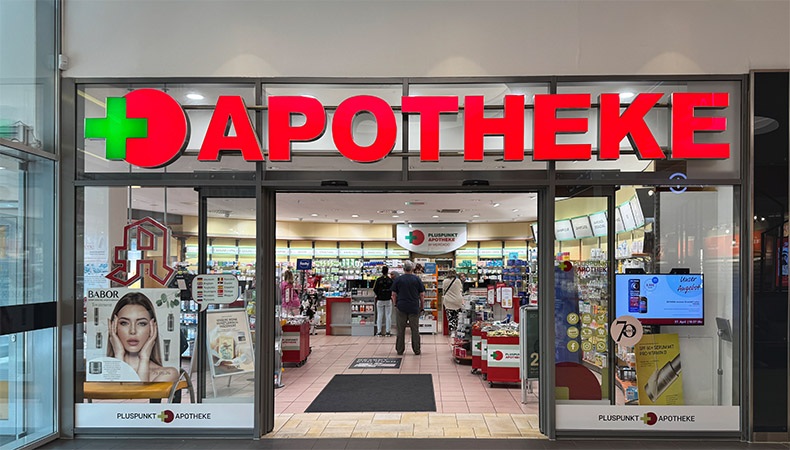
Digital printing processes have become firmly established in the POS sector in recent years. Short run lengths, a wide variety of options, and personalized content are clear advantages of digital printing.
However, as soon as pharmaceuticals or medical devices are advertised, the situation changes significantly. Print service providers in Germany and the European Union are subject not only to technical requirements but also to legal ones. These go well beyond traditional point-of-sale (POS) advertising. This article focuses primarily on the legal situation in Germany. Companies operating across borders should therefore also familiarize themselves with local regulations.
The central legal basis for communication regarding all pharmaceutical products in Germany is the Law on the Advertising of Medicines (Heilmittelwerbegesetz, or HWG for short). It regulates the advertising of pharmaceuticals and medical devices, regardless of whether they are prescription or over-the-counter medications. Certain dietary supplements and technical products, such as smartwatches with health features, may also fall under this law. The goal is to prevent misleading or unsubstantiated claims in this sensitive area.
It is supplemented by the Unfair Competition Act as well as by European regulations, such as the EU Regulation on Medical Devices, known as the Medical Device Regulation.
Among other things, this regulation stipulates that advertising claims must always be consistent with a product’s approved intended use. Claims that go beyond this are considered impermissible. For printing companies, this means that not only does print quality matter, but so does the formal accuracy of the content. This is particularly relevant for printing service providers who create their own layout proposals or adapt data supplied by customers. After all, the cost-effective production of regionally or linguistically adapted versions of a design is one of the major advantages of digital printing processes.
However, having multiple versions—some of which may be in foreign languages—significantly increases the risk that required information will be omitted, misplaced, or reproduced incorrectly. This can have serious consequences for the client. Therefore, in such cases, the print run must be reprinted, resulting in substantial costs.
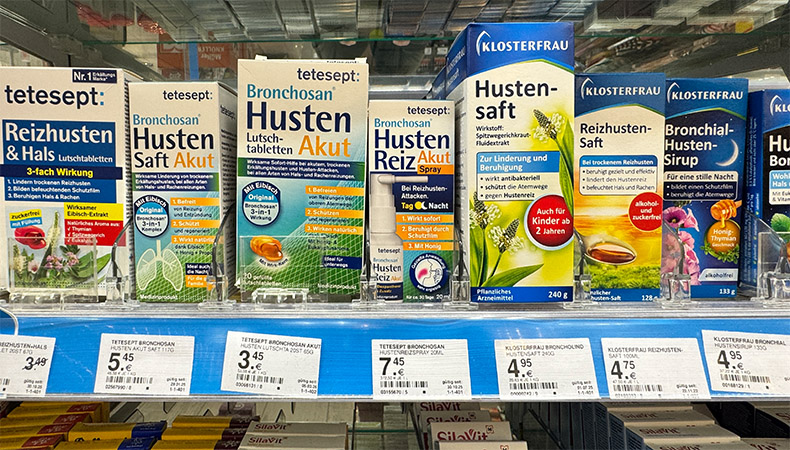
Point-of-sale (POS) advertising for medical products differs fundamentally from traditional consumer goods advertising. With POS displays for food or cosmetic products, the focus is on emotions and incentives to buy.
With pharmaceuticals, on the other hand, the focus is on trust, safety, and accurate information. Advertising must not make any claims of healing or raise expectations that cannot be medically substantiated. These content restrictions have a direct impact on design as well as on production processes.
Another difference lies in the target audience. POS materials in the pharmaceutical sector are aimed either at end consumers or at professionals such as doctors and pharmacists. This distinction is legally relevant.
In Germany, advertising prescription drugs directly to consumers is largely prohibited, even at the point of sale (POS). Printed materials may only provide factual information and must be directed at healthcare professionals. Print service providers should therefore clarify with the client the context in which a product will be used. This is especially important when the development of point-of-sale displays is also offered. This helps to avoid misunderstandings and mismatched expectations before costly mistakes occur.
Product information included as part of a point-of-sale (POS) display is a special case. Similar to a package insert in a medication box, there may be high requirements here in terms of readability, material selection, and process control. Faulty or misleading printed materials can not only damage a company’s reputation but, in some cases, also give rise to liability issues.
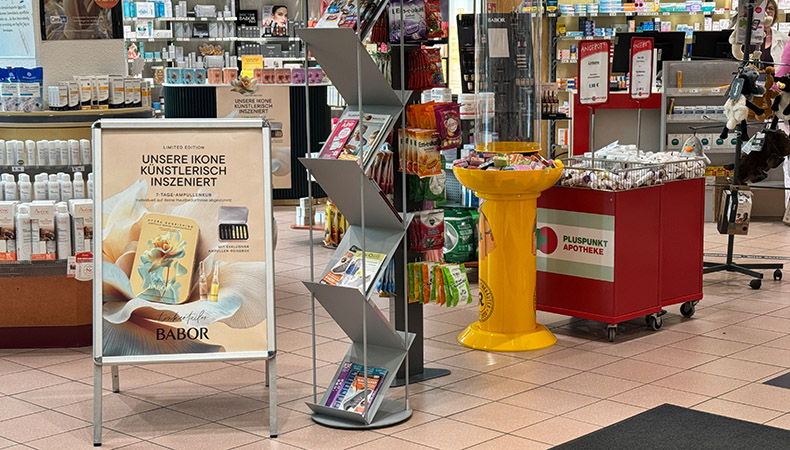
Digital printing offers clear advantages for pharmaceutical advertising, primarily due to its flexibility and speed. This makes it possible to run campaigns on short notice and with a high degree of customization. However, this very fact also increases the risk that errors or inaccuracies will slip through in the rush. Strict process and quality control are therefore essential.
In practice, this means that integrated workflows for the production of pharmaceutical advertising often need to be supplemented with additional verification steps. These include documented approval processes, version-controlled data management, and, ideally, automated verification mechanisms.
One aspect that is often underestimated is the specific location where POS advertising is used. From a legal standpoint, it makes a significant difference whether a pharmaceutical advertisement is placed in a drugstore, a retail store, or a pharmacy.
Pharmacies are subject to additional professional regulations that directly affect what advertising is permitted. Highly emotional designs or aggressive price promotions are generally not allowed. In addition, simply due to space constraints, most pharmacies only accept small-format counter displays for medication advertising. For printing service providers, this means that the same design cannot simply be used across different distribution channels.
In the retail sector for over-the-counter products—which can be sold in pharmacies as well as drugstores and health food stores—there is, in fact, relatively greater creative freedom compared to marketing communications for prescription drugs.
In this context, storefront posters or counter displays do not necessarily have to remain factual; rather, they may be used to create certain incentives to buy. However, even for over-the-counter pharmaceutical products, exaggerated or unsubstantiated claims about efficacy can pose legal problems.
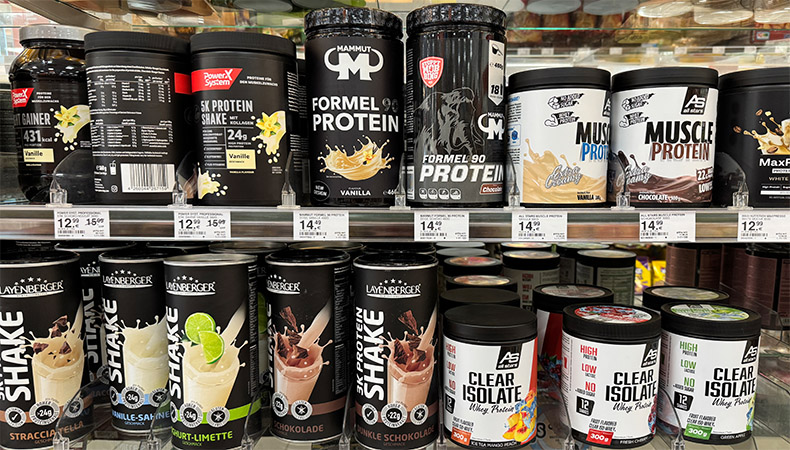
Digital printing for pharmaceutical advertising at the point of sale (POS) is a demanding niche market that combines technical expertise with an understanding of the legal framework. The actual print quality is just one of several relevant factors. Equally important are streamlined processes, legally compliant data-handling structures, and a fundamental understanding of the unique characteristics of medical products.
Print service providers looking to establish a presence in this market need patience, a willingness to invest, and close coordination with their clients. At the same time, this segment offers stable business relationships and a comparatively high barrier to entry. This provides significant protection against purely price-driven competition.

The new trade show “Corrugated,” featuring curated conference content aimed at corrugated cardboard processors, will take place at Fira Barcelona from May 19 to 22, 2026.