In digital printing, the concepts of personalization, customization, and one-of-a-kind items tailored to customer preferences are becoming increasingly important. They represent different degrees of product customization and have one thing in common: without digital technology, they would not be economically viable.
The terms “personalization,” “individualization,” and “customization” are often used imprecisely by buyers of printed products. For digital print shops, however, it is important to be fully aware of the differences between these concepts. Only then can they provide their customers with the best possible advice. This article discusses these concepts and their significance for the future of the industry.
Definition and Relevance for Digital Printing
Personalization refers to the process of tailoring a product to a specific person, usually by adding a name, photo, or other individual features. Digital printing companies and signage firms often offer personalized textiles, such as towels and T-shirts, with printed or embroidered names or portraits. However, mugs, bags, and other promotional items are also increasingly being personalized. Personalization is often automated and based on templates that are supplemented with variable data.
Personalization means not only adding personal details to an existing product, but also modifying its design. Colors, patterns, materials, or layouts can be customized according to the customer’s preferences. An example would be a custom-designed seat cushion or rug for a public lounge, whose color scheme and design are tailored to a company’s corporate identity. Decals featuring a logo and corporate colors on a company vehicle are also often considered a form of customization.
A one-of-a-kind item tailored to customer specifications (customization) refers to the complete development of a new product based on specific requirements. The result is a unique item that is not based on existing designs. In textile printing, this could be a large-format wall hanging for a hotel lobby, produced based on artwork provided by the customer. In large-format printing, for example, the complete cladding of a building would be a custom project, since it cannot be based on an existing product.
The three terms—personalization, customization, and one-of-a-kind items tailored to customer preferences—are not mutually exclusive. In digital printing companies, they also depend on how the company has structured its product catalog.
Personalization, customization, and one-of-a-kind items made to a customer’s specifications often overlap. Occasionally, they may also appear together in a single project. For example, if a company car is marked with the driver’s name or portrait, this constitutes personalization in addition to customization.
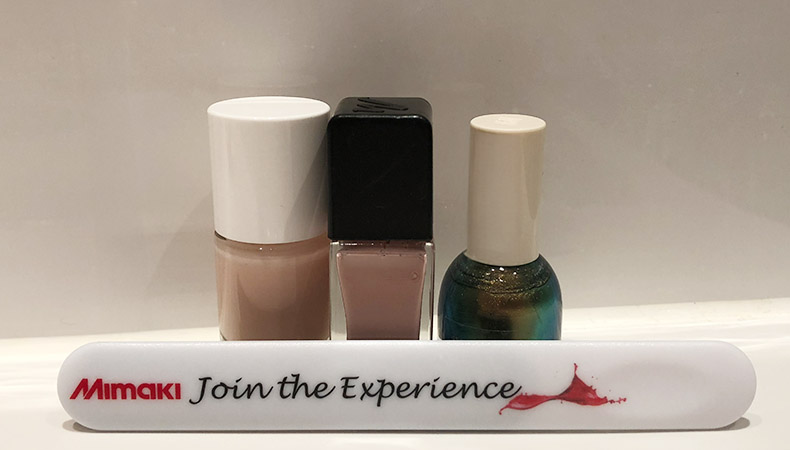 A nail file can be turned into an effective promotional item through customization. Photo: Sonja Angerer
Personalization, Customization, and One-of-a-Kind Items as Business Models
For the digital printing industry, the concepts of personalization, customization, and one-of-a-kind items tailored to customer preferences remain of central importance. Compared to the dawn of the digital printing era at the end of the 20th century, the focus has shifted somewhat. At that time, the ability to produce small runs and one-of-a-kind items was the main selling point for digital printing. In terms of quality, reliability, and cost structure, the emerging digital technologies were, for the most part, significantly inferior to the established analog printing technologies.
Even today, personalization, individualization, and customization underscore the flexibility and cost-effectiveness of digital technologies compared to analog processes. However, the focus has shifted. Analog printing shops have long been able to offer even small print runs at competitive prices, while digital printing is increasingly becoming the standard for medium and large print runs.
The ability to produce personalized, customized, and client-specific one-of-a-kind items has formed the basis of the business model for digital print shops. Instead of focusing on mass production, print shops and sign-making companies have increasingly been able to position themselves as service providers for creative solutions since the turn of the millennium. Value creation shifted from pure production to consulting, design, and the implementation of complex customer requests.
Alongside the mostly small-to-medium-sized digital print shops that focus on personalization, customization, and one-of-a-kind items tailored to customer requests, large online print shops with a high degree of automation have emerged in recent decades. These initially focused on standard products. Today, however, providers such as Cewe, Flyeralarm, Onlineprinters, and WirmachenDruck are also able to deliver personalized and customized products.
Customers can design and order many printed materials directly in their browser. They don’t need any advice and therefore don’t seek out a specialized provider. This trend poses challenges for medium-sized digital print shops. To remain competitive, they can turn to customizable Web-to-Print software solutions or specialize in niche markets such as one-off items tailored to customer specifications and the execution of complex projects.
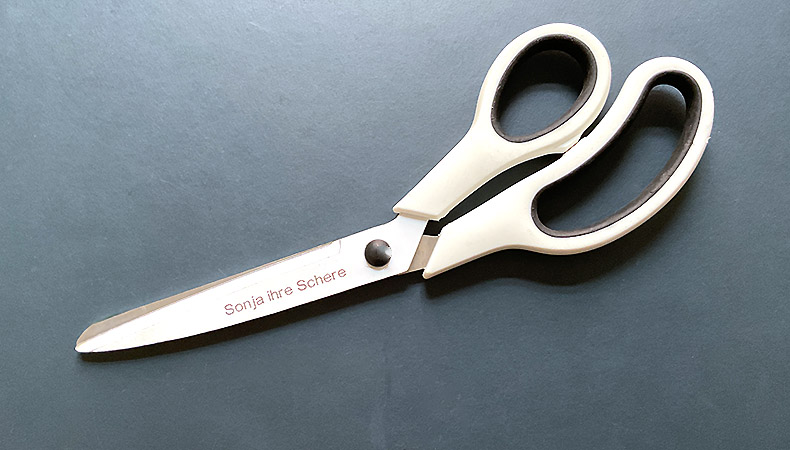 Personalization: Scissors with a name. Photo: Sonja Angerer
Personalization, Individualization, One-of-a-Kind Items, and Society
Demand for personalized and customized products continues to grow steadily. This is linked to several societal trends. Sustainability plays a central role: Consumers prefer products that are durable, locally produced, and tailored to their needs. Mass-produced goods are losing their appeal. One-of-a-kind items, on the other hand, are seen as an expression of conscious consumption.
The growing trend toward regionalization is also affecting the industry. Customers value local production and short supply chains. Digital print shops that produce locally and offer customized solutions can position themselves as attractive partners in this context. The trend toward online shopping is reinforcing this development.
The digitization of society also fuels the expectation that products can be customized quickly and flexibly. This applies not only to consumer goods but also to the design of public spaces. Cities, companies, and institutions are looking for ways to customize their environments. Digital printing offers an ideal solution here, as it combines creative freedom with technical precision.
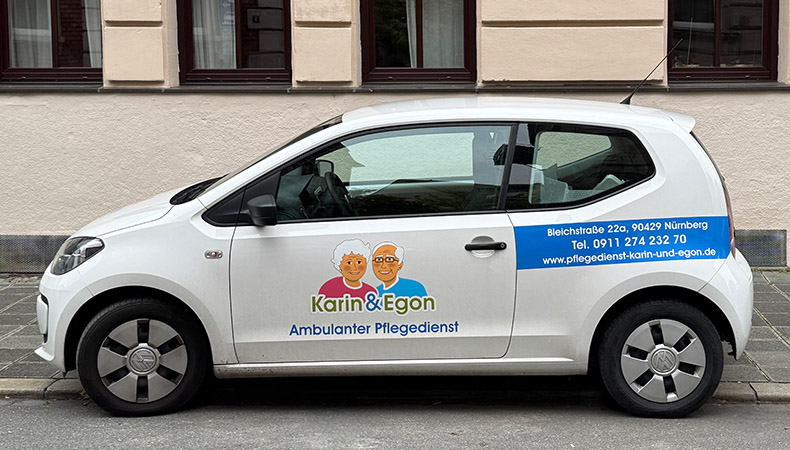 Customized and personalized: A care team’s company cars featuring their names and illustrated portraits. Photo: Sonja Angerer
Conclusion
Personalization, customization, and the production of one-of-a-kind items tailored to customer specifications are key success factors in modern digital printing. They enable print shops to distinguish themselves from mass production and position themselves as creative service providers.
At the same time, these concepts reflect social trends such as sustainability, regional focus, and the desire for unique products. Digitalization has not only made technical implementation easier but has also changed customer expectations: flexibility, speed, and creative freedom are now the norm.