Industrial print offers wide-format providers lucrative opportunities beyond signage, particularly in product decoration and direct-to-object personalisation. Utilising high-precision, small-format UV-LED flatbeds, businesses can print durably onto diverse substrates—from phone cases to curved parts—minimising material waste and unlocking agile new revenue streams in retail and manufacturing markets.
There was a time when wide format printing was only used to make signs, but we’re way past that and nowadays the same basic technology drives a number of different market sectors from display graphics through to packaging and textiles. But one of the most interesting areas is industrial print, which covers a number of different uses and technical challenges.
It’s not always easy to define industrial print and often it just refers to applications outside of display graphics. That means that the industrial print umbrella sometimes helps to incubate emerging applications. That was true of the early days of textile printing, which has grown from soft signage to include home decor and furnishing, as well as garments.
The same could also be said of some packaging, particularly printing very short runs to corrugated boards on wide format flatbeds. That proved a market need and lead to the development of dedicated single pass corrugated presses.
These days industrial print also refers to functional printing, which could include printed electronics. Indeed, printing technology is used in many industrial segments, including production of circuit boards and solar panels. Print technology is also being used to apply functional coatings such as waterproofing to various surfaces or even security tagging to protect against counterfeiting.
But perhaps the most practical form of industrial printing from a wide format perspective is product decoration. This can include adding graphics to existing products, with the most obvious application being imagery for smartphone cases. That could be for short run branding for local businesses, or for targeted marketing campaigns but is also particularly useful for personalisation. Equally, the printing could be more practical, such as printing instructions or health warnings directly onto a product instead of via a label. There’s a good argument that printing direct to product and cutting out the labelling step can help save materials and costs.
Over the last decade or so several vendors have introduced a new class of small format flatbed printers that are designed specifically for the industrial market. There’s much more to these printers than just having a smaller bed than standard wide format printers. The smaller size does allow them to fit into a variety of spaces, including retail and office settings as well as at the end of product manufacturing lines. And the smaller bed is usually better suited to loading and unloading small objects than a bigger printer might be.
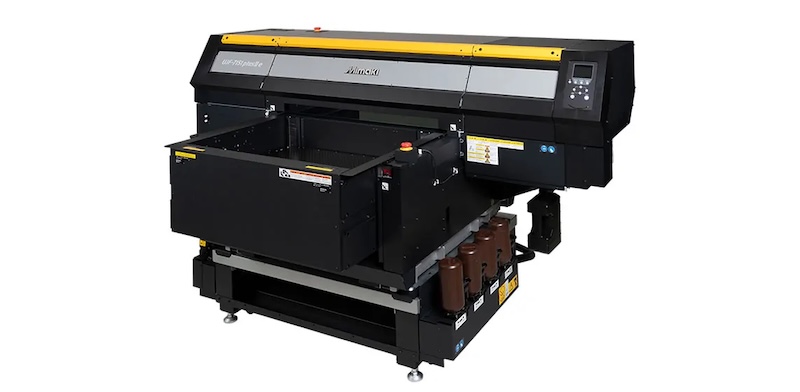
Beyond this, what these particular devices really bring to the table is high precision, both in terms of high resolution for small text as well as for placing graphics on small objects and maintaining their repeatability over many hundreds of prints. A good example of this is Mimaki’s UJF 7151 Plus II, which uses a ball screw drive mechanism to position the carriage with an accuracy of +/- 0.1mm. At the same time, this printer also offers up to 1800 dpi resolution. Mimaki has recently introduced a new version of the UJF7151, the Plus II e, that has a new LD mode for better results on curved or stepped parts where there might be up to 10mm of variance in height. It also allows for embossing effects of up to 5mm.
Nonetheless, most of these printers are designed to print to flat objects. Roland DG has tried to get around this limitation with its VersaObject series which will typically take objects up to 242mm in height and can cope with some curvature such as printing a logo on to a football. There’s a choice of different bed sizes, with the more expensive LO-series having two printheads for greater productivity.
As noted, most of these printers are much smaller than standard flatbed printers. Epson’s tabletop A4-sized V1000, for example, has been designed to sit neatly on a retail counter and as such gives shops a useful way to decorate and personalise small objects from fridge magnets to phone cases, even while customers wait.
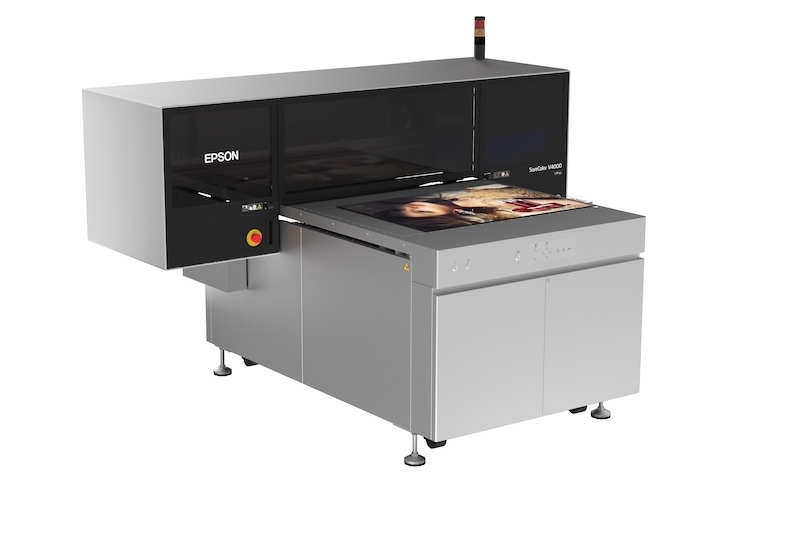
As the market has expanded, so several vendors have brought out larger models, with Mutoh introducing its A1+ sized 1462UF a couple of years ago. The latest model from Epson is the SC-V4000, which also has an A1+ sized bed. The bed has a vacuum system that is divided into four separate zones. It has a 10-colour UV inkset based on Epson’s existing Ultrachrome inks, which includes CMYK plus light cyan, light magenta, grey, red, white and varnish. Interestingly, this ink can also be used to print Direct-to-Film, using cut sheet UV-DtF film, without any compromise in its performance on printing direct to rigid objects. The V4000 is fitted with three Epson PrecisionCore printheads, which allows it to print three layers – white, colour and varnish – at the same time. These heads have eight channels each, with two heads used for the colours, and the third head split between the white and varnish inks.
These small format printers that are aimed at the industrial and decorating market use UV-LED inks to ensure they have good adhesion with a broad range of different substrates. Most vendors also offer a choice of inksets between rigid and flexible materials to optimise the performance of the ink. That’s essential with product decoration because the final objects might be in use for many years and handled regularly by consumers – as is the case with smartphone cases – so the inks have to have excellent adhesion to the substrate, as well as good colour gamut. Consequently these inksets usually include white, to help enhance the inks on darker surfaces, and clear or varnish inks to give the ink more protection as well as creating a more tactile experience.
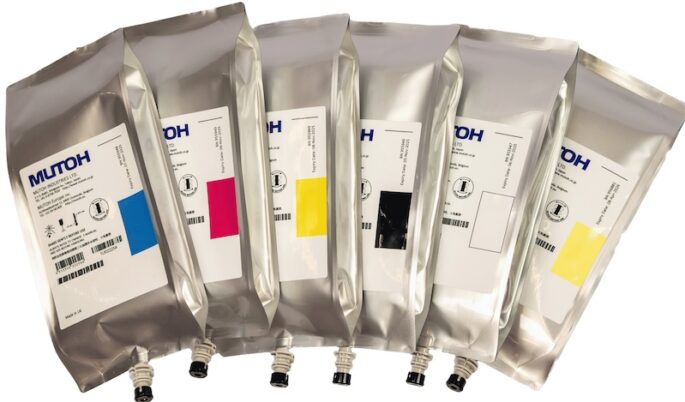
Mutoh has just introduced a new ink for its UF series of industrial printers. The UH71 ink is a UV LED-curing ink that’s designed for printing to rigid materials such as PET, PC, ABS, PS, PVC, PMMA and aluminium. As such its suitable for a broad range of applications including novelty items, industrial parts and promotional products. It’s said to offer strong adhesion, high durability, chemical resistance, low odour and tack-free output. The full inkset includes the CMYK colours plus white and clear. Naturally it complies with the latest certifications.

In truth, these small format industrial printers are not really designed for the wide format market. Instead their vendors are hoping to diversify into other sectors, including retail and product manufacturing. But there’s no reason why wide format print service providers can’t also use them to diversify their
Discover more content on wide format printing