Cultural grants play a crucial role in supporting the arts and culture. But what happens when these grants are cut? This poses major challenges not only for artists but also for the printing industry.
Funding for the arts and culture is currently taking a hit in Germany: Local governments, the federal government, and the states are planning—in some cases, substantial—budget cuts or have already approved them. This isn’t just causing problems for artists. Cultural and civil society institutions, such as nonprofit organizations, contribute significantly—in some cases substantially—to the revenue of printing service providers.
Orders from Artists and Cultural Professionals to the Printing Industry
The culture and events industry, as well as clubs and organizations, order a wide variety of products from printing companies. These range from flyers, posters, and brochures to admission tickets, wristbands, roll-ups, and banners. Online printing companies such as Flyeralarm, Onlineprinters, and Wir machen Druck therefore offer a wide range of printed materials specifically designed for the arts, culture, and clubs. In some cases, even less experienced customers can easily design the products right in their browser.
In addition to the independent and volunteer-based arts and culture scene, government institutions, theaters, museums, publishing houses, and other cultural organizations also purchase significant quantities of printed materials. The production of permanent and special exhibitions requires specialized expertise, such as in high-end photo printing. As a result, some printing companies have specialized in orders from museums or theaters. They are particularly hard hit by cuts to cultural funding because, in the worst-case scenario, this can result in the loss of revenue from entire event programs.
Impact of Cuts to Arts Funding on Printing Companies
One of the most immediate effects of cutting cultural funding is the decline in orders for printing companies. Many museums, theaters, cultural organizations, event organizers, and publishers rely on grants to finance their projects.
This involves the allocation of substantial funds. Berlin’s cultural budget for 2024/25 alone amounts to more than one billion euros.
If funding for the arts is cut back, fewer exhibitions, performances, and other cultural events will be able to take place. In addition, even project organizers who have been relatively spared by the cuts are reducing their spending as a precaution. This is because funding for the arts could remain under similar pressure in the coming years. The shifting priorities in government budgets certainly point in that direction.
As a result, in the medium term, it is likely that not only digital and large-format printing companies will be indirectly affected by the cuts to arts and culture funding. The magazine and book industries could also face further declines in the coming years.
Without subsidies, publishers and authors must cover the entire production costs themselves. This may lead them to try to cut costs. They will therefore likely choose more affordable printing options or reduce print runs. It’s quite possible that even more small and medium-sized clients will have to order books and brochures centrally from low-cost large-scale printers rather than locally.
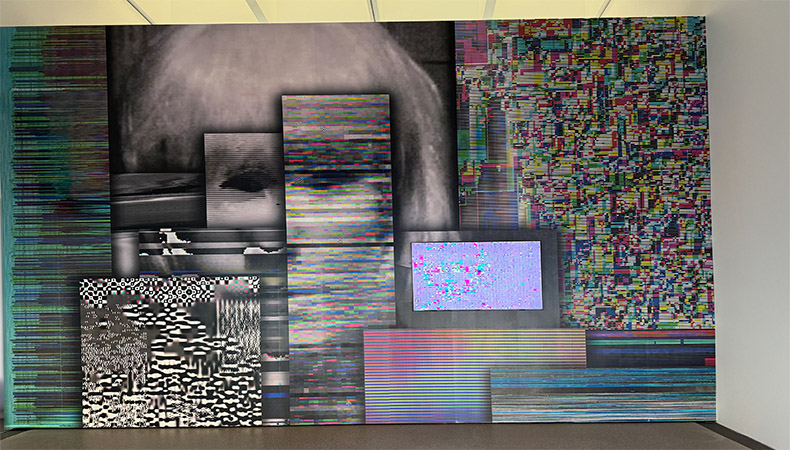
Cultural funding also affects digital printing companies: Large-format printing for the “Glitch” exhibition at the Pinakothek der Moderne. Photo: S. Angerer
Without support for the arts, there would be less innovation—including in the printing industry
Cultural grants help make a wide variety of projects and initiatives possible. They support not only mainstream projects but also niche events and experimental works. If these funds are eliminated or significantly reduced, cultural practitioners will have to focus on safer, more commercially successful projects. This will lead to a loss of cultural diversity and innovation.
But this also applies to printing companies. After all, they must continually test new substrates and production methods, especially for immersive and scenographic projects. Such complex projects require substantial budgets, which are unlikely to be available in their current form following budget cuts. As a result, digital print shops lack both the need and the financial resources to develop such innovations and bring them to market.
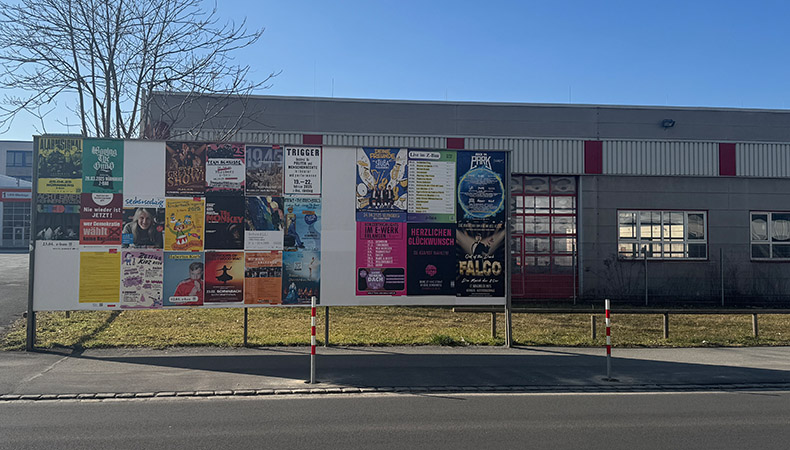
Without support for the arts, there are also fewer posters: a billboard in Nuremberg. Photo: S. Angerer
Adaptation Strategies in the Printing Industry
To address the challenges posed by cuts in cultural funding—which also affect printing companies—printing companies should continue to diversify their services, focusing on booming segments such as personalization and packaging printing. This will enable them to enhance their competitiveness and tap into new sources of revenue.
Another strategy could be to strengthen collaboration within the industry. Printing companies could form partnerships with publishers, associations, institutions, and other stakeholders in the cultural sector to carry out joint projects. Networks and collaborations can help mitigate the impact of funding cuts and develop innovative solutions.
Nevertheless, there is no denying that the elimination of cultural funding also poses significant challenges for the printing industry. A decline in orders, higher production costs, and a narrower variety of printed materials are just a few of the possible consequences.
However, through adaptation strategies such as diversifying services and strengthening partnerships, the industry can find ways to address these challenges. It is to be hoped that the importance of supporting the arts will be recognized and that appropriate measures will be taken to support cultural diversity—and the printing industry.