From 19 – 22 May 2026, Textile will take place at the Gran Via, Fira de Barcelona. The event will highlight a multitude of opportunities and technologies across the textile printing landscape – from garment decoration, to apparel, to interior décor.
Visitors will also have the opportunity to attend selected panel discussions at The FESPA Conference, where industry experts will provide practical insights into textile printing and related topics.
Ahead of the event, keynote speakers Harry Mustoe-Playfair, Founder, Prinfab and Giovani Re, Dimense Ambassador, Roland DG, discuss the trends that are shaping the future of the textile printing industry as we know it…
With trends such as personalisation, automation and sustainability in higher demand than ever, how do you see these shaping the future of the textile printing industry?
Harry Mustoe-Playfair: In response to the demand for faster turnaround and to reduce the waste created by traditional manufacturing, businesses are integrating rapid on-demand manufacturing. As a result, smaller companies can operate with the same gross margins as larger enterprises, but without the huge overheads, creating new opportunities that are accessible with low levels of investment in time and resources.
Personalised products printed on demand (POD) require a tailored manufacturing approach, and we’ve seen a fundamental shift in how textile printing businesses think about quality control. In addition, the companies that build those systems now will have a significant head start.
Traditionally, the automation of textile printing has not been simple, as there is minimal machinery designed specifically for fabric handling. However, we have recently seen advances in this area using in-the-field learning techniques for robotics that handle textiles effectively. So, whilst textile handling robotics are still a few years away, machine learning and AI are automating behind the scenes. The barrier to bespoke solutions for specific workflows is now significantly reduced, allowing further refinement of already highly optimised processes.
Giovani Re, Dimense Ambassador of Roland DG
Giovanni Re: Personalisation, automation and sustainability are not simply trends. They represent a transformation in the way products are produced and experienced. For decades, the textile industry has been based on standardisation. We buy clothes in predefined sizes and designs decided by someone else. Yet, every human being is different and the way we express ourselves through clothing is deeply personal.
A few years ago, I performed my own 3D body-scan and extracted key measurements which were fed into a parametric CAD system that generated the pattern pieces of a jacket.
With the support of a configurator, I designed my own patterns that resonated with me, personally. The fabric was digitally printed, automatically cut and assembled by a tailor.
The result? A piece of clothing perfectly adapted to my body and individual taste, with no wasted material and no unsold inventory.
This illustrates the direction in which the textile industry is moving. Digital textile printing technologies enable production models where creativity, data and manufacturing are connected. Personalisation becomes economically viable, automation keeps the process efficient and sustainability emerges naturally from producing only what is truly needed.
What do you believe will be the biggest obstacles for businesses trying to align with these trends?
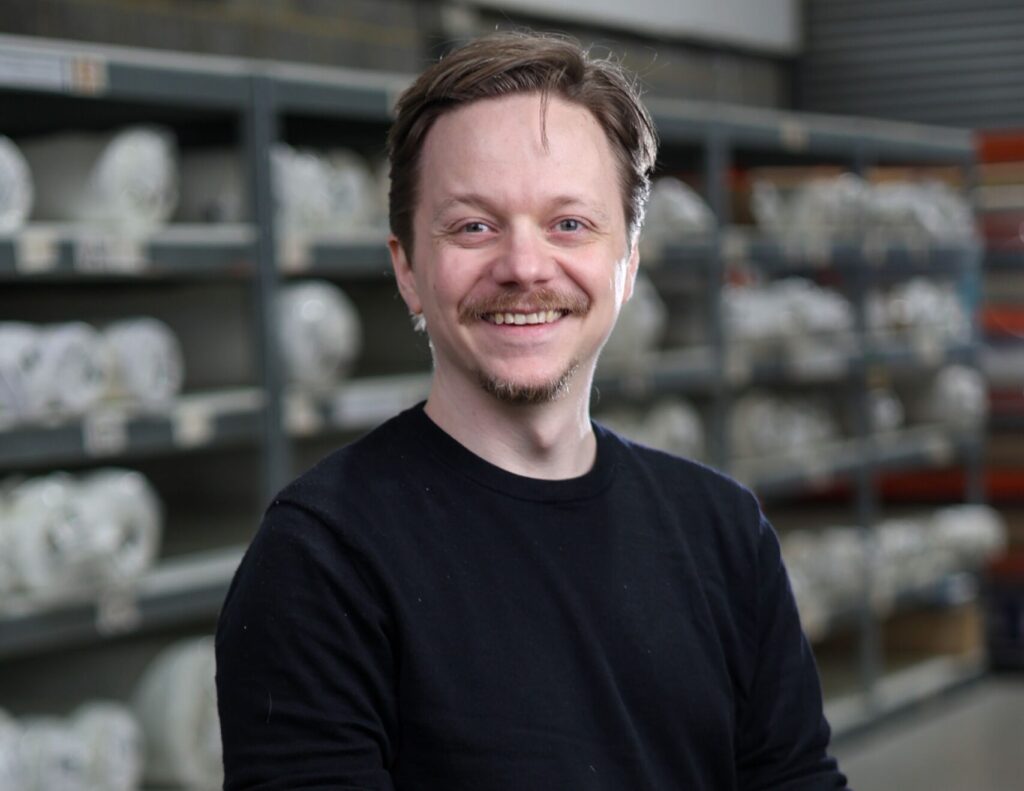
Harry Mustoe-Playfair, Founder of Prinfab
Harry Mustoe-Playfair: In my opinion, technical capability is a huge challenge. Businesses need to adapt their workflows to new, advanced tools. These tools enable the expansion of product offerings and internal workflows to be developed and thoroughly tested in days or weeks.
Businesses must also remain relevant to consumers. New technologies must be implemented sensitively, and evaluating the long-term effect of your latest investment is essential.
Take Prinfabs AI design generator, which when launched, received a mixed reaction from our customers, by providing customers with access to AI powered editing tools, it has supported them to optimise workflows.
Giovanni Re: The biggest obstacles for businesses trying to align with these trends are rarely technological. In most cases the technologies already exist and are becoming increasingly accessible. The real challenge is cultural.
With many production models designed for large volumes and standardised products, moving toward personalisation, on-demand production and sustainable workflows requires a different mindset. From redesigning processes, to rethinking the relationship between designers and production teams, to embracing digital tools – businesses must shift to connect creativity with manufacturing.
For example, Roland was asked to develop a sustainable decoration concept for a hospitality space by using AI to generate interior visuals, which designers refined into printable patterns produced with digital printing on textured surfaces. As the decoration was created for a specific location, we were able to ensure that only the exact materials needed were made to eliminate waste, excess stock, as well as over-production.
But, what was the challenge? Helping the client and production partners to understand that the process had changed and that, instead of choosing from a catalogue, they were co-creating an environment.
The industry is shifting from providing products to delivering experiences that require new skills and workflows, and a willingness to rethink traditional models. Those that succeed combine design thinking, digital manufacturing and intelligent tools into a single process.
Visitors to Textile, can expect these trends to surface throughout the events in Barcelona. Those in attendance will also gain free access to co-located events FESPA Global Print Expo, European Sign Expo, Personalisation Experience, WrapFest and the brand-new Corrugated, where they can explore the latest developments across speciality print, signage, packaging and wrapping.
Discover Textile 2026
Textile 2026, launching alongside FESPA Global Print Expo in Barcelona (19–22 May 2026), is where function, print, and production converge to shape the future of textiles. Visitors can purchase super early bird tickets for €55 until 20 April by using the code FESG601.