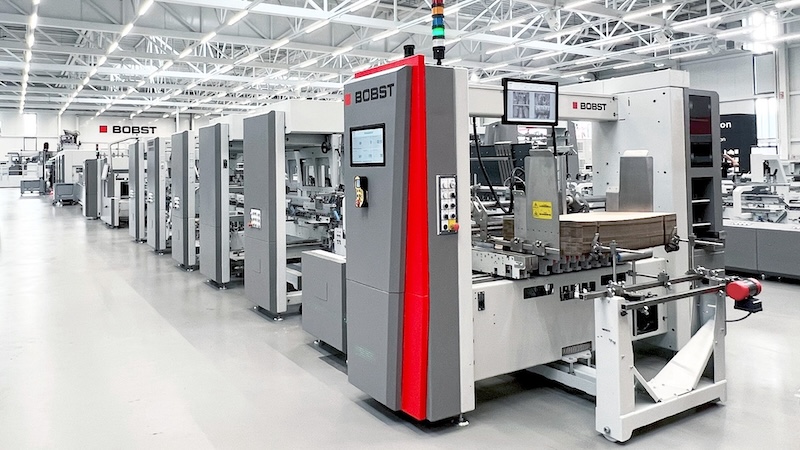
Folder gluer machines are essential for transforming flat corrugated sheets into high-strength packaging. Modern models from Bobst, Koenig & Bauer, and others offer advanced automation, handling diverse flute types from micro-flute to double-wall. Precise folding and gluing are critical to maintaining structural integrity, especially for the booming e-commerce and sustainable display markets.
We generally think of paper and paper-based products, including corrugated boards, as being rather flimsy. And yet corrugated boxes offer significant dimensional strength that goes far beyond what a flat board would be capable of. For the most part, the strength depends on the particular grade of corrugated that’s used.
But much of that dimensional strength also comes from the way the box is formed. And that comes down to the folder/ gluer machine. These devices are designed to take flat sheets that have already been die-cut with the folding lines creased. In some cases, the folder gluer may be used to apply the creasing. In any case, the main task is to fold the sheets along the crease lines, apply the glue where needed, and then bond the different surfaces together to form the box. Increasingly these machines will also count and stack the finished boxes. Some manufacturers break their solutions down into different modules for each of these tasks but an integrated folder gluer machine can include more automation for better productivity, especially with the heavier corrugated sheets.
These machines need to be fast, but they also need to feed the corrugated sheets through the machine without damaging them, with the quality of the feeder and alignment systems playing a big role. And of course they need to bring consistent and even pressure to make accurate folds – anything other than a perfect fold will compromise both the integrity of the box and the reputation of the brand owner. Naturally the folder gluer should be capable of producing all the different types of folds and the different box shapes, including straight line folds, lock bottom folds and multi-point folds.
It also follows that the machine should be able to handle all the different types of glue, including ambient temperature controls to ensure consistent glue viscosity. Most of these machines will be configured with an inspection system and should include the ability to eject boxes that aren’t up to scratch. Most of the current machines on the market also offer a high degree of automation, though some of this is an optional extra.
Ideally, these machines should be able to handle a wide range of different substrates, including cardboard, folding carton and of course corrugated boards. Some folder gluers are aimed at smaller boxes and will often handle a broader range of different materials, while others offer much wider working widths and are mainly designed for corrugated sheets.
As well as the sheet sizes, you’ll also need to look at the weight and thickness of substrates that any given folder gluer can work with. Most of these devices can handle the more common flute types – typically the larger A, C and E – but not all will take the thinner N-flutes. The same is true with double flutes, with some handling the thicker materials such as a double wall combination of EE or EC, but very few will take triple combinations.
There are quite a few different folder gluer machines to choose from, far too many to cover them all here. But a handful of the more common machines should give a reasonable idea of what’s available as a starting point.
Bobst produces several different ranges of folder gluers, which cover various materials, board sizes and production volumes. Amongst the portfolio is the ExpertFold 145/ 165 models, which can produce both four and six corner boxes. They will take solid boards up to 800 gsm, and can handle a wide range of different single flute types from A to N as well as the more heavy duty EE. They can run at speeds of up to 250 mpm. These models were recently updated with an automated blank aligner and full support for digital job and recipe management.
Bobst has added more automation features to its ExpertFold 145/ 165 series folder gluer machines.
Earlier this year Bobst added two new sizes to the 145/ 165 series. These include the 106, which is for smaller formats, such as the production of micro-flute boxes, up to 1060mm in width, together with all the automation features of the bigger models. The new 215 size is for larger corrugated board applications and will handle boards up to 2.3 metres wide. As such, it boasts an extended feeder section, plus a 6m folding and a 6.6m delivery section. Both the 145 and 215 models can be configured with a PolyVacuum and GyroBox module for applying inline self-adhesive tapes and opening stripes, which are increasingly in demand for e-commerce jobs.
Koenig and Bauer makes the Omega range of folder gluer machines. The top of the range is the Omega Magnus, which has been specifically developed for corrugated work. It’s available in four different widths, which between them will take boards from a minimum of 240mm up to 2300 mm, and ranging from 300 to 1200 gsm in weight or up to 7mm in thickness. It works with a wide range of different flute types, from the very thin N-flutes up to combinations such as EC and EB fluting. It can run at speeds of up to 300 mpm, and is said to be highly automated to minimise the time needed to set up jobs.
Koenig and Bauers Omega Magnus folder gluer is designed mainly for high volume corrugated work.
American International Machinery sells a range of used converting equipment as well as its own Signature series of folder gluers. These include the Eagle, which will handle both folding carton and corrugated, while the Albatross is designed for corrugated work. As such it can take N to A flute sheets plus various double wall combinations. It can produce straight line, lock bottom and 4/6 corner boxes, and runs at up to 350mpm.
The Chinese company New Luolan Machinery sells several series, including the PC series of automatic high speed folder gluers with lock bottom folds. These can handle A, B and E flute sheets up to 1800mm wide and with a maximum weight of 800gsm. They run at 260 mpm and use a water-based cold glue. They can produce both straight line and bottom lock boxes.
In conclusion, the demand for folder gluer machines will only increase, driven by the increasing use of corrugated packaging and display stands as consumers and brands look for more sustainable solutions.
Discover Corrugated 2026
Coming to Fira Barcelona, 19-22 May 2026, Corrugated is a new dedicated exhibition with curated conference content aimed at corrugated converters. Visitors can purchase super early bird tickets for €55 until 20 April by using the code FESG601.