Microfactories that use digital textile printing solve many of the problems facing the textile industry. That’s because they bring the production of custom-made clothing closer to the markets. This reduces the carbon footprint and prevents waste. Why aren’t there more of them in Europe?
Just a few years ago, it seemed clear: the era of fast fashion, produced in the Far East, was coming to an end. Instead, customers want unique, durable pieces—ideal conditions for microfactories.
What are microfactories?
Microfactories are generally defined as compact, highly automated production environments that rely on digital technologies and flexible workflows. In the textile industry, fabrics are no longer pre-produced in large quantities but are digitally printed, cut, and sewn to order according to customer specifications. Often, other digital production methods are also used for this purpose, such as digital cutting, automated sewing machines, or modern knitting machines.
Microfactories are often located in shopping malls. One example is the“Shift Microfactory”at Bikini Berlin. It opened in March 2025 as a collaboration between the University of Management and Law and VORN, with support from the German Federal Environmental Foundation (DBU). However, consumers cannot shop there. The initiative is intended as a learning space for fashion designers and students.
Epson supports the Microfactory Future Fashion Lab Hamburg (FABRIC) at the Galleria Passage. The design, production, and sale of sustainable fashion are spread across three floors there. This space is primarily aimed at professionals and students in the fashion and textile industries. Since 2024, they have been able to design and produce one-of-a-kind pieces and small batches there using various Epson printers. However, during events and pop-up sales, the collections are also available for purchase by the general public.
Kim Lea Kaufmann, director of the FABRIC Future Fashion Lab workshop, explains: “We place a high priority on sustainability, upcycling, recycling, and sustainable business models that move away from fast fashion.”
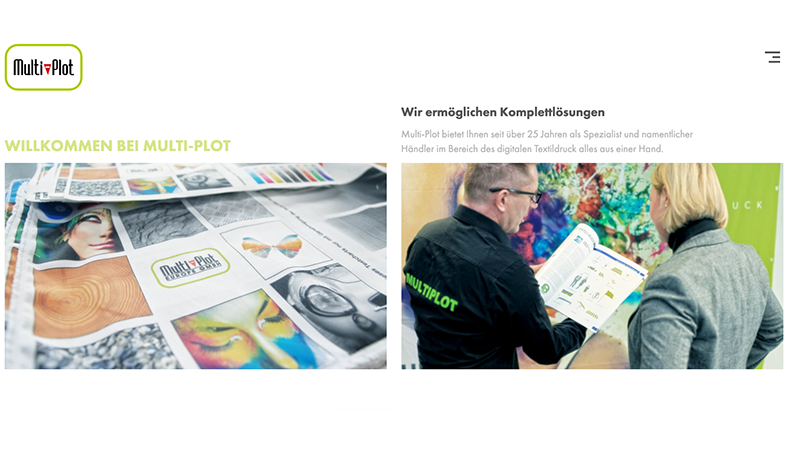
Multi-Plot Europe website, center: Joachim Rees, Dipl. Ing., CEO and specialist in digital textile printing and textile microfactories.
Challenges in the Textile Industry: Is the Microfactory the Solution?
The textile industry is under enormous pressure. Overproduction, unstable supply chains, and increasing sustainability requirements are key challenges. According to industry analyses, millions of metric tons of unsold textiles are destroyed each year. This is not only environmentally concerning, but also economically unsustainable in the long term.
“As a specialist in digital textile printing and textile microfactories, I continue to view this topic as strategically relevant,” says Dipl. Ing. Joachim Rees, Managing Director of Multi-Plot Europe GmbH. “However, my outlook is also significantly more pragmatic than it was a few years ago. In Germany and Europe, local production is on the rise—not across the board, but selectively—in areas where time-to-market, product variety, personalization, and risk reduction are the deciding factors.”
At the same time, the textile industry in the European Union is facing massive pressure from costs, weak demand, and competition from imports. This is slowing down investments in microfactories in areas where the business case is not clear. “But new online sales channels—supported by AI in design, sales, and marketing via social media—offer particularly good prospects for success.”
Epson also continues to support the Microfactory concept because, according to Epson Germany, this production method aligns very well with the company’s strategy and provides customers with significant benefits:
“Microfactories improve the efficiency of resource use within a production line and, due to the significantly reduced logistical effort, lower both the carbon footprint and costs. They also increase the reliability of a supply chain by avoiding risks associated with trade barriers, tariffs, and other disruptions.”
Future Fashion Lab Microfactory in Hamburg. Epson Germany is supporting the initiative; several Epson printers have been installed for textile printing. Photo: Epson.
Opportunities for Printing Service Providers and Manufacturers
“On-site, on-demand production minimizes waste, can significantly reduce costs, and increases the flexibility of a supply chain thanks to small, independent manufacturing steps. These are all factors that strengthen a manufacturer’s market position and clearly speak in favor of microproduction,” says Epson Germany: “For this reason, we offer a broad portfolio of suitable solutions that make it possible to create efficient and cost-effective microfactories.”
“I see a stable future for microfactories using digital printing, but not as a one-size-fits-all solution,” says Joachim Rees. “Growth will come primarily from areas where on-demand and short runs are in demand—that is, quick response times, many variations, and less inventory.” The hype surrounding DTF textile printing is a good example of this. Instead of one large megafactory, a network of several smaller locations close to the sales market is more likely to prevail, in order to shorten delivery times and spread risks.”
“Process simplification and, above all, automation will also be crucial: The more automated the workflow and handling are, the lower the turnaround times and complexity will be.”
Rees also draws very clear lines, however: “Mass-produced goods will continue to be manufactured where unit costs are unbeatable. Microfactories don’t win on the basis of the lowest price, but rather through speed, product variety, lower risk, and often sustainability considerations as well.” Whether this pays off depends heavily on the business case: capacity utilization, process stability, color management, material handling, data quality, quality assurance, expertise, and energy prices are the typical factors to consider.”
In practice, the microfactory will establish itself as a business model: AI-supported workflow, high-quality digital textile printing, software-driven order and production management, and automated finishing and handling as an integrated process chain. The winners will be the companies that don’t just print, but deliver end-to-end—from the online store/ERP through production to the shipping label.”
Discover Textile 2026
Textile 2026, taking place alongside the FESPA Global Print Expo in Barcelona (May 19–22, 2026), is the place where functionality, printing, and production come together to shape the future of textiles. From apparel manufacturing and finishing to home textiles and printed clothing, Textile 2026 offers insights, technologies, and innovations that drive real business growth.