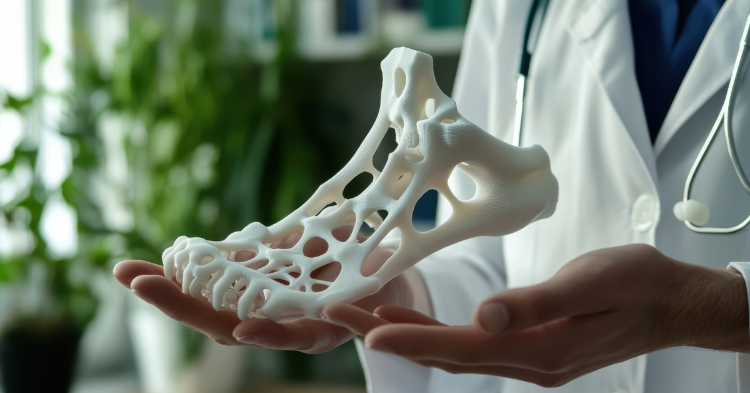
This disruptive and promising technology enables the rapid and precise manufacturing of medical devices tailored to each patient’s individual needs.
In an environment where the demand for personalization and more patient-centered care continues to grow, 3D printing is offering new solutions that are transforming the way medical professionals approach diagnoses, treatments, and procedures. This technology not only improves the quality of medical devices but also reduces production times and the costs associated with their manufacture.
Thanks to the ability to create highly customized prostheses, implants, and other devices, 3D printing is playing a key role in the evolution of modern medicine. Advances in biocompatible materials and printing processes allow specialists to develop customized solutions that improve patient comfort and optimize clinical outcomes. As 3D printing technology continues to advance, its potential to revolutionize healthcare is enormous, offering new opportunities to personalize medicine in ways that were previously unimaginable.
Personalization for More Precise Care
One of the main advantages of 3D printing in the medical field is the ability to create customized devices. From prosthetics to implants and splints, customization ensures that each device fits the patient’s anatomy perfectly, significantly improving comfort and functionality. The result is more effective treatments and a better prognosis for patients.

Advanced Materials for Medical Applications
The choice of materials is key in 3D printing for medical devices. There are various biocompatible materials that can be used, ranging from medical-grade plastics to metal alloys and advanced polymers. These materials are not only safe for the human body but also allow for great flexibility in the design and manufacture of high-quality devices. Current research continues to explore new materials with improved properties for more complex applications.
Reduced costs and production times
Traditionally, the manufacture of custom medical devices required lengthy and costly processes. With 3D printing, it is possible to reduce both costs and production times, as it eliminates many of the intermediate steps in the conventional manufacturing process. This not only speeds up turnaround time but also makes customization more accessible to a larger number of patients. In many cases, devices can be ready in a matter of hours or days, rather than weeks.

Emerging Applications: Bioprinting
Although still in the experimental phase, 3D printing of tissues and organs—known as bioprinting—has the potential to completely revolutionize regenerative medicine. Although there is still a long way to go, advances in this field are promising, and in the future they could enable the creation of personalized organs for transplants, which would alleviate the shortage of donors. This technology could also facilitate the development of new personalized treatments and advanced therapies.
Challenges and Regulations
Despite these advances, 3D printing in the medical field faces some challenges, particularly in terms of regulations and safety certifications. Devices must comply with strict regulations to ensure their safety and efficacy before being approved for clinical use. However, with a focus on responsible research and development, 3D printing has the potential to continue gaining ground in the medical industry.

With the ongoing evolution of 3D printing technology, the use of customized medical devices is expected to continue growing, improving patients’ quality of life and optimizing medical outcomes. Advances in this area offer an unprecedented opportunity for innovation in healthcare, and printing professionals are ideally positioned to lead this change. Collaborations between the printing industry and the medical sector are driving this exponential growth.
Discover the latest innovations in 3D printing and customization at FESPA Global Print Expo 2025, Europe’s leading printing and signage trade show, which will take place May 6–9 at Messe Berlin in Germany. It will showcase the most innovative products, visionary concepts, and the latest developments in the future of printing. Register to visit here and use the promo code FESJ506 to pay €50 for your admission ticket.