Interior design is influenced by fashion trends. This also has an impact on printing service providers who specialize in this field. How are fashion and home textiles connected, and what are the trending themes for 2025?
Sometimes patterns are all the rage, and other times it’s solid colors in soft tones: the world of fashion is constantly changing. It’s not uncommon for such trends to filter down into interior design after a certain delay. After all, many people view the spaces they live in—just like fashion—as an expression of their personality.
It is therefore important for employees and management at textile printing companies to be aware of the latest trends in home textiles and upholstery fabrics. Ideally, they should also have an idea of what their customer base might like in a year or two. There are two main reasons for this:
- Interior decor is usually purchased based on its design.
- However, not every design trend can be implemented equally well using digital printing.
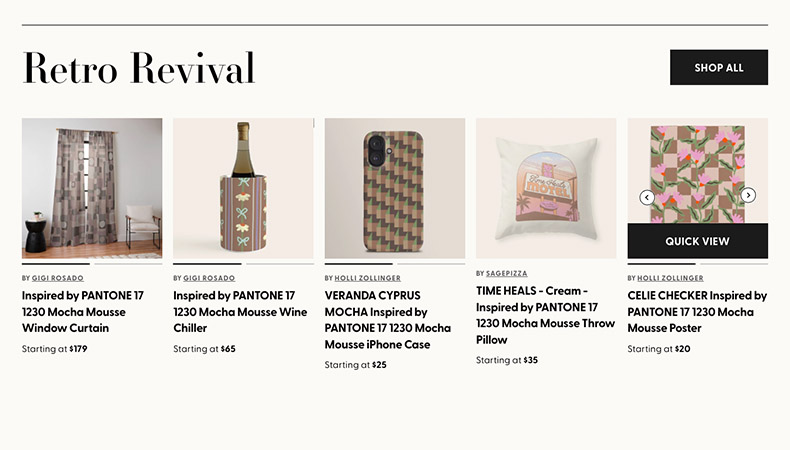
Online home decor stores like Society6 feature an entire collection of products in Pantone’s 2025 Color of the Year, “Mocha Mousse.” Photo: Screenshot.
Color Trends for 2025 and Beyond
Every year, Pantone introduces a trend color; for 2025, it’s called“Mocha Mousse,” a warm medium brown. Typically, a whole range of partner companies offer products in the Pantone Color of the Year. These include online stores for home decor, such as Society6, and furniture manufacturers, such as Joybird.
This is particularly important for printing service providers because, starting in 2022, they will need to purchase the corresponding color libraries directly from Pantone in order to work with Pantone colors. Previously, these were included in the Adobe Creative Cloud subscription.
But Pantone isn’t the only company promoting trend colors. For example, in a blog post, the Swiss studio Hinton also highlights other earth tones such as terracotta and clay, as well as beige, cream, and olive green, as being in style.
They are replacing more vibrant shades such as orange, snow white, and bright blue, which have enjoyed great popularity in recent years.
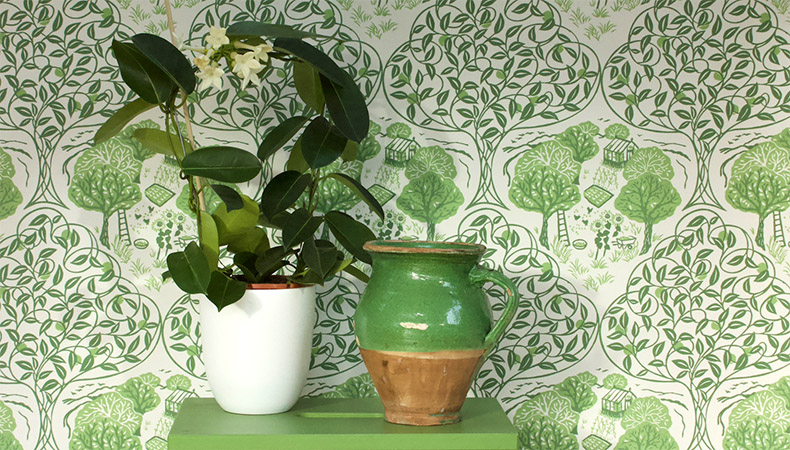
An increasingly popular trend for interiors: a mix of new and secondhand items. The “The Orchard / Apple” wallpaper by Fiona Howard Wallpapers is a perfect fit. Photo: Fiona Howard Wallpapers
Fashion trends are also social trends
But it’s not just colors that define trends in interior design. Homes, as well as offices and hospitality spaces, always strive to reflect social trends and textile fashions.
For example, cutouts and geometric shapes from the 1950s through the 1970s are currently popular in both fashion and interior design. One reason for this is likely the ubiquitous secondhand trend. After all, it’s not just used clothing—old furniture is also currently popular, especially among younger demographics, particularly when the pieces are by well-known designers.
Secondhand items in fashion and home textiles also align well with the growing demand for sustainable products that are environmentally friendly. In interior design, this is also reflected in soft, organic shapes and a focus on natural fibers such as cotton and linen. These fabrics may also feature textured surfaces. Synthetic fibers, on the other hand, are being phased out more and more—if only to prevent the global microplastic problem from getting even worse.
In most developed countries, the proportion of older adults in the population is also growing. Technology companies are therefore introducing products to the market that can help them live independently in their own homes for longer.
In contrast to the first “smart home” wave, during which connected products were very prominently displayed in homes, today’s preference is for smart home and assistance systems that blend discreetly into their surroundings. This also has implications for home textiles, as they must now comply with technical requirements regarding fire safety, heat resistance, and light transmission, for example.
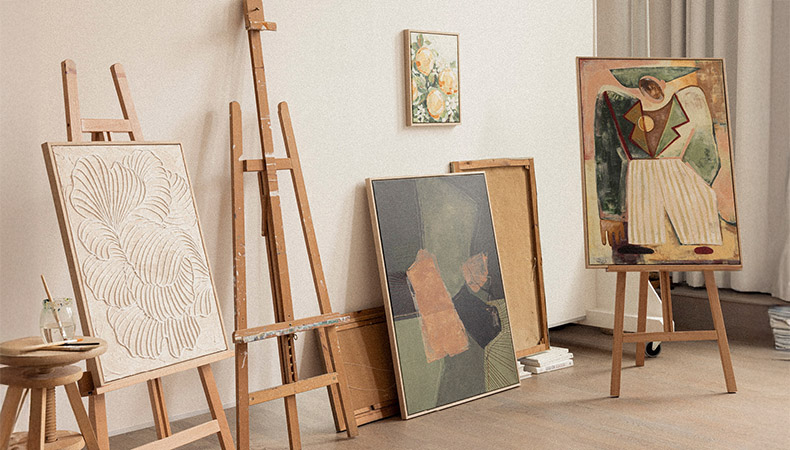
Soft colors and geometric patterns, like those featured in these fine art prints from Desenio, remain popular for living spaces. Photo: Desenio
The Impact of Home Decor Trends on Digital Textile Printing
Demand remains high for personalized interior decorations—whether custom-made for individual customers or produced in small batches. Digital printing is an excellent way to produce artwork, wallpaper, rugs, pillowcases, and much more.
However, current trends are making the work of textile printing companies more difficult. This is because light-colored, solid-color areas and large, geometric patterns are much harder to produce in high quality using digital printing than smaller, more detailed motifs and patterns.
In many cases, it will therefore be more affordable and easier for customers to buy yarns or fabrics in the desired color right away, rather than having them printed. Textured surfaces, such as tweed made from bouclé yarn, are virtually impossible to print on without losing the fabric’s distinctive character.
The trend toward natural fibers also presents challenges for digitally printed interior décor. This is because it largely eliminates the widespread, reliable sublimation transfer printing method, which works only on polyester or coatings containing polyester. One alternative could be the TRAPIS process recently introduced by Mimaki, which works on many commonly available fibers.
Textile roll-to-roll printing with pigment, reactive, or acid-based inks is also suitable for natural fibers, but the pre- and post-treatment processes can be quite labor-intensive in some cases. For printing on finished home textiles made of natural fibers, DTG (Direct-to-Garment) and DTF (Direct-to-Film) are the primary options.
However, environmentally conscious customers often prefer that interior decorations be made primarily with natural and plant-based dyes. In digital textile printing, however, this is currently difficult to achieve, as such inks are not compatible with commercially available printheads.
Conclusion: Fashion trends are also important for interior design
Fashion trends have a significant impact on interior decoration printing. It is crucial for textile printing companies to closely monitor these trends. To do so, ongoing market analysis and trend research are essential—for example, at trade shows and industry events. Collaborating with designers can also be helpful, as it allows companies to set their own trends.
In addition, it may be necessary to adapt production processes in order to continue meeting customer expectations. Companies should therefore respond proactively to changes in the market.
At the same time, it is important for business leaders in the home textiles industry to understand that many fashions and trends coexist today. They may be limited to specific regions or appear among different age groups or ethnicities. Digital textile printing, with its flexibility, is ideally suited to providing even small target groups with exactly the printed interior decor they desire. This will ensure its continued success in the future, regardless of prevailing trends.