Visit European Sign Expo 2026
At European Sign Expo 2026, you'll experience the full spectrum of non-printed signage - from channel lettering, dimensional signage, and digital displays to architectural and illuminated signage.
Dimensional signage is essential for standing out in urban environments. This article compares traditional subtractive methods, like CNC routing, with modern additive manufacturing. While routing is a trusted staple, 3D printing reduces waste, enables more intricate designs, and allows sign makers to diversify into large-scale industrial display objects.
We all depend on signs to find our way, particularly when it comes to navigating the urban landscape. But those signs have to fight to stand out from everything else that’s going on in the built environment. Sign makers rely on a number of tried and trusted techniques but one of the most common is to use dimensional signage to create additional visual appeal in a bid to draw more attention.
Dimensional signage can refer to any kind of sign that has a raised element, which gives sign makers a lot of scope to use their imagination. Such signs can include a printed element but are more likely to rely on more traditional skills, which itself appeals to a lot of sign makers.
The most basic approach to creating dimensional signage is simply cutting out letters and other shapes from thicker materials such as an acrylic block. This can easily be done with a digital cutting table, or more often, with a CNC router, depending on how thick and how dense the material is. The letters can be mounted flat to a base board, or raised to give a more pronounced effect. Depending on the location, the raised letters may also create shadows that will heighten the effect. Another variation is to mount on top of this a second, slightly smaller letter cut from a different material or colour to create more depth.
However, although this approach works well for letters and simple shapes, it’s less effective for images including logos. This is where relief signs really win, where a design is routed, from a thicker board. Most routers can produce quite intricate cuts so this approach can lead to a detailed and eye-catching sign. Depending on the choice of material, such signs should be able to withstand weathering and general ambient conditions and are suitable for everything from wayfinding signs to shop nameboards.
However, routing is by its nature a subtractive method that involves cutting material away from a solid block, which turns some of that material – that has already been paid for – into waste. These days it’s also possible to use an additive manufacturing approach to 3D-print these dimensional designs, which eliminates waste as you are building the product up one layer at a time. The advantage of additive manufacturing is that it allows for more curves and intricate shapes and it’s straightforward to design in channels for LED lighting to illuminate the sign. There’s a good choice of materials, mostly plastics and acrylics, usually available in different colours. Some people will argue that 3D printing can lower wage costs because there’s less need for skilled staff to build the signs. But in reality it just requires a different set of skills to create the CAD files. And of course it still requires the same creative skills to come up with the designs in the first place!
Additive manufacturing also allows sign makers to go beyond typical dimensional signs and produce a range of large display objects. That could include items to advertise a business such as a large animal outside a pet shop – the possibilities are literally endless, limited only by imagination.
Most 3D printers are designed for producing smaller parts though there are some machines that offer large build areas suitable for producing individual letters and logos. Generally, these are not fast machines but they can be left running overnight. There are only a handful that are truly big enough to produce large display objects.
Massivit was one of the first companies to see the potential in such objects, pioneering the idea of large scale 3D printers that could be used specifically to create dimensional signs and display objects. The company developed its own UV-curable gel-like resin, which produces objects that are dimensionally stable and capable of withstanding outdoor weather conditions but all coloured white so that they need further colouring or wrapping.
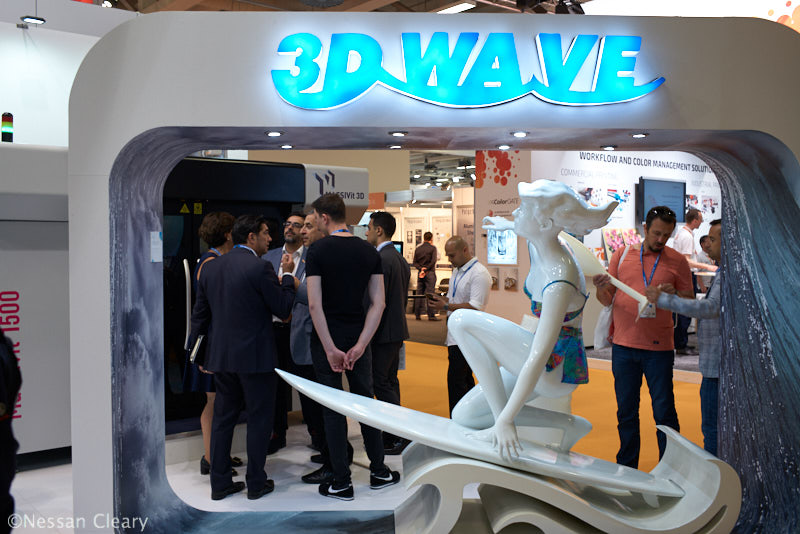
Massivit has branched out into other manufacturing sectors alongside the sign market, but Mimaki continues to concentrate on the display market, rebadging a Massivit machine as its own 3DGD-1800. This is able to create objects up to 1450 x 1110 x 1800 mm at a speed of 350mm in height per hour. It’s fitted with two heads so that it can print two separate objects side by side.
The German company Big Rep also produces large scale 3D printers and found that sign makers appreciate the sizes that it can accommodate. It’s best known for the BigRep One printer, which has been sold for over 10 years with more than 500 installations. This has a one cubic metre build area and can be configured with two extruders that are synchronised together for faster print speeds. It takes a resin filament material, with a choice of different types depending on the properties required, including PLX which produces a smooth finish and is not too expensive as well as rPETG which has good strength and chemical resistance and is easily recycled
Another, specialised form of dimensional signage is channel lettering, where the letters have been built up by forming deep sides to them, which can give the lettering a great deal of depth. Often these channels are created by taking flat materials, such as aluminium sheeting, cutting them into strips and then bending those strips to form the sides of the letters.
These channels can just as easily be 3D printed, which allows for more customisable shapes. Better still, 3D printers are extremely good at producing lattice structures that offer excellent strength to weight ratios for signs that can better withstand wind and weathering.
A further advantage of mastering additive manufacturing is that it can open the door to other manufacturing possibilities. Large 3D printers such as those from Massivit and BigRep are routinely used to produce moulds for industrial products such as large cooling fans or car parts. And in these days of uncertain economics, sign makers should embrace such opportunities for diversification.
In conclusion, additive manufacturing isn’t going to completely replace the more traditional techniques used to create dimensional signage. But it can give sign makers another option in their toolbox that might prove more cost-effective for some jobs. More to the point, it can offer a way for sign makers to differentiate themselves from their competitors in the eyes of their customers, which is sometimes hard to quantify in monetary terms but can prove invaluable.
At European Sign Expo 2026, you'll experience the full spectrum of non-printed signage - from channel lettering, dimensional signage, and digital displays to architectural and illuminated signage.