Discover European Sign Expo 2026
At European Sign Expo 2026, you'll experience the full spectrum of non-printed signage - from channel lettering, dimensional signage, and digital displays to architectural and illuminated signage.
Digital screens are evolving through LED, OLED, and AI technologies. Beyond standard billboards, innovations like 3D holographic displays and augmented reality are increasing consumer engagement. By integrating AI and sensors, modern screens can now automatically adapt content to weather or footfall, providing measurable ROI and a smarter, more responsive advertising experience.
Take a brief walk around pretty much any town centre and you will be able to see plenty of digital screens, of all sizes, both indoor and outdoor. There’s no question that this technology is here to stay and that the use of these screens is continuing to expand across a growing number of locations from city centres to small towns. This includes outdoor billboards as well as screens inside shopping centres and retail units for marketing and navigation, plus screens in diverse locations from hotels to museums for general information.
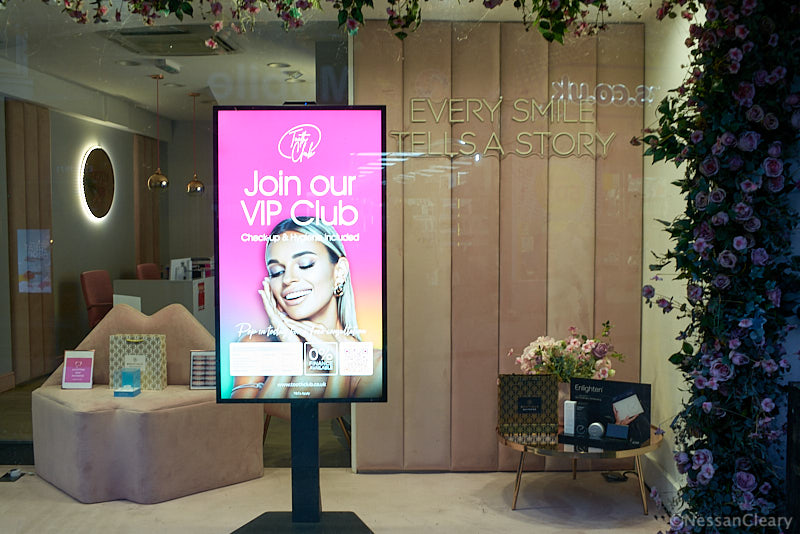
There’s a choice of several different technologies behind the screens themselves. One of the older technologies is Liquid Crystal Display, or LCD, which gives good colour accuracy and reasonably clear images. LCD displays are generally more affordable and offer longer durability, making them a cost-effective choice for advertising.
However, LCD screen are being supplanted by Light Emitting Diodes or LED displays, which offer high brightness levels combined with good energy efficiency, while also being suitable for outdoor use. The LED concept is based on solid state semi-conductors, which emit light when an electrical current passes through them. Essentially LED screens work by combining individual red, green and blue LEDs together into clusters to create pixels, with the display made up of many thousands of these pixels. The images can then be displayed by controlling the colour and intensity of the light from each pixel. The smaller the pixels, the higher the resolution, which is measured in pixels per inch. However, it’s best to match the resolution to the intended viewing distances to optimise both the viewer engagement and the cost of the installation.
A newer alternative is Organic Light Emitting Diode, or OLED, which is widely used for mobile phone and tablet screens. The central component is an organic compound film that acts as a semi-conductor, sandwiched between two electrodes, at least one of which is transparent. Applying a current forces the organic layer to emit light. It’s expensive to scale up to larger screens for commercial use but improvements in manufacturing efficiency and economies of scale thanks to its use on consumer devices all mean that the price of OLED screens is starting to come down. These are said to offer better colour contrast than LED though this will be more noticeable for interior use, such as a shopping mall, shop or cafe.
Regardless of the technology behind the screen, the overall brightness will have a major impact on how easy it is for viewers to engage with the screen. The maximum brightness must be able to cope with the ambient conditions around the screen, and there should be a sensor to automatically adjust this accordingly. There are two ways that brightness can be expressed: either as Candelas per square metre, which is the intensity of light emitted in one direction; or as Nits, which is the light output in any direction. Regardless, the measurement is the same so that, for example, 1000 cd/m2 is the same as 1000 nits. For those screens used in an interior setting, up to 500 to 700 nits should be adequate, whereas those placed outdoors should consider 3000 to 5000 nits, or higher depending on the location and the direction the screen is facing in.

There are a number of ways to increase the impact of using digital screens. The simplest is grouping large numbers of screens together so that passers by can absorb the message as they move from one screen to the next, which is becoming more feasible as the costs are starting to fall. It can be quite eye-catching when all the screens change their displays at once, or you can create a ripple effect with a delay as the display changes across the different screens. Equally you can have images move from one screen to the next and even appear to follow individuals as they walk past or ride up a escalator.
Another option is to use a holographic or 3D display where the images appear to reach out of the screen. The effect is down to an optical illusion where two different versions of an image, each taken at a slightly different angle, are projected together. It can be quite effective, enough to stop commuters at a busy station from walking past a pop-up stand, even with a relatively small screen. But the effect really comes into its own with a big screen mounted high up on a building. It’s even more striking where two screens are used on either side of a corner of a building, which gives the illusion of seeing into that corner. This sort of thing is rarely seen in the UK but can be found on quite a few buildings in Tokyo, where there are less restrictions on planning permissions for advertising.
Another special effect is augmented reality or AR, which can show viewers a mirror image of themselves in different settings. Imagine, for example, a screen at a travel agent shop that might show viewers images of themselves on a beach, or standing in New York’s Times Square. Equally a museum could use this technology to transport visitors back to a historical setting!
So far we’ve mainly considered the hardware that is available. But this technology is maturing and there’s a good choice of screens for different environments, applications and budgets. So the next big technical advance in digital screens is likely to come from greater use of artificial intelligence.
AI technology can be used to exploit the major advantage of using a digital screen over a print – the ability to change the display quickly as needed. That could mean responding to changes in the weather and switching automatically from advertising ice creams to umbrellas. Or it could mean analysing the type of footfall traffic past each screen and reacting as office workers give way to evening revellers. A centralised AI system can automatically update the content to individual screens across a network to maximise the value of those screens.
If sensors are included in those screens, then such a system can also provide feedback as to how many people pass the screen, how many stop to engage with the content, and how the viewing figures change as the content updates. That in turn makes it easier to quantify the return on investment for a given campaign. And ultimately, the expected return on investment should be the starting point in choosing to use any one technology over another.

At European Sign Expo 2026, you'll experience the full spectrum of non-printed signage - from channel lettering, dimensional signage, and digital displays to architectural and illuminated signage.