DTF is the new star on the horizon when it comes to digital apparel printing. Will Direct-to-Film now shake up the printed interior decoration markets as well?
What is DTF printing, and why is it relevant for interior decoration?
DTF printing has undergone remarkable development in recent years. This is because the transfer process offers impressive opacity, vivid color, and a strong bond with many common textile fibers, such as cotton, polyester, blended fabrics, nylon, and viscose.
Currently, the technology is primarily used for printing on workwear and athletic apparel, promotional T-shirts, and small designer collections of sporty streetwear. In these areas, DTF has even largely replaced the direct-to-garment (DTG) process. Isn’t it about time that DTF played a bigger role in printed interior decor as well?
“We haven’t yet heard from our customers that they are producing large quantities of home textiles using DTF,” says Andree Bölkow, managing director of Easy Inks GmbH. The company offers DTF ink from its own production, DuPont Artistri P1600 DTF ink, as well as compatible films and adhesive powders.
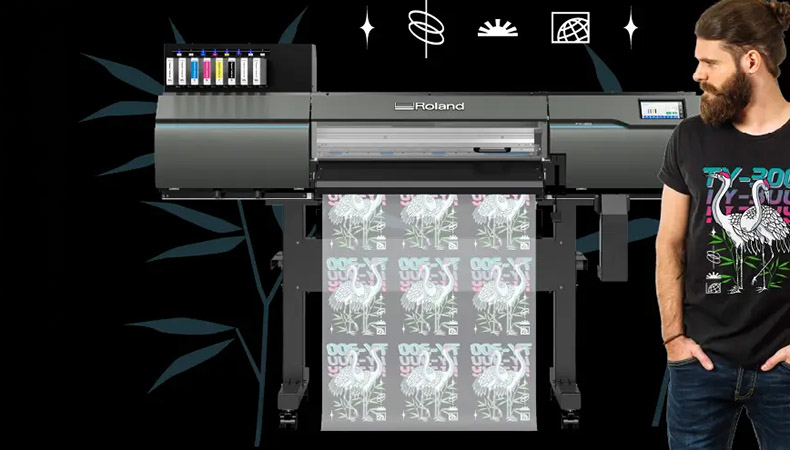
“DTF has certainly shaped expectations within the interior design industry, but its impact is currently more complementary than transformative,” adds Encarna Luque, EMEA Product Manager at Roland DG. In January 2026, the company launched the TY-300i model—a revised version of its second printer designed for DTF printing—on the European market, capable of handling film rolls up to 76 cm wide. With a throughput of nearly 11 square meters per hour in standard mode, it is well-suited for producing larger runs of DTF film, as Luque confirms: “The TY-300i’s dual-printhead architecture, expanded ink capacity, and automated maintenance systems make it a true production machine.”
The Roland DG TY-300i DTF printer, introduced in January 2026, is designed for longer print runs. Photo: Roland DG.
Applications of DTF in Interior Design
However, although brand-new models such as the Roland DG TY-300i or the Epson SureColor G9000 open up many new possibilities—especially for natural and blended fibers as well as leather—Luque believes that DTF is “not necessarily better than sublimation or DTG for textile printing in the interior design sector.”
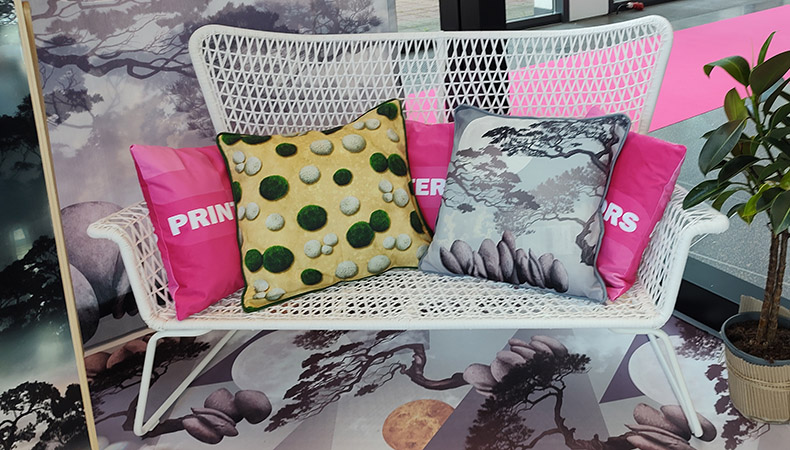
Rather, he emphasizes that DTF transfer “should be viewed as a complementary technology that expands the range of possible applications rather than replacing the others.” Thanks to the versatility of DTF, he considers the process particularly well-suited for complementary products such as pillows, doilies, or small-format wall decorations.
Bölkow sees it similarly. He points out that DTF interior prints are generally not as wash-resistant as sublimation-printed designs on polyester. “I can therefore easily imagine interior decorations made using the DTF process being well-suited for the seasonal hospitality industry. For example, Easter or Christmas designs on a small cotton doily for the bread basket. Or DTF-printed pillows used specifically for an annual event. These might only need to be washed once per season, which means they can be used for many years.”
Currently, most experts view DTF printing as a complement to existing technologies such as sublimation and direct printing in the field of interior design. Photo: Sonja Angerer
Limitations of the Process in Interior Decoration
As Bölkow has already pointed out, DTF transfer prints—much like direct-to-garment (DTG) printing with pigment inks—are not suitable for applications where the product must be washed too frequently. This is because after about 20 machine washes, the prints usually show significant signs of wear and lose their vibrant colors. This limits the possible applications of DTF printing on home textiles. DTF is therefore hardly suitable for bed linens or towels.
However, the process has other limitations as well. Since the design is transferred from the film to the fabric under pressure and heat, DTF does not work satisfactorily on heavily textured textiles, high-pile materials, or heat-sensitive fibers. At the specified temperature of approximately 150 to 160 degrees, the transfer film cannot bond completely with the fabric. If the pressure or temperature in the transfer press is increased, however, discoloration or damage to the fabric can quickly occur.
This makes DTF particularly well-suited for smooth or medium-fine woven materials. Fortunately, these textures are currently widely used in modern interior design.
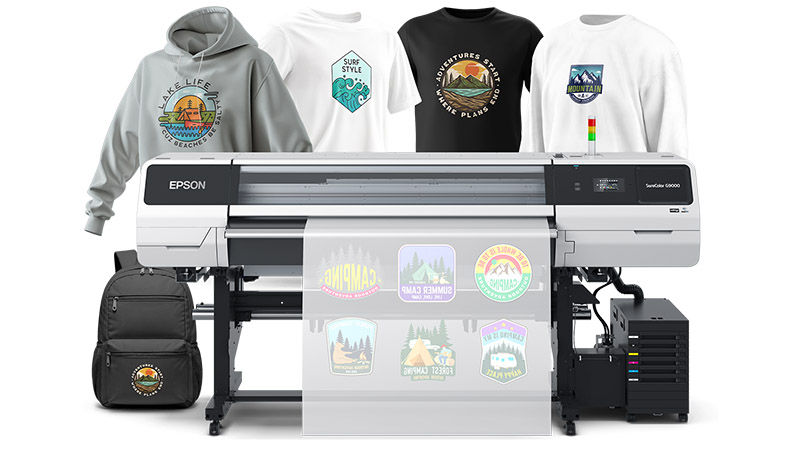
The new Epson SureColor G9000 prints on standard DTF films up to 1.63 cm (64 inches) wide. Photo: Epson
Conclusion: DTF is a supplement
As is clearly evident from the DTF printers introduced by Epson and Roland in early 2026, the DTF market is shifting from one-off items and very small production runs to larger production runs. This is well-suited to the production of home textiles.
Achim Bukmakowski, Head of Commercial & Industrial Printing at Epson Deutschland GmbH, commented: “Customers expect their printing solutions to deliver high productivity, reliability, and minimal maintenance. The SC-G9000 was developed specifically to meet these requirements and is therefore the ideal solution for high-throughput production environments.”
Luque expresses a very similar view: “The Roland DG TY-300i is specifically designed for use in environments with high volumes of apparel decoration and fulfillment processes that require consistent white ink performance, reliability during multi-shift operation, and high production speeds.”
At the same time, however, the Roland DG EMEA Product Manager makes it clear: “Other technologies, such as UV, resin (latex), and eco-solvent, continue to dominate the interior design market for large surfaces.”
Nevertheless, it’s safe to say that DTF printing also significantly expands the options for interior decoration. This is because DTF transfer makes it possible to digitally print small home textile items—such as pillows, textile prints, or doilies made of cotton, blended fabrics, or leather—with rich detail and vibrant colors, without the need for a primer.
In summary, Luque says: “DTF is an extremely flexible supplementary solution that is suitable for various types and colors of fabric. It is well-suited for small runs and customizations. New developments, including 64-inch systems, are expanding its potential for producing larger quantities and could enable more efficient decoration of larger textile pieces for interior design applications in the near future.”
Discover Textile 2026
Textile 2026, taking place alongside the FESPA Global Print Expo in Barcelona (May 19–22, 2026), is where functionality, printing, and production come together to shape the future of textiles. Visitors can purchase super early-bird tickets for €30 using the code FESG601 through March 23.