Discover how the Durst NEXT Technology Festival is redefining the future of print. Learn how Durst Group is transitioning into an AI-driven technology enterprise, leveraging AI workflow automation, global connectivity, and sustainable manufacturing to drive digital transformation and competitive advantage in industrial inkjet printing.
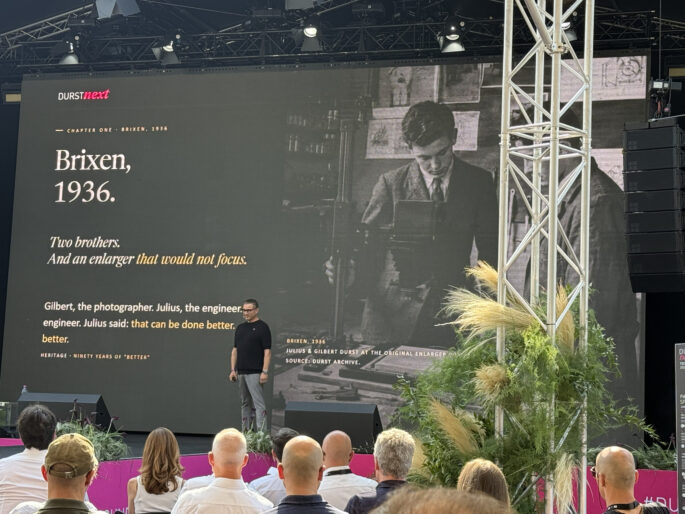
What does it mean to truly lead an industry through transformation? Not to follow trends, not to react to disruption – but to architect it? That question hung in the air at the Durst NEXT Technology Festival in Brixen, Italy, this June, as Christoph Gamper, CEO and co-owner of the Durst Group, took to the stage and delivered one of the most compelling keynotes I have witnessed in years.
The room was filled with print professionals, technologists, and industry innovators. But what unfolded wasn’t simply a product showcase or a corporate vision statement. It was a call to rethink everything we believe about the future of print.
Durst Is Not a Print Company Anymore – And That’s the Point
Christoph Gamper made no attempt to soften this message. Under his leadership, Durst – long regarded as a global leader in high-end industrial inkjet printing and production technology – has undergone a profound and deliberate reinvention. The company is no longer positioning itself as a manufacturer of printing machines. It is positioning itself as a globally connected, AI-driven technology enterprise. This is not semantics. It is strategy.
“We are a technology company that happens to produce printing systems,” Gamper conveyed with characteristic clarity. The distinction matters enormously. A printing company optimises for today’s output. A technology company builds for tomorrow’s possibilities. And Durst, it is clear, is firmly in the latter camp.
For those of us embedded in the textile and print industries, this reframing carries significant weight. If one of the sector’s most venerable names is pivoting its entire identity towards AI and connectivity, the industry at large can no longer afford to treat digital transformation as a distant priority.
The Convergence of AI and Industrial Print
Central to Gamper’s keynote was the role of artificial intelligence – not as a buzzword or a bolt-on feature, but as the foundational layer upon which the next generation of print production will be built.
Durst’s vision articulates AI as an enabler across every dimension of the production workflow:
- Predictive maintenance: Machines that anticipate failure before it occurs, dramatically reducing downtime and maintenance costs
- Intelligent colour management: AI systems that self-calibrate and ensure consistency across production runs, regardless of scale or substrate
- Automated workflow optimisation: Removing human bottlenecks from repetitive decision-making, freeing operators to focus on higher-value tasks
- Real-time production analytics: Live data feedback loops that allow operators and managers to make informed decisions at the point of production, not after the fact
What struck me most was not the sophistication of these applications – impressive as they are – but the conviction with which Gamper delivered them. This was not speculative technology. These are systems being deployed, refined, and scaled across Durst’s global customer base right now.
Connectivity as Competitive Advantage
A recurring theme throughout the keynote was the concept of the connected factory – or more precisely, the globally connected print enterprise. Gamper described a future already taking shape – in which individual production sites are nodes within a broader intelligent network, sharing performance data, optimising collectively, and responding dynamically to demand signals.
This vision has profound implications for print businesses of all sizes. The competitive advantage in the coming decade will not be determined solely by the quality of the machine on the floor. It will be determined by the quality of the data flowing through it, and the intelligence applied to that data.
For smaller print operations, this might sound daunting. But Gamper was clear: the democratisation of AI tools means that the barriers to entry are falling. The question is not whether your business can afford to embrace this technology. It is whether you can afford not to.
Sustainability as a Non-Negotiable
To his credit, Gamper did not allow innovation to overshadow responsibility. A significant portion of his address was devoted to Durst’s sustainability commitments and the broader obligation of the print industry to address its environmental footprint.
The message was unambiguous: sustainability is not a marketing position for Durst. It is embedded within the engineering philosophy of its products. From reduced ink consumption through AI-optimised print heads, to lower energy usage across production systems, and a commitment to circular thinking in manufacturing – Durst is treating ecological responsibility as a design principle, not an afterthought.
This matters for the industry at large. Brands are under mounting pressure from regulators, investors, and consumers to demonstrate genuine environmental progress across their supply chains. Print and textile production sit squarely in the crosshairs. Companies that can demonstrate sustainable credentials – backed by measurable data – will hold a significant commercial advantage in the years ahead.
What the Industry Must Take Away from Durst NEXT
Attending this festival, I was struck not only by the technology on display, but by the cultural posture of Durst as an organisation. There was no complacency in that room. There was urgency, curiosity, and an almost restless appetite for what comes next.
That is the posture the entire print and textile industry must adopt.
We are at an inflection point. The convergence of AI, connectivity, sustainability, and advanced inkjet technology is not a future scenario – it is the present reality for those willing to engage with it. The businesses that thrive over the next decade will be those that:
- Invest in digital infrastructure – not just hardware, but the data and connectivity layers that give machines intelligence
- Build AI literacy within their teams – understanding how AI tools can be applied to their specific workflows and challenges
- Treat sustainability as strategy – not compliance, but competitive differentiation
- Stay curious – attending events like Durst NEXT, engaging with technology partners, and refusing to be satisfied with the status quo
The Future of Print Is Being Written Now
Christoph Gamper closed his keynote with a sentiment that has stayed with me since leaving Brixen. The future, he reminded us, does not arrive fully formed. It is built – decision by decision, investment by investment, by those bold enough to act before the path is entirely clear.
The Durst Group is building that future. And they are inviting the rest of the industry to build alongside them.
For print professionals everywhere, the message from the Durst NEXT Technology Festival is clear: the window for passive observation has closed. The time for innovation is now.
Be inspired. Embrace the tools available to you. And have the courage to reinvent what your business can become.
The future of print is not something that will happen to us. It is something we must create – together.
Debbie McKeegan is the Fespa Textile Ambassador, and CEO of Texintel, a leading intelligence and innovation platform for the textile and print industries. She was invited as a guest and to moderate “The Textile Reset” Panel discussion at the Durst NEXT Technology Festival, Brixen, Italy, June 2026. A full review of that panel discussion will follow.
Discover the latest content on AI