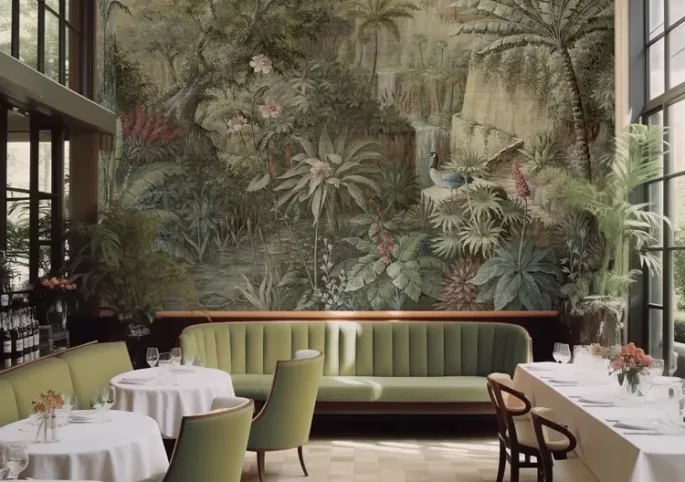

Driven by growing demands for personalisation and sustainability, the digital interior decor market is shifting towards design-led “interior fashion”. Technological innovations like UV gel texture layering and sustainable textile printing enable on-demand customisation. This print-on-demand model eliminates overproduction, reducing environmental waste while unlocking global opportunities for creators.
What if covering a wall or window was never really the point? What if the goal was to dress it – to give it texture, character, and a story all its own?
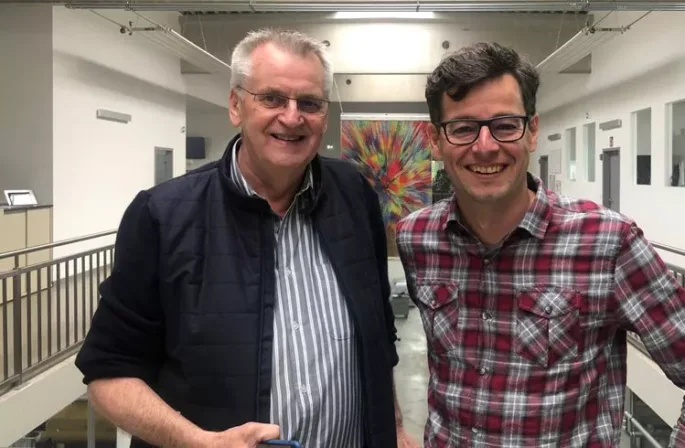
That provocative reframing sat at the heart of the “Decor on Demand: Design to Dispatch” panel, held at the FESPA conference, Barcelona May 2026, where three of the industry’s most influential voices gathered to map the seismic shifts redefining how interior products are designed, produced and delivered. Moderated by Debbie McKeegan, CEO of Texintel and FESPA Textile Ambassador, the discussion brought together Mathew Faulkner of Canon, Terry Raghunath of HP, and Rodd Harrison of Mimaki – each offering a distinct vantage point on a sector McKeegan rightly described as “ripe for disruption.”
And the numbers back her up. The digital decoration marketplace is forecast to grow at a CAGR of up to 20.3% through to 2030. But this isn’t a story about statistics alone. It’s a story about a fundamental change in what customers expect, what technology now enables, and what our industry owes the planet. Here’s what the conversation revealed.
The market shift: from function to fashion
The most striking insight to emerge wasn’t technological – it was philosophical. As Terry Raghunath of HP put it, the industry needs to stop thinking small. “How inspiring does it sound to cover a wall?” he asked. “How about if we dress up a wall? How about if we call it wall fashion, or interior fashion?”
This is more than clever wordplay. It signals a decisive move away from commoditisation towards design-led value. Consumers, Raghunath argued, now buy surfaces the way they buy clothing – with their eyes and their hearts first. Design has moved to the forefront of the purchasing decision, and that changes everything about how products are conceived and sold.
Two forces are driving this transformation:
- Personalisation and customisation. Post-pandemic, a wellness and mental-health movement has made people want to curate and personalise their own spaces. As Mathew Faulkner of Canon observed, this desire “is becoming part of how we as consumers think about almost everything we do.”
- Sustainability. The shift towards print-on-demand is dismantling the old inventory-heavy model, replacing waste with precision.
There’s also a quiet redefinition of what a surface is for. Why should a window blind be beige? Why shouldn’t an acoustic panel carry a floral pattern? Raghunath made the case for transforming purely functional products into functional products that decorate – even layering in properties like antimicrobial finishes. The surface, in other words, is being asked to do more than ever before.
The technology: democratisation in action
If there was a single word that defined the panel, it was democratisation.
Not long ago, a minimum order for digital wall coverings sat at around 200 rolls – itself a revolution compared with the 2,000 to 3,000 rolls required for analogue printing. Today, the economics have collapsed to a run of one. That single shift has opened the doors of the industry to an entirely new generation of creators.
Faulkner pointed to the parallel evolution in materials science as the quiet enabler behind the headlines. The range of printable media now available is staggering – self-adhesives sophisticated enough to be removed from a wall years later “with no residue, no damage,” fabrics, cork studded with pressed daisies, suede, silk, cotton, organic cloths. “There isn’t a surface that is safe from digital production,” as McKeegan noted.
The panellists were equally clear that digital has stopped imitating analogue and started surpassing it. As Raghunath put it, quoting his father: “you have to be where the other isn’t.” Among the standout innovations discussed:
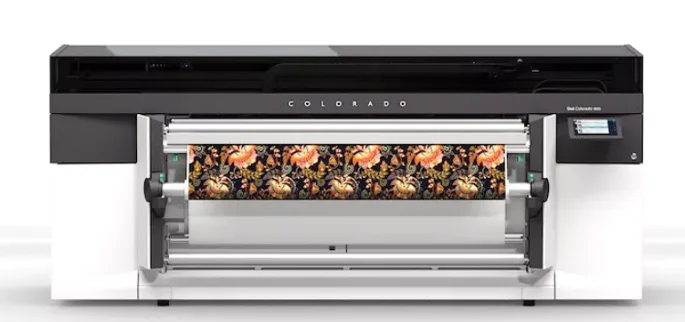
- UV and Gel layering for texture. Canon’s Arizona flatbed technology can now build textured surfaces up to four millimetres, instantly curing each layer. Its Colorado roll-to-roll system creates “micro textures” across five layers – simulating wood, stone or marble using the ink itself, and adding considerable value per square metre.
- The strategic use of white ink. Far from a technical afterthought, white ink – printed beneath, on top of, or alongside colour – brings designs to life. The challenge, as Raghunath noted, is education: customers often don’t realise what’s possible until you show them.
- Sustainable textile printing. Mimaki’s TRAPIS technology, championed by Rodd Harrison, allows printing across almost any fabric – organic, synthetic or blended – in a single process, with a footprint small enough to fit on a stage. Crucially, it sidesteps the polymer-based fabrics that carry such a heavy environmental cost.
The case studies: where the rubber hits the road
Theory is one thing; real businesses are another. The panel grounded its arguments in stories of genuine transformation.
Harrison shared the example of a UK wallpaper manufacturer producing kilometres of product a day, who wanted to extend logically into curtains and soft furnishings. Their problem? “I don’t want to know about chemistry.” They had the design catalogue, the online ordering system, the customer base, the payment gateways – everything but a trouble-free way to print onto fabric. The TRAPIS solution allowed them to do exactly that, digitally, without acquiring decades of specialist knowledge.
Raghunath offered two equally telling stories. A wallpaper designer based in Cape Town now generates roughly two-thirds of his revenue from the United States – not by shipping product across the world, but by sending designs to printers located near his customers. A Romanian company that didn’t exist five years ago now ships wallpaper worldwide. Neither could have accessed these markets without digital production.
These aren’t outliers. They are evidence of an industry being reshaped from the ground up, where geography and scale no longer dictate who gets to compete.
The future forecast: resisting commoditisation
For all the optimism, the panel returned repeatedly to a sober truth: this growth must not repeat the mistakes of fast fashion.
Harrison delivered the discussion’s most arresting figures. Today, 70% of all fabric produced globally is polyester – a material responsible for around 10% of microplastics entering our oceans, now present in the food we eat. Fabric-to-fabric recycling sits at roughly 1%. We remain, as he put it, “very much in a linear economy.”
The opportunity in digital is therefore not merely commercial – it is environmental. The projected shift from 12% to 20% of fabric decoration being digitally printed by 2030 could keep a trillion litres of water and a billion kilos of CO2 out of the environment each year. Print-on-demand, by eliminating overproduction, accelerates that progress further still.
The deeper antidote to environmental harm, the panel agreed, is creativity itself. “Nothing drives an unhealthy industry like commoditisation,” Harrison argued. The more creators can express themselves – and the more consumers understand they can personalise their own environments – the further the industry moves from disposable, mass-produced sameness towards bespoke, valued, longer-lasting products.
On the question of AI, McKeegan struck a characteristically humane note. AI may assist design, she conceded, but “the human seeks the artisan and detects the synthetic.” The creative remains irreplaceable.
Key takeaways and action points
For designers, printers and brand owners navigating this landscape, several clear priorities emerged:
- Lead with design. Treat surfaces as fashion. Value and margin now flow from creativity and texture, not from competing on price per square metre.
- Ask your printer the right questions. What technology and materials are they using? Build a genuine partnership rather than a transactional, price-driven relationship.
- Experiment with texture and white ink. These are among the most powerful – and underused – tools for adding value and differentiating your work.
- Embrace the run of one. Digital removes the barriers of minimum orders, geography and stockholding. Use that agility to test ideas and serve global markets.
- Make sustainability central, not incidental. The move to digital and print-on-demand is the single most effective way to reduce water use, emissions and waste in the sector.
- Resist the fast-fashion trap. Protect the artisan, design for end-of-life, and build a circular model before commoditisation sets in.
The printed interior is no longer simply about decoration. It is about expression, responsibility and a smarter relationship between what we make and what the planet can bear. Those who grasp that now will be the ones who thrive.
Our sincere thanks to Mathew Faulkner of Canon, Terry Raghunath of HP, and Rodd Harrison of Mimaki for generously sharing their time, their experience and their vision for the future of the textile and decor industries. Conversations like this don’t just inform the industry – they help shape where it goes next.
Discover more content on interior décor