Become a FESPA Member
to Continue Reading
The relatively recent ability to print to textiles has added an extra dimension to garment production, opening this market up to a whole range of new players.
People will always need clothing and there are many long-established conventional suppliers for this market. It does not matter if you’re coming from a sign making background or starting from scratch, there are plenty of different opportunities from fast fashion to luxury apparel.
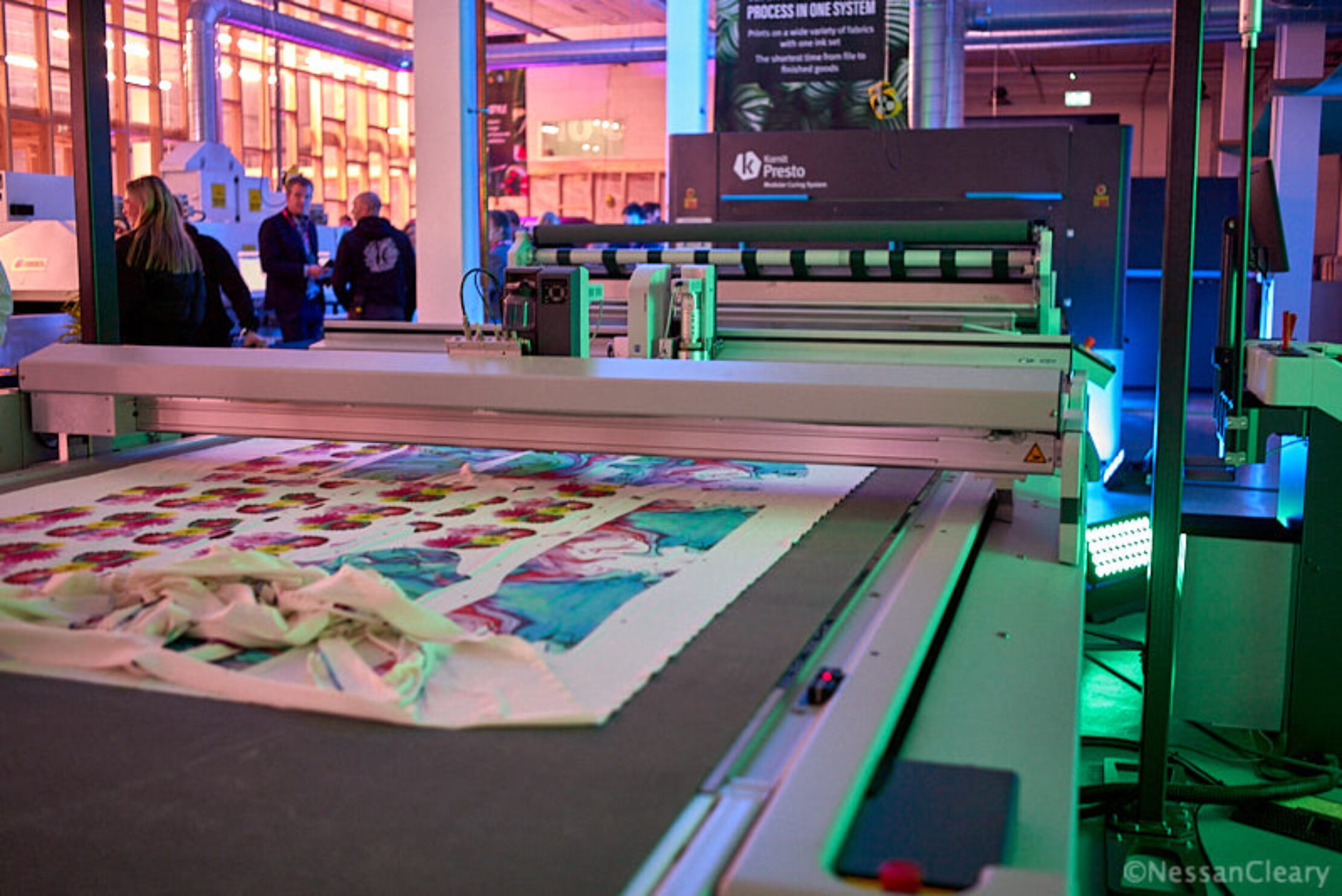
There are two basic approaches. The first is decorating – taking an existing product such as a blank t-shirt and then printing an image to that. The alternative is converting – taking a roll of fabric and printing a pattern onto that, either to sell the roll or cut and sew the products from that roll.
For most people, the most obvious place to start will be decorating, as this avoids the manual garment manufacturing step. This can mean either printing direct-to-garment (DTG), such as to a blank t-shirt or hoodie, or direct-to-film (DTF) to produce a graphic that can be posted to a customer or applied direct to a blank garment.
The DTG method is mostly limited to cotton or cotton blends, though there are a couple of DTG printers that can handle polyester from the likes of Ricoh and Kornit. Cotton gives a high-quality feel that can command a decent price per unit. However, it’s a fairly manual production process as the t-shirts have to be loaded onto a platen one at a time, and then a pre-treatment added to hold the ink in place, before the printing followed by unloading the t-shirt from the platen and moving it to a heat tunnel. Some vendors such as Kornit and Aeoon offer bigger machines with multiple platens to speed up the productivity but at higher cost.
Against this, DTF offers much faster production with a relatively low investment point, which all adds up to a reasonable rate of return. The process is quite easy to master but the plasticky feel of the graphics means that it is best suited to shorter run work such as promotional t-shirts.
Screen printingFor really high volumes, there’s still the old-school approach of screen printing. A fully automated flatbed screen printing machine can decorate around 900 garments per hour with a single operator. However, only digital can ensure that every garment is different, al though many screen printing machines now incorporate a digital…
...