While textile print is regularly sounded out as a key growth market for print companies, is there still room for growth in this market? Rob Fletcher gains further insight into the sector and learns about some of the entry-level machines available to those making the move.
There is no doubting the growth of the textile print sector in the past few years. A recent report from Grand View Research valued the global market at $25.8 billion in 2024, with a forecast of this increasing at a compound annual growth rate of 9.3% to $56.7 billion by the year 2033.
So, while it is clear that the market will continue to expand and grow, what does this mean for those not yet involved in textile print? Is there still room for them to move into the area and take advantage of what is clearly a high demand for work, and if so, what sort of machinery should they be looking to take on?
Several major manufacturers have come forward to give their opinion on the market and offer advice on investment for printing companies that want to transition successfully into textile print.
Digital print driving growth
Phil McMullin, head of sales for commercial and industrial at Epson UK, said digital print will have a major role to play in the projected growth of textile print. He said while traditional methods of textile printing are not sustainable and generally rely on large volumes to be financially viable, digital print offers another route to market.
“Digital textile printing offers very low run lengths and improved sustainability through less wastage and local production,” McMullin said. “Demand for customised and personalised goods shows no sign of abating so this is the growth area that print companies can tap into.”
On this note, McMullin offered insight into the type of work that those moving into this market should consider. He picked out garment and home decor printing as areas where Epson has seen increased demand in recent times.
“The latter can be challenging to take on without the right investment, so for most printers, garments in the form of corporate workwear is an easier and less costly addition to your print capability,” he said.
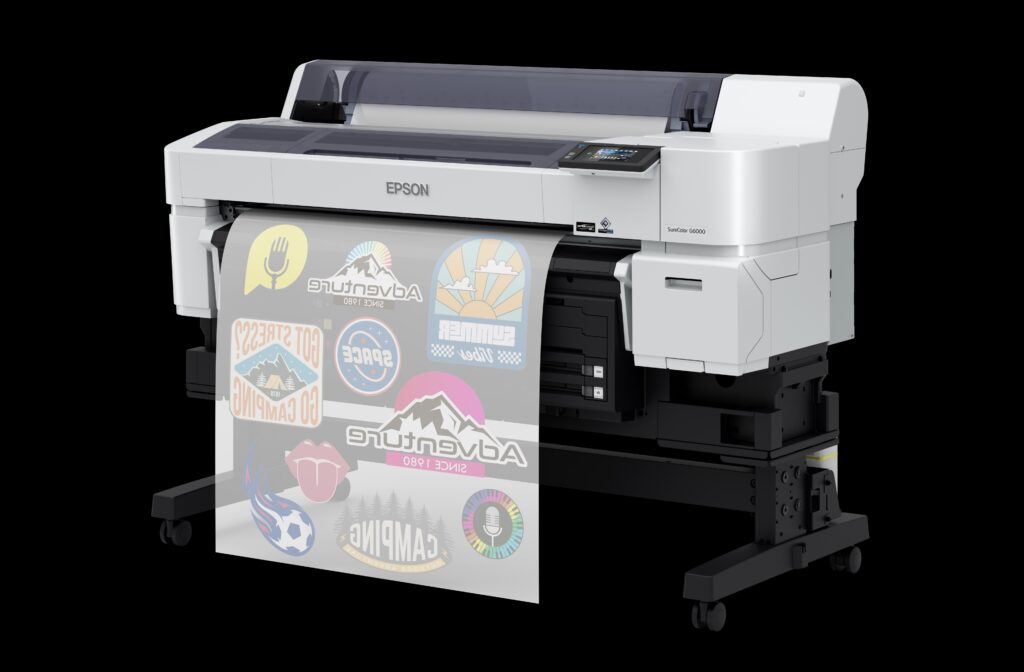
The SureColor G6000 is the first direct-to-film, roll-to-roll printer from Epson
Machine-wise, he highlighted several entry-level machines from Epson that he said would be a good fit. First was the SureColor G6000, the first direct-to-film and roll-to-roll printer from Epson that is suitable for both newcomers in this market and more experienced users.
For those looking to test the waters for less than a £5,000 investment, McMullin pointed to the SureColor F1000 printer. This machine offers both direct-to-film printing and direct-to-garment in the same unit, without the need to switch inks. In addition, with dye sublimation, Epson’s SureColor range starts with A4 machines priced under £400 up to industrial print units.
Access new opportunities
Meanwhile, Arjen van der Sluijs, product manager at Mimaki Europe, said textile printing remains a strong growth area for printers. He said while fashion and apparel remain important, there are now many opportunities beyond clothing such as promotional wear, home textiles, soft signage, and other interior applications.
“The market continues to diversify, giving print companies multiple avenues to expand their business,” van der Sluijs said. “Customisation and small-batch production have been a consistent trend over the past few years and show no sign of slowing down. Customers increasingly want personalised products—from curtains and home décor to branded promotional items, so there’s a strong opportunity for printers to offer short-run, customised printing.”
Looking to machinery, van der Sluijs said Mimaki’s TxF Series direct-to-film printers are well suited to promotional wear. He said this technology has grown quickly in recent years thanks to its flexibility and ease of use, making it ideal for short runs and customised jobs.
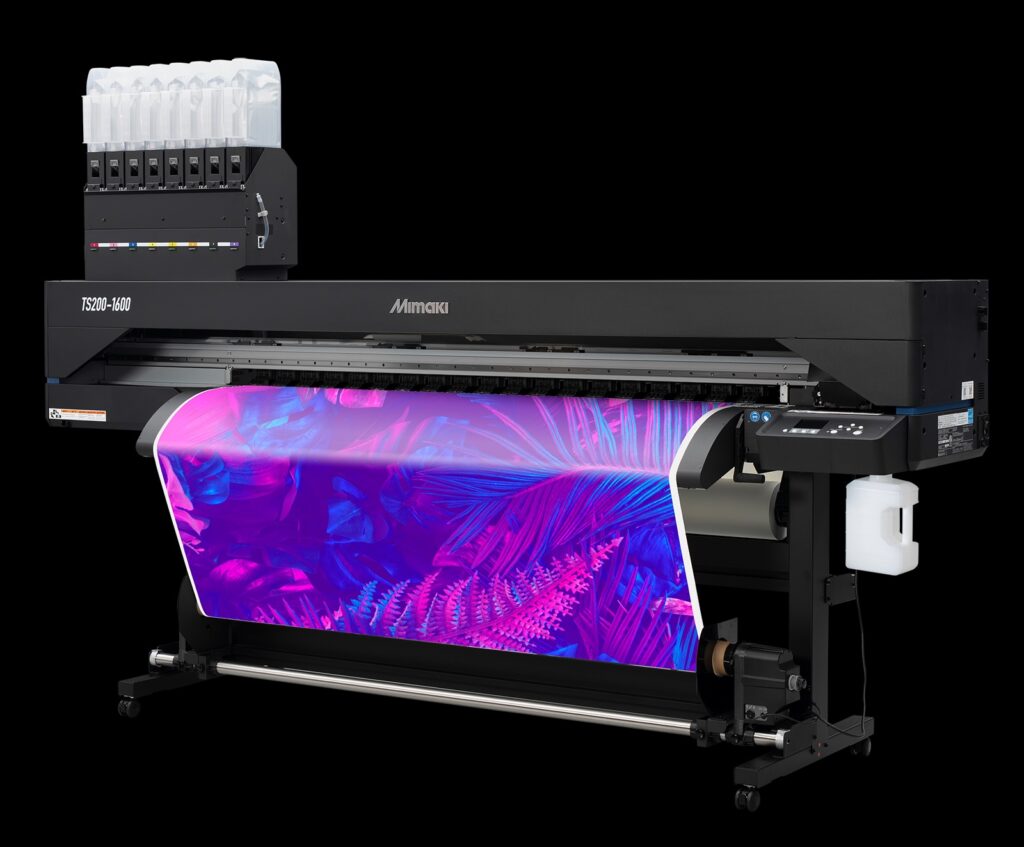
The Mimaki TS200-1600’s extended eight-colour configuration includes orange, violet and fluorescent pink and yellow inks.
On the dye-sublimation side, he said the TS200-1600 has seen interest, mainly because of print quality and ink set. He said an extended eight-colour configuration, including orange, violet and newly developed fluorescent pink and yellow inks, makes it easy for users to produce vibrant, eye-catching applications.
“With a competitive price point, it’s a practical choice for businesses looking to move into textiles and printing on rigid materials, covering applications such as sportswear, home décor, promotional items, corporate gifts and personalised products,” he said.
For those looking to print on a wider range of fabrics, including natural fibres, van der Sluijs said Mimaki’s TRAPIS solution offers an accessible entry point. This uses a transfer-based process similar to dye-sublimation, but with textile pigment inks, allowing printing on materials beyond polyester. This, he added, makes it a flexible option for customers targeting applications such as cotton-based textiles and interior décor.
Finally, Mimaki recently expanded the TS330 Series with the TS330-1800. With a print width of up to 1,940mm, van der Sluijs said this allows users to take on higher-value applications such as curtains, tapestries and large-format soft signage for interior and commercial spaces.
Broader range of applications
Elsewhere, Rob Goleniowski, regional general manager for the UK, Ireland, Scandinavia and Baltics at Roland DG Europe, said at the entry-level, the manufacturer’s focus is on removing barriers to professional print production while delivering the quality and reliability that the Roland brand is known for.
“In roll-to-roll, the VersaSTUDIO BN2 Series has quickly become one of our most popular platforms, particularly among start-ups, creators and small print businesses looking to bring production in-house,” Goleniowski said.
Roland DG will demonstrate the BN2-30 on its stand at the FESPA Global Print Expo 2026
“The BN2 combines high-quality eco-solvent printing with precision contour cutting in a single, compact device, making it an ideal first step into professional print-and-cut workflows. It enables users to produce everything from stickers, labels and decals to heat-transfer graphics and signage, without the complexity or footprint traditionally associated with roll-to-roll systems.
“With print speeds up to four times faster than the original BN-20, front-loading media and ink, and intuitive software included as standard, it’s designed to be productive from day one – even for users with little or no prior print experience.”
Goleniowski went on to say that the BN2-30 builds on the success of the BN2 platform by offering greater media width and increased productivity, while retaining the same desktop-friendly footprint users of the existing machine are familiar with. Offering the ability to print on media up to 762mm wide and with a larger printable area, he said it opens the door to a broader range of applications, from larger graphics and decals to higher-volume production runs.
“What really sets the newer BN2-30 apart is how it balances accessibility with professional performance,” he said. “Users benefit from high-resolution output up to 1,440 dpi, excellent colour vibrancy, and durable prints suitable for real-world use, all powered by Roland’s Eco-Sol MAX ink technology. Integrated cutting, automated media handling features and included professional RIP software ensure consistent, repeatable results, making it a strong choice for businesses that want to grow without over-investing too early.
“Whether you’re a new business entering print for the first time or an established operation looking to add agile, on-demand production, the BN2-30 demonstrates how accessible professional print-and-cut technology has become.”
Roland DG will be showcasing the BN2-30 on its stand at the FESPA Global Print Expo 2026, which takes place in Barcelona, Spain from 19-22 May. Running alongside the main event will be the all-new Textile 2026, a fresh platform covering everything from garment manufacturing and decoration to soft furnishings and printed apparel.
To learn more about the new event, including how you can register to attend, click here.
Discover Textile 2026
Textile 2026, launching alongside FESPA Global Print Expo in Barcelona (19–22 May 2026), is where function, print, and production converge to shape the future of textiles. From garment manufacturing and decoration to soft furnishings and printed apparel, Textile 2026 delivers the insight, technology, and innovation that drive real business growth.